
How to Close a High-Yield Savings Account
Closing a high-yield savings account is usually straightforward, but withdrawing the visible balance is not enough. A pending transfer, automatic deposit or delayed fee could reach the account after you believe it has been closed.
You should also check how the provider handles earnings that have accrued but have not yet been credited. Some institutions may not pay those earnings if the account closes before the scheduled crediting date.
The safest approach is to review the account terms, redirect every transaction, wait for pending activity to clear and obtain written confirmation when the closure is complete.
Can You Close a High-Yield Savings Account at Any Time?
In most cases, you can ask the bank or credit union to close your high-yield savings account whenever you want. The provider may still require you to resolve outstanding activity first.
You may need to:
- Repay an overdrawn or negative balance
- Wait for a recent deposit to become available
- Allow pending transfers to finish
- Pay a disclosed account-closure fee
- Complete an additional identity check
TheConsumer Financial Protection Bureau warns customers to check for pending payments, fees and other transactions before closing an account. A transaction that arrives after closure may be rejected or could create a negative balance.
The account agreement should explain how to submit a closure request. A high-yield digital savings account may allow you to close it through the app or a secure message. Another institution may require a phone call, signed form, or branch visit.
If you only want to take out part of the balance, read our guide towithdrawing from a high-yield savings account.
What Should You Do Before Closing the Account?
A little preparation can prevent returned payments, missing deposits and unnecessary fees.
Review the account agreement
Check the provider’s rules for:
- Account closure
- Early-closure charges
- Transfer limits
- Pending deposits
- Minimum balances
- Accrued earnings
- Final statements
Some providers charge a fee when an account is closed shortly after it was opened. The fee and qualifying period should be disclosed in the account terms.
Confirm the receiving account
Make sure the account receiving your money is active and able to accept the full transfer. Verify the routing and account numbers before sending anything.
If the provider limits daily transfers, you may need to move the money across several days or request a wire or official check.
Redirect incoming money
Update any payroll deposits, benefit payments or scheduled contributions going into the old account.
A direct-deposit change may take one or more payment cycles. Wait until the first deposit reaches the new account before assuming the change is complete.
Our guide todirect deposits into a high-yield savings account explains what different providers may accept.
Cancel automatic withdrawals and transfers
Review several months of transactions. Look for recurring transfers, subscriptions, savings rules and payments connected to the account.
Stopping a payment with the provider does not always cancel the underlying service or contract. The CFPB recommends contacting both the company taking the payment and the financial institution. A formal stop-payment order may carry a separate fee.
If you have used the account for scheduled payments, seewhether you can pay bills from a high-yield savings account.
How to Close a High-Yield Savings Account Step by Step
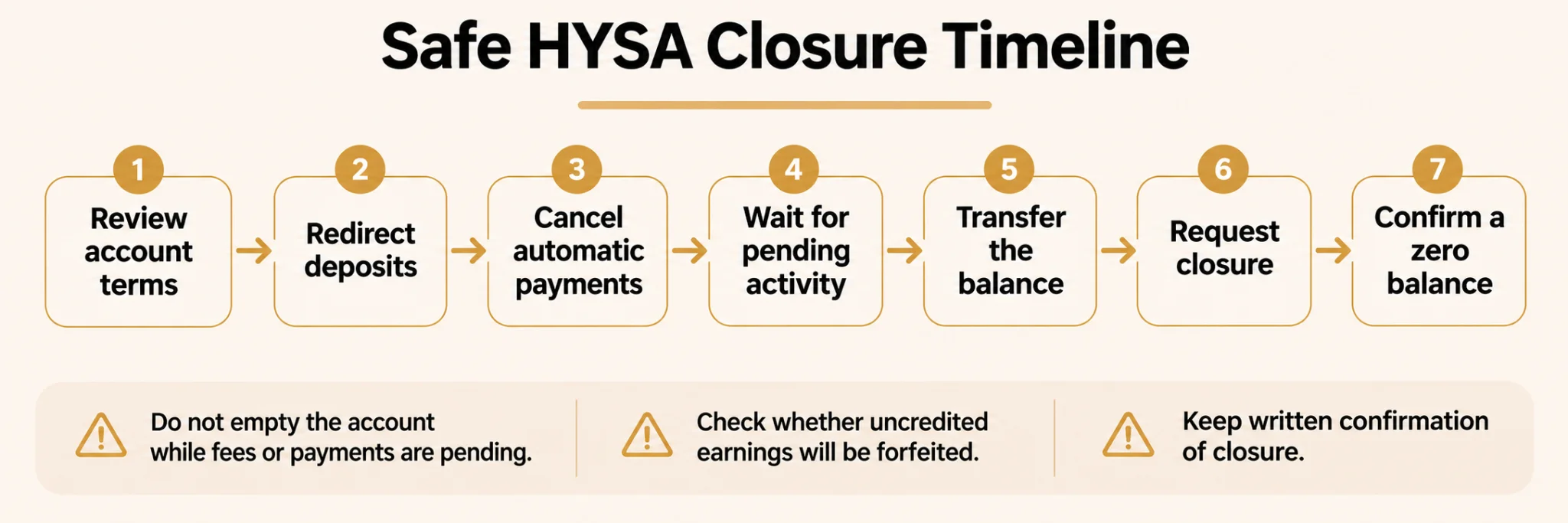
1. Check the available balance
The current balance and available balance may be different. A recent deposit can appear in the account while still being subject to a hold.
Use the available balance when planning the transfer. Contact the provider if you do not understand why part of the money is unavailable.
2. Wait for pending activity
Allow deposits, withdrawals, reversals and fees to finish processing. Closing the account too early could cause a deposit to be returned or a payment to fail.
Do not rely only on the fact that no transaction is marked as pending. Review recent statements for less frequent payments that may not have arrived yet.
3. Save your records
Download the account agreement, recent statements and transaction history. You may lose online access after the account closes.
Keep any tax documents already available. The institution may still issue a year-end tax form later if the account generated reportable earnings.
4. Transfer the remaining money
An online savings app may let you send the balance electronically to a linked account. Other options can include an internal transfer, wire, cashier’s check or mailed check.
Ask whether withdrawing the entire balance automatically closes the account. A zero balance does not always mean the account is closed.
5. Submit the closure request
Follow the provider’s required process. Give the correct account details and confirm where any small remaining balance should be sent.
The provider may ask why you are closing the account, but you do not normally need to keep it open simply because the APY has changed.
6. Ask about residual funds
A small amount could enter the account after your main withdrawal because of a correction or scheduled credit.
Ask whether the provider will send residual funds automatically and how it handles transactions received after closure.
7. Obtain written confirmation
Ask for an email, letter or secure message confirming that the account has been closed with a zero balance.
Keep the confirmation with the final statement. It can help if the account later appears active or a transaction is sent to it by mistake.
What Happens to Pending Earnings?
Savings earnings may accrue each day but be added to the account on a different schedule. For example, a provider may calculate earnings daily and credit them monthly.
Earnings already credited to the account are part of the balance. You can normally transfer them with the rest of your money.
Accrued but uncredited earnings are different. UnderTruth in Savings guidance, an institution may decline to pay accrued earnings when an account closes before the crediting date if that policy was disclosed when the account was opened.
Check the account agreement or ask the provider:
- When are earnings credited?
- Will accrued earnings be paid at closure?
- Would waiting until the next crediting date change the final amount?
- How will any final earnings be delivered?
Do not assume every institution follows the same policy. The compounding and crediting schedule can differ even when two accounts advertise similar APYs.
For more detail, readhow often high-yield savings accounts pay earnings.

Can You Be Charged for Closing a HYSA?
A provider may charge an early-closure fee if the account is closed within a specified period after opening. It may also charge for the method used to remove the money.
Possible costs include:
- Outgoing wire fees
- Official-check fees
- Stop-payment charges
- Early-account-closure fees
- Monthly fees triggered by a lower balance
- Charges connected with returned transactions
A no-monthly-fee account can still charge for optional services. Check the full fee schedule instead of relying on a “no fee” headline.
Our guide tohigh-yield savings accounts with no monthly fees explains which other costs may still apply.
What Should You Check After the Account Closes?
Confirm that the full transfer reached the receiving account. Then verify that the old account shows a zero balance and closed status.
Keep the final statement and closure confirmation. Continue checking your email and mail for any tax documents, returned deposits or notices from the provider.
If an automatic payment reaches the closed account, update the payment details immediately. Do not ignore a negative-balance notice simply because you previously asked for closure.
Closing the account should complete the relationship. A digital savings platform should not continue treating the account as active without a valid reason.
Put your dollars into something real
With PureFi, your projected earnings come from shares of real homes with tenants. Choose your properties from your phone, review the documents, and see every fee before you confirm.
Learn more about how PureFi can help youown real estate shares ordownload the app to get started today.
Up to 6% APY is projected, variable, and not guaranteed. Property shares can lose value. PureFi is not a bank, and its balances and real estate shares are not covered by FDIC insurance or another government deposit scheme.


