How to Avoid Tax on a High-Yield Savings Account Legally
You generally cannot avoid federal tax on earnings from a standard high-yield savings account. The IRS normally treats those earnings as taxable income in the year they are credited to your account. Keeping the money in the account, moving it to another bank, or earning less than $10 does not create a tax exemption.
There are still legal ways to manage the cost. A tax-advantaged account may work for a specific long-term goal. Treasury securities can reduce state and local tax in some cases. After-tax comparisons can also help you make a clearer choice.
This guide covers general U.S. federal rules. State rules and individual tax situations vary.
Can You Avoid Tax on High-Yield Savings Account Earnings?
Not when the earnings come from a regular taxable account. A bank may call the product an online account, a premium savings account, or a high yield digital savings account. The product name does not change the federal tax treatment.
The IRS generally treats earnings from bank accounts, credit-union share accounts, certificates of deposit, and money market deposit accounts as ordinary income. You owe tax on the earnings, not on the balance you deposited.
Suppose you put $20,000 into an account and receive $800 during the year. The $20,000 principal is not taxed again simply because it is sitting in the account. The $800 is the amount generally included as taxable income.
Our guide to taxes on high-yield savings accounts explains the basic reporting process in more detail.
When Do Savings Earnings Become Taxable?
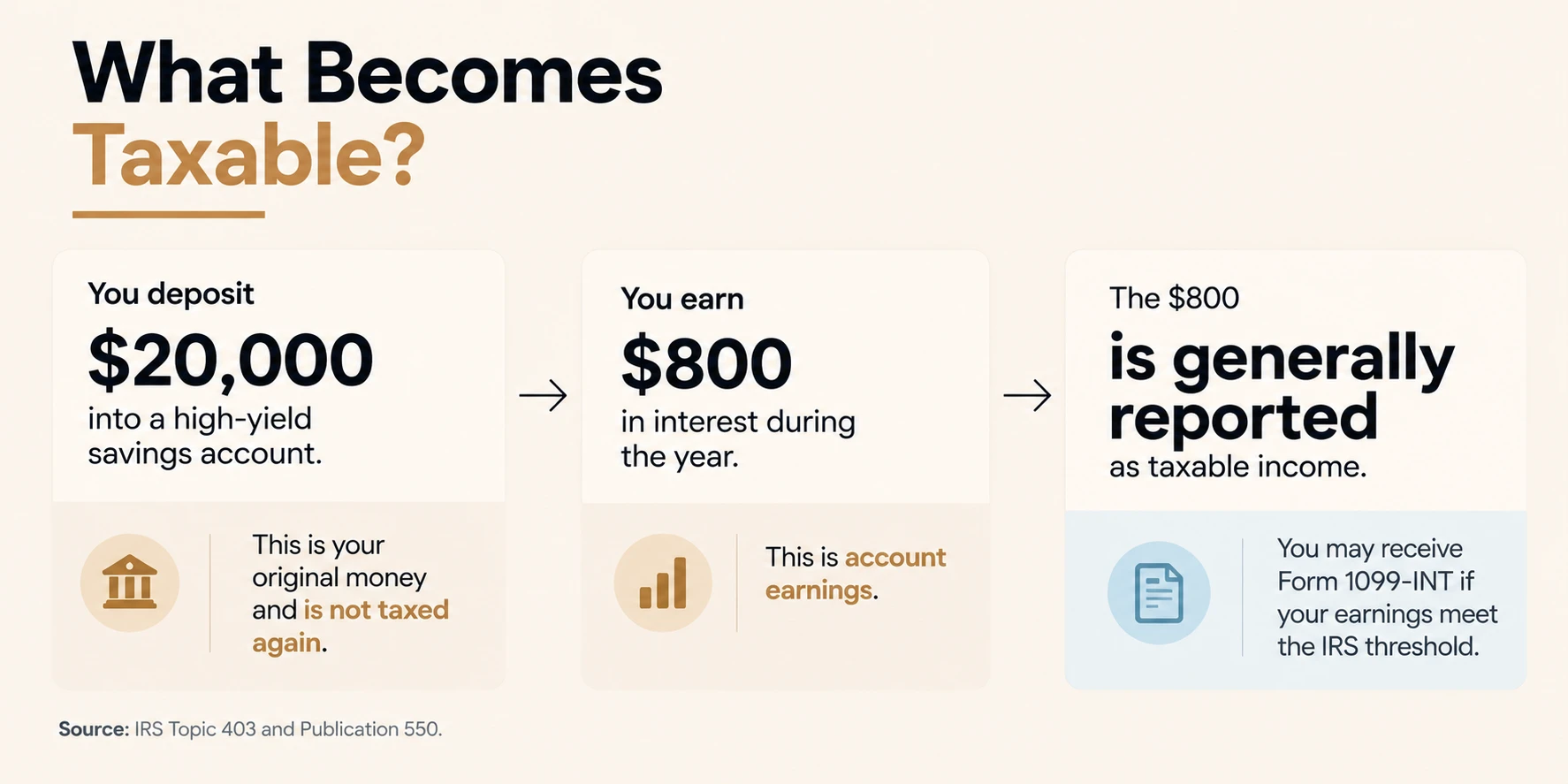
For most individual taxpayers, savings earnings become taxable when they are credited to the account and available to withdraw. You do not need to transfer the money to checking or spend it first.
This rule is known as constructive receipt. The IRS explains in Publication 550 that income is generally received when it is credited or made available without a substantial restriction. That means automatic reinvestment does not usually delay the tax.
For example, imagine that your online savings app credits $450 during 2026. You leave the full amount in the account so it can continue earning. The $450 is still generally included on your 2026 federal return because it was added to your balance and available to you.
How Does Form 1099-INT Work?
Banks and other payers generally issue Form 1099-INT when they pay at least $10 in reportable earnings during the calendar year. The form usually becomes available early in the following year. Depending on the provider, it may arrive by mail or appear in your online document center.
The $10 Threshold Is Not a Tax-Free Allowance
If you receive $8 and do not get a form, the $8 does not automatically become tax-free. IRS Topic 403 states that taxpayers must report taxable amounts even when they do not receive Form 1099-INT.
If your total taxable earnings exceed $1,500, the IRS generally requires Schedule B with Form 1040. Other circumstances can also trigger Schedule B, so review the current instructions or speak with a qualified tax professional.
How Much Tax Could You Owe?
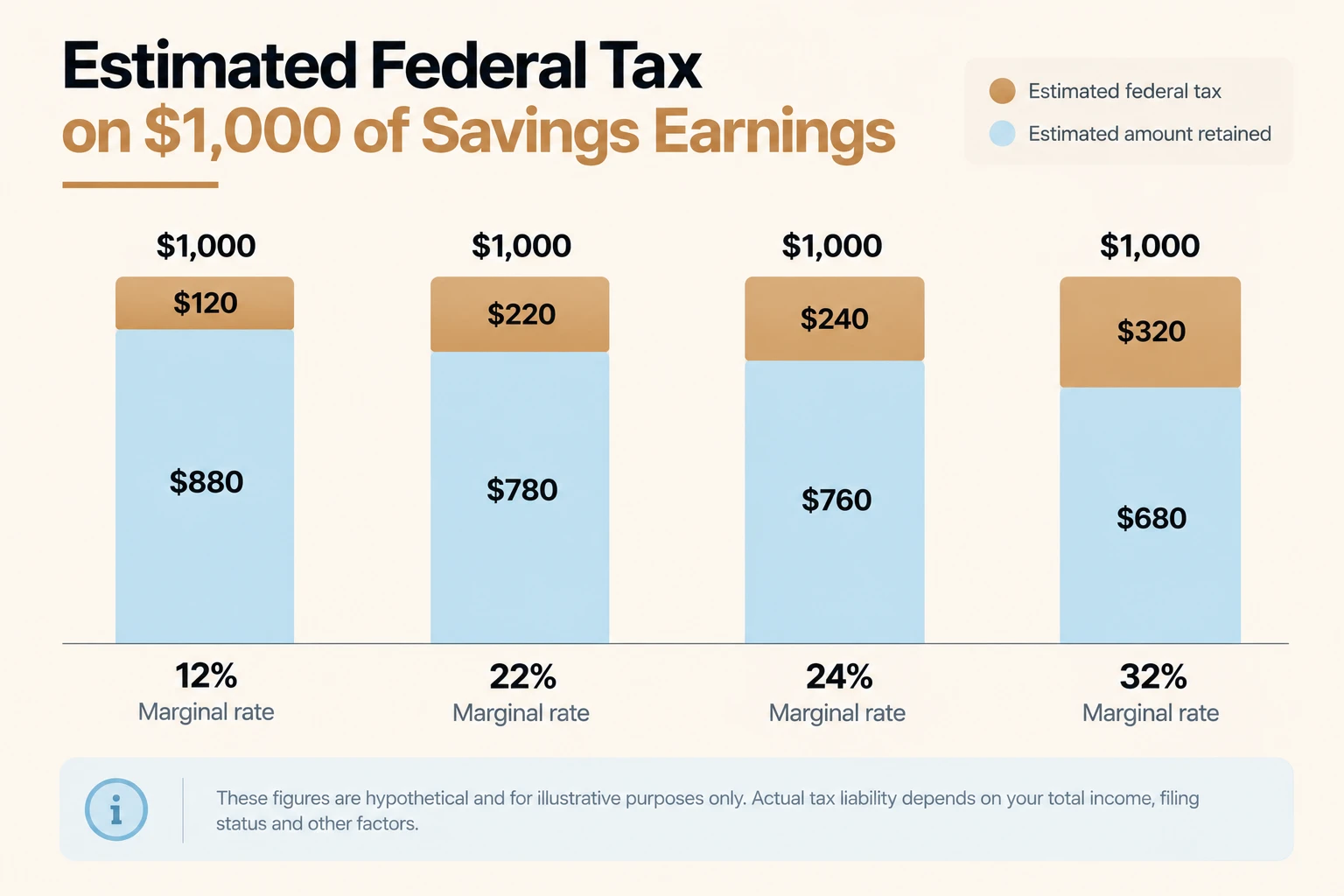
Savings earnings do not have a separate federal rate. They are generally added to your other ordinary income. The final cost depends on your taxable income, filing status, deductions, and marginal tax bracket.
A basic estimate is:
Taxable savings earnings × marginal federal tax rate = estimated federal tax
If an account produces $1,000 and your marginal federal rate is 22%, the estimate is:
$1,000 × 22% = $220
This does not mean every dollar of your income is taxed at 22%. The United States uses graduated brackets. The example simply applies the assumed marginal rate to the additional $1,000. It also excludes any state tax.
APY, deposits, withdrawals, and the time your money remains in the account affect the earnings figure. You can review how much a high-yield savings account may earn before estimating the possible tax.
Legal Ways to Manage the Tax Cost
There is no special deduction that makes ordinary HYSA earnings disappear. The useful options involve choosing the right account for the goal, considering the tax treatment of other products, and planning for the amount due.
Use a Tax-Advantaged Account When the Goal Qualifies
Some savings-like holdings can sit inside a tax-advantaged account. This is different from opening an ordinary HYSA through a digital savings platform.
A traditional IRA may defer tax until withdrawal. Qualified Roth IRA distributions can include tax-free earnings. HSAs can provide tax-free distributions for qualified medical expenses, while 529 plans can do so for qualified education expenses.
These accounts are not general-purpose replacements for emergency savings. Eligibility rules, contribution limits, permitted uses, and withdrawal restrictions apply. An early or nonqualified withdrawal may create income tax and an additional tax.
Use these accounts only when the money is intended for the purpose they were designed to support. Do not move an emergency fund into a restricted account solely to chase a tax benefit.
Consider Treasury Securities for Potential State-Tax Savings
Treasury bills, notes, and bonds are subject to federal tax, but their earnings are exempt from state and local income taxes. This can make their after-tax result more competitive for someone who lives in a state with an income tax.
They are not HYSAs. Treasury securities have maturity dates, purchase procedures, and different access rules. Selling a marketable Treasury before maturity can also produce a gain or loss. TreasuryDirect explains the federal, state, and local treatment.
Compare liquidity as well as yield before moving short-term savings. Money needed without notice may still be better suited to an accessible bank account.
Compare After-Tax Yield Instead of APY Alone
The highest advertised APY does not always provide the best result after tax, fees, balance rules, and access limits.
You can make a simple estimate with this formula:
After-tax earnings = estimated earnings × (1 − marginal tax rate)
Using the earlier example:
$1,000 × (1 − 0.22) = $780 after estimated federal tax
This is only an estimate, but it provides a clearer comparison than APY alone. Our guide to APY on a savings account explains what the percentage includes.
An online savings app can make earnings easier to monitor, but its interface does not change the tax treatment.
Prepare for the Bill During the Year
Tax planning does not reduce the taxable amount, but it can prevent an unpleasant cash-flow problem. Review year-to-date earnings and set aside part of them if you expect a material bill.
People with wages may be able to adjust withholding. Others may need estimated payments. A tax professional can help determine whether payments are necessary.
What Does Not Legally Avoid the Tax?
Several common tactics change where the money sits but not whether the earnings are taxable:
- Leaving the earnings in the account
- Opening several accounts so each pays less than $10
- Moving the balance to a different bank before year-end
- Closing the account after the earnings have been credited
- Choosing a high yield savings app that does not immediately display a tax form
- Failing to receive Form 1099-INT
Having more than one account can help organize goals or keep eligible deposits within insurance limits. It does not create extra tax-free allowances. Read our guide to multiple high-yield savings accounts for the practical advantages and tradeoffs.
Should You Move Money Out of a HYSA to Reduce Tax?
Tax should not be the only factor. A lower-tax product can have less liquidity, price risk, a fixed maturity, or restrictions on how the money may be used.
Start with the purpose of the funds. Emergency reserves usually need quick access and a stable value. Longer-term goals can support different structures and risk levels. Our comparison of saving versus investing explains why time frame and tolerance for loss matter.
A high-yield investment platform is not automatically a substitute for an insured savings account. Investments may fluctuate and can lose value. Compare the source of earnings, access rules, fees, tax documents, and protections before making a change.
The Bottom Line
You generally cannot avoid federal tax on earnings credited to a normal high-yield savings account. You must usually report the amount even if it stays in the account, is divided among providers, or is too small to generate Form 1099-INT.
Legal planning starts with the right structure for the goal. Tax-advantaged accounts may help with eligible expenses, while Treasury securities may reduce state and local tax. After-tax comparisons can show what you may keep.
Tax rules depend on the account, owner, location, and wider financial situation. Treat this article as general information and consult a qualified tax professional for personal advice.
Put your dollars into something real
With PureFi, your projected earnings come from shares of real homes with tenants. Choose your properties from your phone, review the documents, and see every fee before you confirm.
Learn more about how PureFi can help you own real estate shares or download the app to get started today.
Up to 6% APY is projected, variable, and not guaranteed. Property shares can lose value. PureFi is not a bank, and its balances and real estate shares are not covered by FDIC insurance or another government deposit scheme.