
How Often Do You Get Returns on High-Yield Savings?

Most high-yield savings accounts add earnings to your balance once a month. That does not necessarily mean the bank waits until month-end to calculate them. Many accounts calculate and compound earnings daily, then post one combined credit at the end of the statement cycle.
Calculation, compounding, and payment describe different steps. The APY remains annual even when the account credits earnings monthly.
How Often Does a HYSA Pay Earnings?
Monthly crediting is common. You will usually see one entry on the statement showing the earnings added during that cycle.
The date depends on the provider. One bank may use the final calendar day, while another uses the statement closing date.
Banks do not all have to follow the same schedule. Under federal Truth in Savings rules, institutions can choose to compound or credit earnings daily, monthly, quarterly, annually, or on another disclosed basis. What matters is that the account terms explain the method.
A high yield digital savings account may therefore calculate earnings daily but show one monthly addition. Another could calculate and credit them monthly.
Calculation, Compounding, and Crediting Are Not the Same
These terms are often used as if they describe one event. They do not.
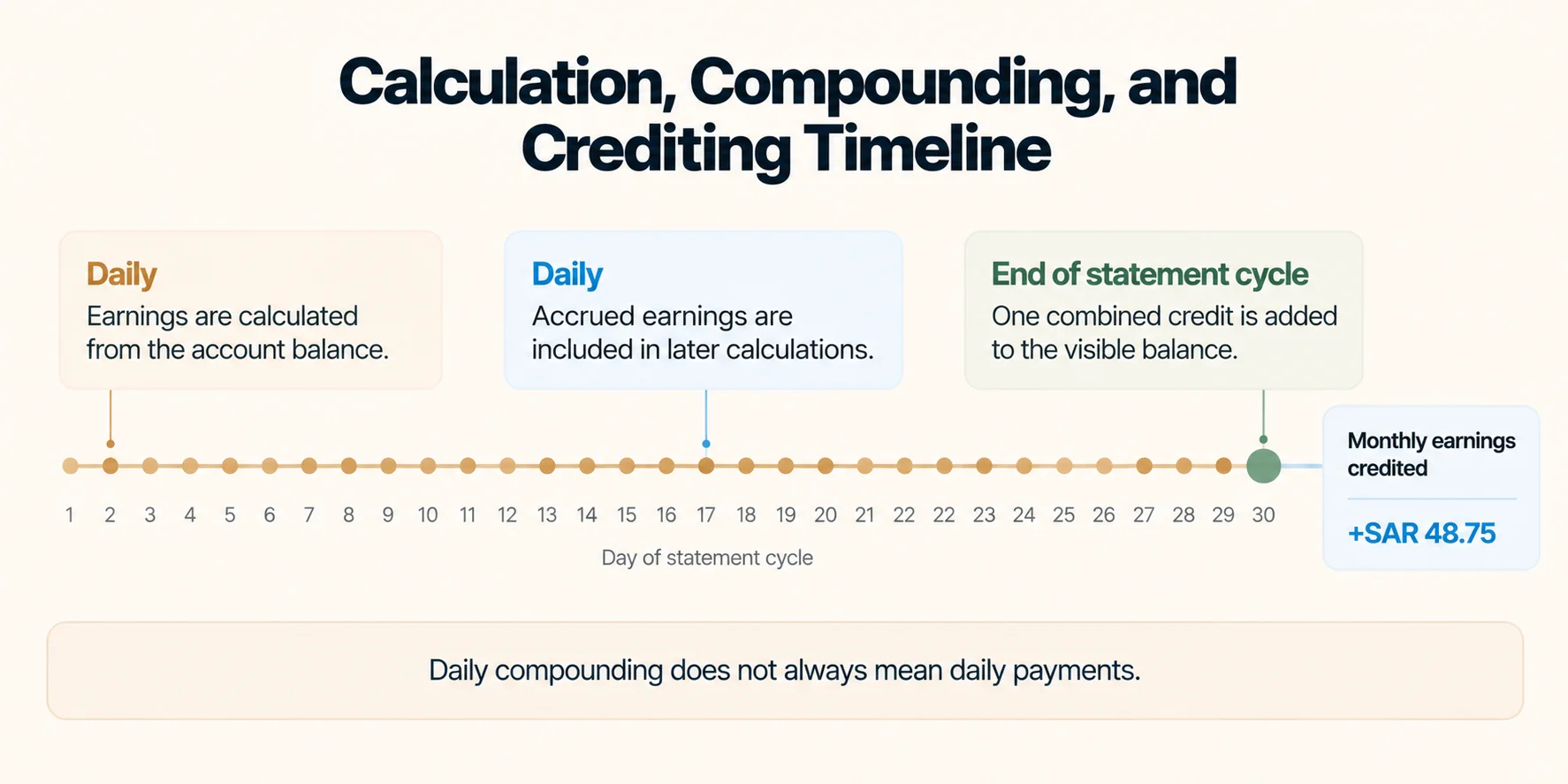
Calculation
Calculation is the process used to work out what the account has earned. Many banks apply a periodic rate to the daily balance or average daily balance.
If the balance changes, the calculation reflects how much was present on each relevant day. An early deposit has more time to earn than one made near the cycle’s end.
Compounding
Compounding makes previous earnings part of later calculations. With daily compounding, each day’s accrued amount can affect what comes next.
That does not mean a new payment appears in the account every day. The bank may track the accrued amount internally until the monthly credit date.
Crediting
Crediting adds the completed earnings to the visible balance. This is the entry shown on the statement or in the app.
An account can therefore compound daily and credit monthly without any contradiction. Our guide to whether HYSAs compound monthly looks at that distinction in more detail.
How Are HYSA Earnings Calculated?
The amount depends on the APY, balance, days deposited, transactions, and any conditions attached to the rate.
Two balance methods are common.
The daily balance method uses the balance held each day. The average daily balance method adds the daily balances and divides by the number of days.
APY already reflects compounding over a year. Dividing it by 12 gives a rough monthly average, not an exact statement credit.
The provider uses its stated rate and compounding method for the actual calculation. Our guide to calculating high-yield savings earnings provides copy-friendly formulas without treating an estimate as an exact bank calculation.
What Does APY Tell You About Payment Timing?
APY shows the annual effect of the rate and compounding, assuming the balance and rate conditions remain in place. It makes accounts with different compounding schedules easier to compare.
It does not tell you the date of the next credit. Two accounts can advertise the same APY while one credits monthly and another credits quarterly. Their annual results may be similar under the stated assumptions, but the statement entries will look different.
APY also does not promise that the rate will last for a year. Most savings APYs are variable. The provider can change the rate while keeping the same compounding and crediting schedule.
Check the APY alongside the account’s stated rate, payment schedule, minimum balance, and fees. A monthly charge can reduce the amount you keep even when the advertised APY looks competitive.
A Simple Monthly Earnings Example
Suppose you keep $10,000 in an account advertising 4.00% APY. Assume the APY and balance remain unchanged for a full year, with no fees or withdrawals.
The approximate annual earnings are:
$10,000 × 4.00% = about $400 per year
A rough monthly average is:
$400 ÷ 12 = about $33.33 per month
Do not expect every credit to equal $33.33. A 31-day period may produce more than 28 days, and statement cycles do not always match calendar months.
The figure can also change if you add money, make a withdrawal, pay a fee, or move into another balance tier. The examples in how much a high-yield savings account earns show how those changes affect the result.
Does Daily Compounding Mean Daily Payments?
No. Daily compounding describes how the account handles accrued earnings, not how often a completed payment appears in your transaction history.
An online savings app may show an estimate during the month. It is not necessarily a posted credit. The agreement and statement show when earnings officially reach the balance.
Federal Regulation DD guidance specifically recognizes accounts that compound daily and credit monthly.
Why Does the Monthly Amount Change?
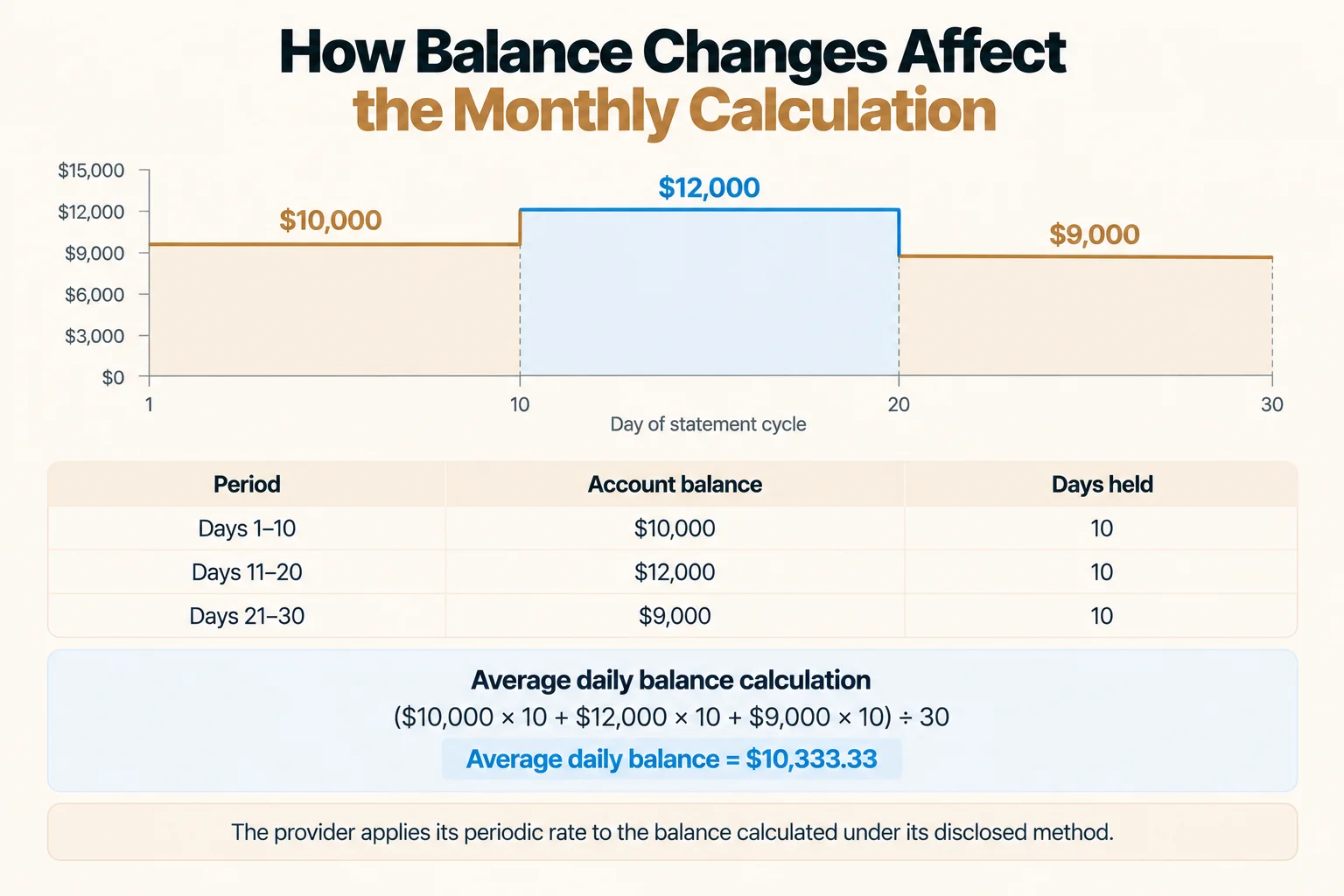
Even when the account always credits earnings monthly, the amount can move around.
The Month Is Longer or Shorter
Daily calculations give 31 days more earning days than 28 days.
You Added or Removed Money
Posted deposits increase the amount available to earn. Withdrawals reduce it. The transaction date matters.
The APY Changed
Most HYSA APYs are variable. A provider may change the rate during a statement period, so one credit can reflect more than one rate.
Our guide to why high-yield savings rates change explains what can move an account’s APY.
The Account Uses Tiers or Conditions
The highest APY may apply only to a balance range or require recurring deposits. Missing a condition can change the rate.
When Will the First Credit Arrive?
Opening an account on June 10 does not guarantee a payment on July 10. The first credit normally follows the provider’s statement cycle.
The amount depends on when the opening deposit posts and the calculation begins. The application date may not be the starting date.
A short first statement cycle can produce a smaller credit even when the APY has not changed.
Read the closing policy too. Some institutions disclose that accrued but uncredited earnings may be lost if the account closes before the credit date.
How Do Regular Deposits Affect the Credit?
Regular deposits raise the balance used in later calculations. A $500 deposit made early in the month has more earning days than one posted on the final day.
Contributions often matter more than a small APY difference. Adding $200 monthly contributes $2,400 over a year before earnings.
A high-yield savings app may schedule deposits weekly, on payday, or monthly. Leave enough in checking for bills. See adding money to savings regularly for deposit methods.
Where Can You Find the Account’s Schedule?
Start with the Truth in Savings disclosure or deposit account agreement. It should state how often earnings are compounded and credited, which balance method is used, and whether a minimum balance is required.
Also check the rate sheet, statement, FAQ, or app support area. Product terms and variable APYs can change.
A clear digital savings platform should make it possible to find the APY, calculation method, crediting frequency, fees, and balance conditions before opening the account.
Savings Earnings Are Not the Same as Investment Returns
People often call HYSA earnings “returns,” but a conventional savings account is a deposit product. Eligible deposits may receive FDIC or NCUA protection, and the balance does not normally follow market prices.
A high yield investment platform may earn from property, securities, or another asset. Its value can move, and payments may follow the asset’s income schedule.
APY alone does not make these products equivalent. Ownership, loss risk, liquidity, fees, and protection also need to be compared.
The Bottom Line
Most HYSAs credit earnings monthly, while many calculate and compound them daily. The monthly amount can change because the balance, APY, number of days, or account conditions changed.
Check the disclosure for three separate details: how the bank calculates earnings, how often they compound, and when they are credited.
Put Your Dollars Into Something Real
With PureFi, your projected earnings come from shares of real homes with tenants. Choose your properties from your phone, review the documents, and see every fee before you confirm.
Learn more about how PureFi can help you own real estate shares or download the app to get started today.
Up to 6% APY is projected, variable, and not guaranteed. Property shares can lose value. PureFi is not a bank, and its balances and real estate shares are not covered by FDIC insurance or another government deposit scheme.


