
How Much Should You Save Each Month in a HYSA?
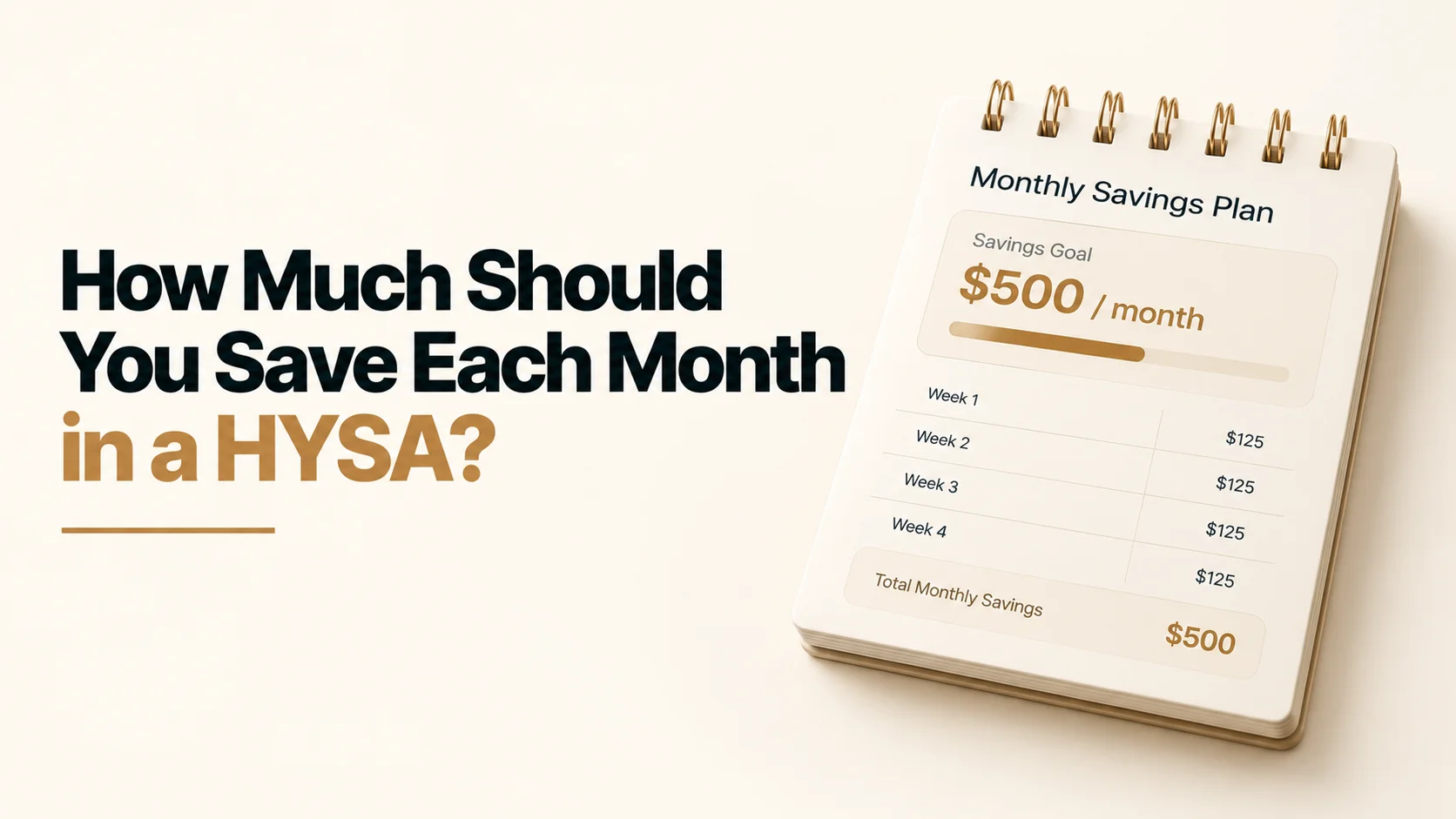
There is no single monthly amount that everyone should put into a high-yield savings account. The right figure depends on your take-home income, essential expenses, current savings, financial goal and deadline.
Saving 10% of your income can be a useful starting point, but it is not a requirement. Someone with high housing or medical costs may need to begin with a smaller amount. Someone saving for a home within two years may need to contribute much more.
The most reliable method is to calculate the amount required for a specific goal, check it against your monthly cash flow and automate a contribution you can maintain.
How Much Should You Save in a HYSA Each Month?
You can set a monthly savings amount in three ways:
- Save a percentage of take-home income.
- Transfer a fixed amount from every paycheck.
- Calculate the exact amount required to reach a goal by a set date.
A percentage provides a simple starting point. If 10% is realistic, someone taking home $4,000 a month would save $400. If that amount repeatedly leaves too little for bills, a smaller contribution is more sustainable.
The amount does not need to look impressive to be useful. Saving $25 each week adds $1,300 over a year before account earnings. The Consumer Financial Protection Bureau recommends setting a specific savings goal and calculating how much and how often you can contribute.
A high yield digital savings account can hold this money while keeping it separate from everyday spending. Before opening one, confirm its fees, access rules, balance requirements and deposit protection.
Start With Your Monthly Cash Flow
Begin with income received after taxes and payroll deductions. Gross salary can make a savings target appear more affordable than it is because that full amount never reaches your account.
Next, total the expenses that must be paid each month. These may include housing, utilities, food, transport, insurance, childcare and minimum debt payments. Add a reasonable amount for normal variable spending rather than assuming you will spend nothing outside the essentials.
Use this calculation:
Take-home income − essential expenses − required payments − planned spending = amount available for saving
Suppose you take home $4,500 each month. Essential expenses and required payments total $3,400, while normal discretionary spending is $500.
$4,500 − $3,400 − $500 = $600 available
That does not mean the full $600 must go into a HYSA. You may also have retirement contributions, investments or another goal. The calculation shows the maximum room currently available without relying on debt or missing bills.
Our guide to adding money to a savings account regularly explains how recurring and one-time deposits work.
Calculate Monthly Savings From Your Goal
Once you know what the budget can support, calculate what the goal requires:
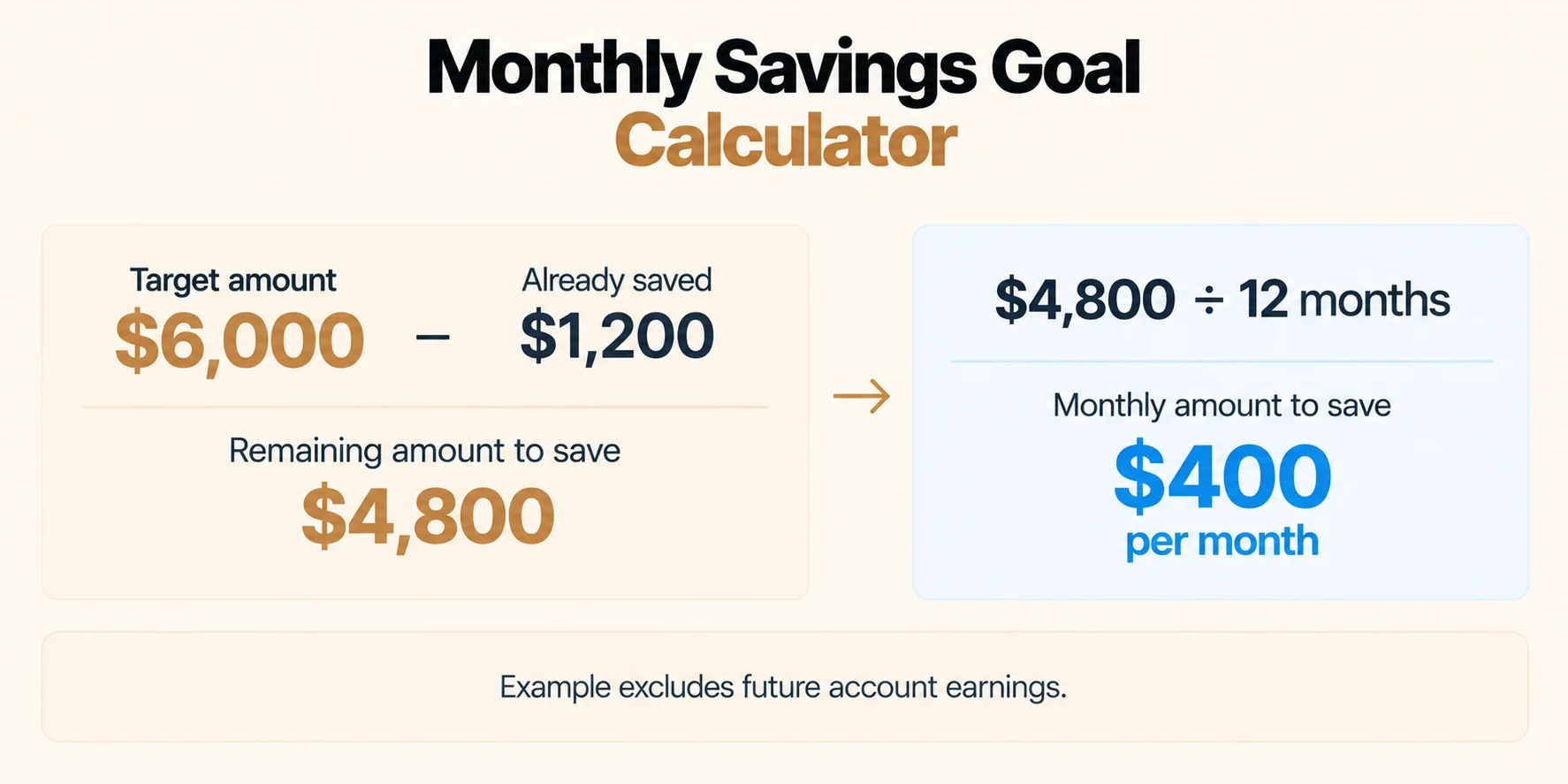
(Savings target − current savings) ÷ months remaining = monthly deposit
For example:
- Target: $6,000
- Current savings: $1,200
- Time available: 12 months
- Amount still required: $4,800
- Monthly deposit: $400
The calculation is:
($6,000 − $1,200) ÷ 12 = $400 per month
This method excludes future account earnings, which creates a small cushion if the account continues paying a yield. APYs can change, so it is safer not to depend on a variable rate to close a large gap.
If the required deposit is higher than your available cash flow, you have four basic options: extend the deadline, lower the target, reduce spending or add income. Avoid setting an automatic transfer that repeatedly causes an overdraft.
The official Investor.gov Savings Goal Calculator can also estimate the monthly contribution required.
How Much Should You Save for an Emergency Fund?
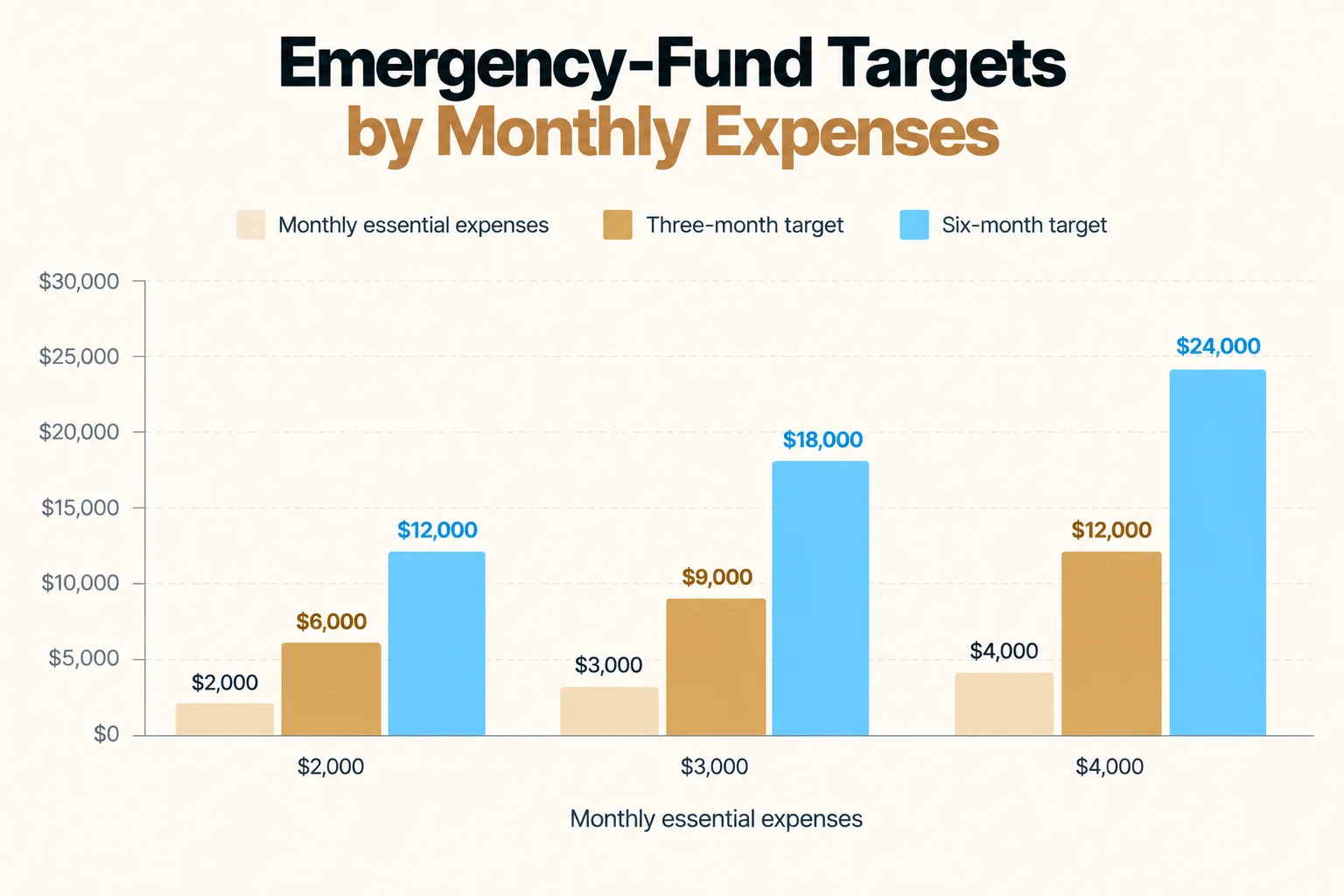
A common emergency-fund target is three to six months of essential expenses. It is a range, not a universal rule. The appropriate amount depends on income stability, dependents, insurance, health needs and how quickly you could replace lost income.
If essential expenses are $3,000 per month:
- Three months of expenses equals $9,000.
- Six months of expenses equals $18,000.
Reaching that full figure may take time. Start with a smaller first target that could cover an urgent repair, medical bill or insurance deductible. Once that buffer is complete, continue toward the larger goal.
Someone with two stable household incomes may choose the lower end of the range. A freelancer, sole earner or person with unpredictable medical expenses may prefer a larger reserve.
The FDIC presents three to six months of expenses as a general emergency-savings benchmark. Your actual figure should still reflect your own risks and monthly obligations.
Monthly Savings Examples for Different Goals
| Goal | Target | Already saved | Time available | Monthly deposit |
|---|---|---|---|---|
| Starter emergency fund | $3,000 | $600 | 12 months | $200 |
| Annual insurance bill | $1,200 | $0 | 12 months | $100 |
| Home deposit | $24,000 | $6,000 | 36 months | $500 |
| Planned travel | $3,600 | $900 | 18 months | $150 |
These amounts exclude future yield and assume no withdrawals. You can keep several goals in one account, but separate savings buckets may make each balance easier to track.
Our guide to different types of savings accounts can help you decide where each goal belongs.
What If Your Income Changes Each Month?
A fixed monthly amount can be difficult for freelancers, commission-based workers and seasonal earners. Instead, combine a small automatic deposit with a percentage of higher-income months.
Base the automatic amount on the lowest normal month. You might then transfer 10% of every payment above that baseline. This keeps the plan active without committing money needed for essential expenses.
One-time deposits can also come from bonuses, refunds or unusually strong months. A high yield savings app or online savings app may let you adjust or pause recurring transfers from your phone.
If even a small fixed contribution is difficult, a micro savings account may provide a more flexible starting structure.
Does APY Change How Much You Should Save?
APY affects the amount the account earns, but your contributions usually have the larger immediate effect when the balance is still growing.
Increasing a monthly deposit from $200 to $250 adds another $600 in contributions over one year. Moving between two accounts with a small APY difference may produce a much smaller change on a modest balance.
Compare APY, but do not let it distract from the contribution amount, fees or access rules. Our examples of how much a high-yield savings account earns show how balance, time and APY work together.
How to Automate Monthly HYSA Deposits
Most banks let you schedule transfers weekly, every payday or monthly. Split direct deposit may also let your employer send part of each paycheck directly to savings.
Schedule the transfer shortly after payday, but leave enough in checking for upcoming bills. The FDIC identifies regular automated deposits and occasional windfalls as practical ways to build emergency savings.
A digital savings platform can make transfers easier, but automation should still be reviewed. Recheck the amount after a raise, income reduction, major expense, withdrawal or change in your goal deadline.
When Should You Stop Adding to the HYSA?
Once a goal is fully funded, redirect the monthly contribution instead of allowing every dollar to accumulate in the same account without a purpose.
A HYSA can work well for emergency reserves and planned expenses. It may be less suitable as the only vehicle for a goal several decades away because inflation can reduce purchasing power. Are savings accounts good for the long term? covers that tradeoff.
A high yield investment platform is different from a savings account. Investments can provide greater growth potential, but they can lose value and have different fees, access rules and protections.
The Bottom Line
Calculate your monthly HYSA deposit by subtracting current savings from the target and dividing the remaining amount by the months available. Then compare the result with your actual monthly cash flow.
If the figure is not affordable, adjust the deadline or target. A smaller contribution you can maintain is more useful than an aggressive transfer that is frequently cancelled. Automate the amount, review it when your finances change and increase it when your budget allows.
Put Your Dollars Into Something Real
With PureFi, your projected earnings come from shares of real homes with tenants. Choose your properties from your phone, review the documents, and see every fee before you confirm.
Learn more about how PureFi can help you own real estate shares or download the app to get started today.
Up to 6% APY is projected, variable, and not guaranteed. Property shares can lose value. PureFi is not a bank, and its balances and real estate shares are not covered by FDIC insurance or another government deposit scheme.


