How Is a CD Different From a Savings Account?
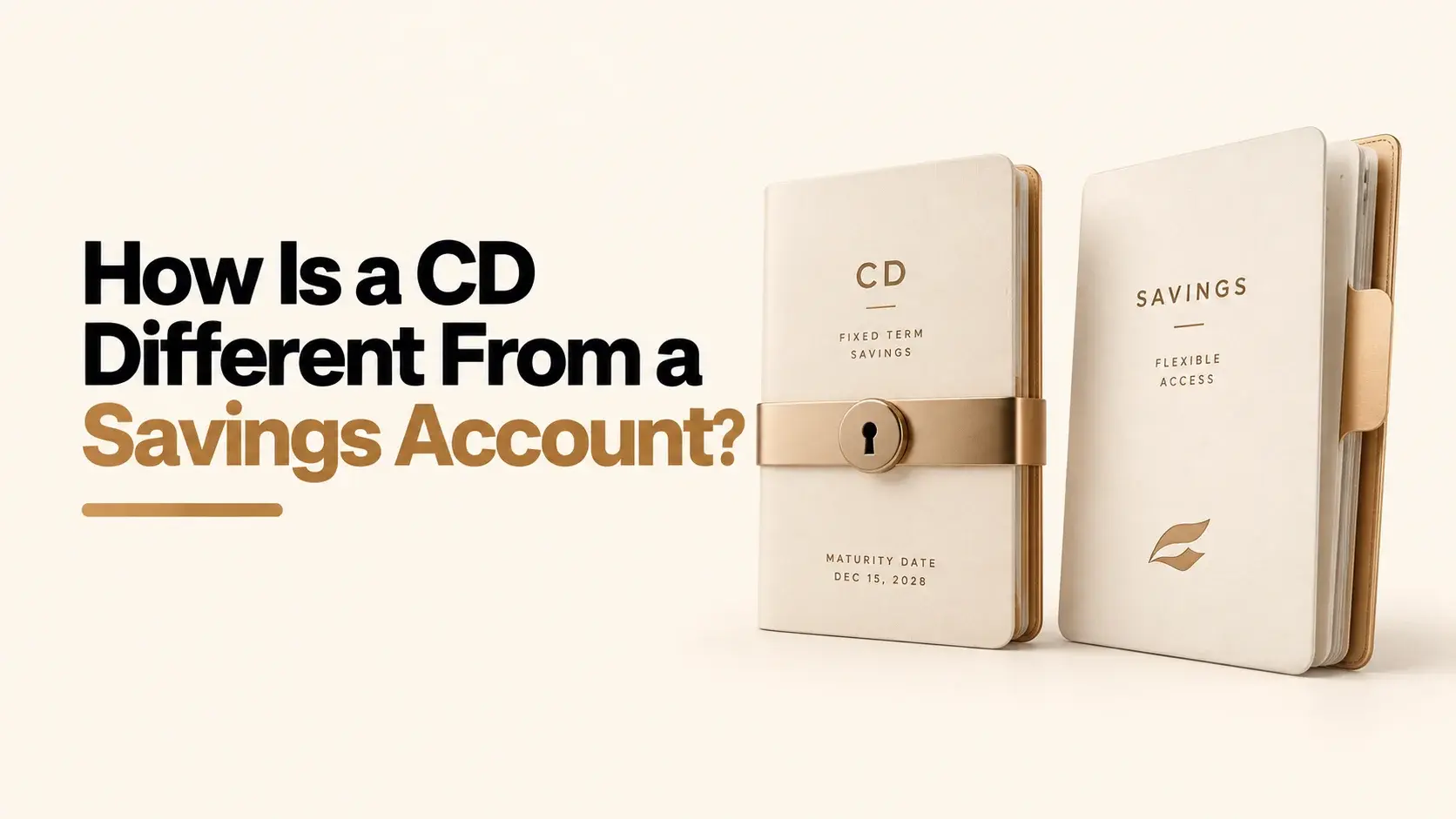
How Is a CD Different From a Savings Account?
A CD usually requires you to leave your funds untouched for a set term, while a savings account provides more flexible access.
Both are deposit accounts. Both can help your balance earn. However, they are built for different needs. A savings account may be useful when you need regular access. A CD may suit funds that you can leave alone until a known date.
In this article, we’ll compare their APYs, access rules, account terms, withdrawal penalties, maturity process, and federal protection.
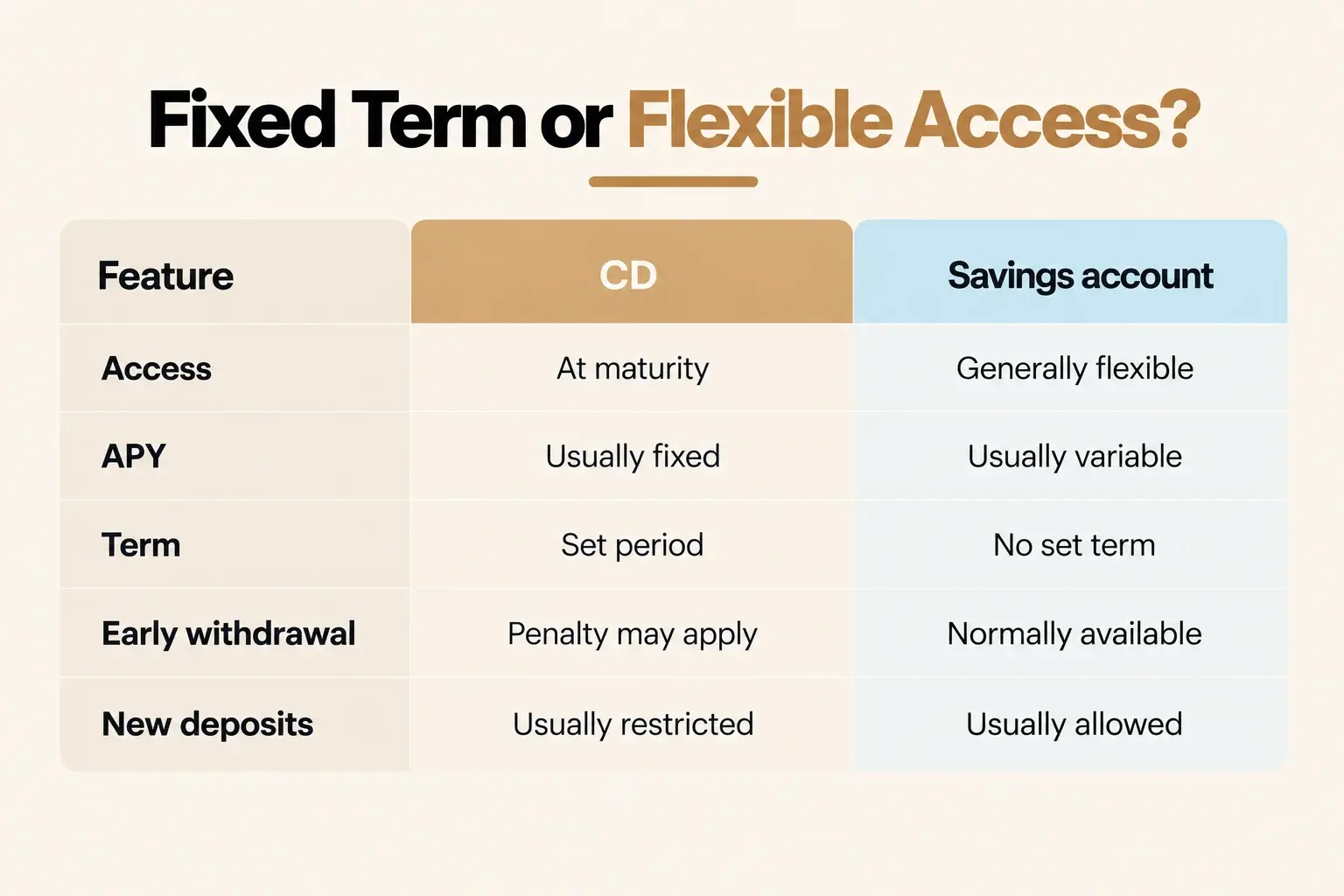
CD vs. Savings Account at a Glance
| Feature | CD | Savings account |
|---|---|---|
| Main purpose | Saving for a known date | Saving while keeping funds accessible |
| Account term | Set period | No maturity date |
| APY | Usually fixed for the term | Usually variable |
| Withdrawals | Penalty may apply before maturity | Generally available |
| Additional deposits | Usually not allowed after opening | Usually allowed |
| Maturity date | Yes | No |
| Federal protection | May apply at an eligible institution | May apply at an eligible institution |
These are common features, not rules for every account. Some CDs have variable APYs or allow early withdrawals without a penalty. Savings account terms also differ between providers.
What Is a Savings Account?
A savings account is a deposit account used to hold funds while earning a return. You can usually add funds after opening the account. You can also withdraw or transfer funds when needed, although the provider may set transaction limits or fees.
The APY on a savings account is normally variable. This means the provider can raise or lower it after you open the account.
A high-yield savings account works in the same basic way. The main difference is that it offers a more competitive APY than many standard savings accounts.
Many high-yield digital savings account providers operate online. You may manage the balance through a high-yield savings app and transfer funds to or from a linked checking account.
A savings account may be useful for:
- Emergency funds
- Regular saving
- Planned bills
- A home deposit
- Travel
- Purchases expected within the next few years
The main benefit is access. You do not need to wait for a maturity date before withdrawing your funds.
What Is a CD Account?
A certificate of deposit, usually called a CD, is a type of deposit account with a set term. When you open a CD, you agree to leave the funds in the account for a stated period. This could be several months or several years.
The date when the term ends is called the maturity date. At that point, you can normally withdraw the balance or place it in another account.
Standard CDs usually offer a fixed APY. This means the APY stays the same for the full term, even if other savings APYs change.
You usually make one deposit when opening the CD. Many providers do not allow additional deposits during the term.
According to the Consumer Financial Protection Bureau , withdrawing funds before the end of a CD term generally means paying a penalty. The amount depends on the account agreement.
How Does Access to Funds Differ?
A savings account gives you more flexible access. You can normally make withdrawals or send funds to another account without waiting for a set date. The provider may still place limits on certain transfers or withdrawal methods.
A CD works differently. Your funds are committed until the maturity date.
You can often request an early withdrawal, but a penalty may apply. The penalty may reduce some or all of the earnings from the CD. In some cases, it may also reduce part of the original deposit.
This makes a CD less suitable for emergency savings. An unexpected expense could force you to withdraw early and pay the penalty.
There are exceptions. Some providers offer no-penalty CDs. These accounts allow withdrawals without the usual early withdrawal charge after any required initial waiting period.
No-penalty CDs may have different APYs or account rules. Read the terms before opening one.
How Do Their APYs Compare?
A CD does not always offer a higher APY than a savings account. Standard CDs usually lock in an APY for the full term. This gives you certainty about how the account will earn if you leave the funds in place.
A savings account APY can change at any time. Your provider may raise or lower it based on its own pricing and wider market conditions.
Locking an APY can help if savings APYs fall during your CD term. It can also work against you. If new account APYs rise, your existing CD may continue earning its original APY until maturity.
A longer CD term does not always provide a higher APY. Providers may offer stronger APYs on shorter or promotional terms.
When comparing a CD vs. a savings account, check:
- The APY
- The CD term
- The minimum opening deposit
- The early withdrawal penalty
- The savings account fees
- The balance needed to earn the advertised APY
- Whether the APY is fixed or variable
The highest number is not always the best option. The account must also give you the access you need.
What Happens When a CD Matures?
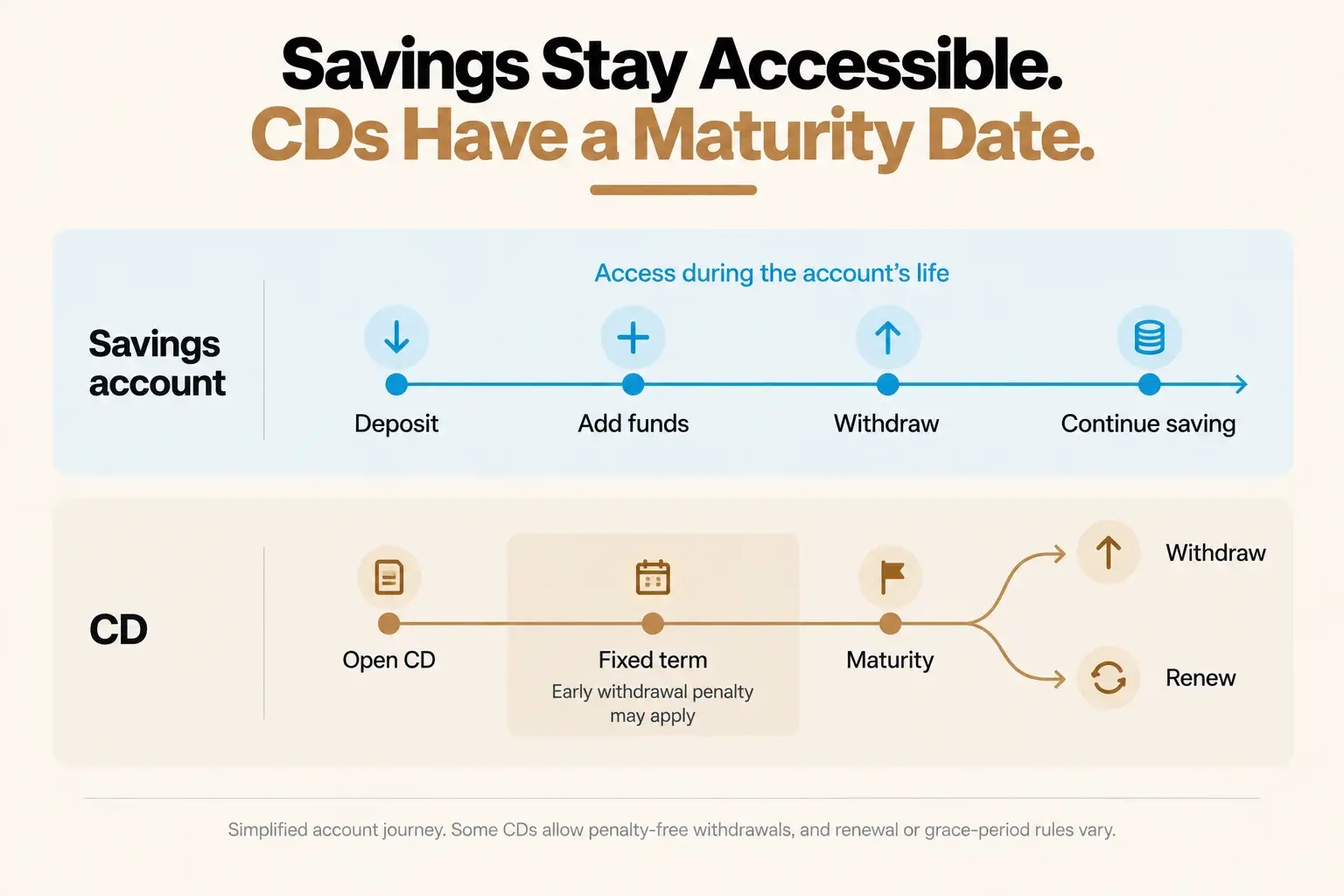
When a CD reaches maturity, its agreed term ends. The provider should tell you what will happen next. You may have several options:
- Withdraw the full balance
- Transfer the balance to another account
- Open a new CD
- Allow the CD to renew automatically
Some CDs renew automatically unless you give the provider other instructions.
An automatically renewed CD may have a new term and APY. The new APY could be higher or lower than the one you previously received. Many providers offer a grace period after maturity. During this period, you may be able to withdraw the balance or change the term without paying an early withdrawal penalty.
Grace periods are not the same for every provider. Your maturity notice should explain the dates and renewal process. The CFPB’s CD renewal guidance recommends comparing current offers before allowing a CD to renew.
Keep track of your maturity date. If you miss the grace period, the funds may be placed into a new CD term.
Are CDs and Savings Accounts Protected?
Eligible CDs and savings accounts can both receive federal deposit protection.
The FDIC generally covers eligible deposits up to $250,000 per depositor, per insured bank and per ownership category.
The NCUA provides similar protection for eligible deposits at federally insured credit unions.
The coverage limit applies to your combined deposits in the same ownership category at the same institution. A CD and savings account do not automatically receive separate coverage simply because they are different products.
For example, if you have a CD and savings account in your name alone at the same insured bank, their balances may be added together when calculating coverage.
Check whether the bank or credit union is federally insured before opening an account. You can use the FDIC BankFind tool or review the NCUA coverage guide .
Which Account May Suit Your Goal?
The right account depends on when you need the funds.
A savings account may suit you if:
- You are building an emergency fund.
- You plan to add funds regularly.
- You may need to make withdrawals.
- You want flexible access.
- You are comfortable with a variable APY.
A CD may suit you if:
- You know when you will need the funds.
- You can leave the deposit untouched.
- You want a fixed APY for a set term.
- You understand the early withdrawal penalty.
- You can meet the minimum opening deposit.
A CD may make sense for a planned expense with a known date. A savings account may make more sense when the timing is uncertain.
Can You Use Both?
Yes. A CD and savings account can support different goals. You could keep emergency funds in a high-yield savings account and place funds for a planned expense in a CD that matures before payment is due.
Some people also use several CDs with different maturity dates. This is known as a CD ladder. It provides access to part of the funds at regular points instead of locking the full amount into one long term.
Using more than one account requires extra tracking. You need to monitor maturity dates, APYs, renewal rules and federal coverage across your accounts.
Put your dollars into something real
With PureFi, your projected earnings come from shares of real homes with tenants . Choose your properties from your phone, review the documents, and see every fee before you confirm.
Learn more about how PureFi can help you own real estate shares or download the app to get started today.
Up to 6% APY is projected, variable and not guaranteed. Property shares can lose value. PureFi is not a bank, and its balances and real estate shares are not covered by FDIC insurance or another government deposit scheme.