High-Yield Savings Account With ITIN
You can open a high-yield savings account with an ITIN at some banks. The ITIN takes the place of an SSN for tax identification when the provider allows it.
It does not guarantee approval. A bank can still require a U.S. address, accepted photo identification, a U.S. phone number, qualifying residency status, or an account at another U.S. bank.
The requirements also differ between providers. Before starting an application, check the complete eligibility rules rather than looking only for an ITIN field.
Can You Open a High-Yield Savings Account With an ITIN?
Yes. Federal rules do not require every savings-account customer to have a Social Security number. Banks must collect enough information to verify a customer’s identity. This normally includes the applicant’s name, date of birth, address, and an identification number.
Depending on the customer and the institution, the identification number may be an SSN, ITIN, passport number, alien identification number, or another accepted government-issued number.
The bank decides which forms it supports. One online bank may accept an ITIN throughout its application. Another may require an SSN even though a branch-based account at a different institution accepts foreign documents.
An ITIN is also only one part of the application. Capital One, for example, accepts an ITIN for 360 Performance Savings but limits the account to U.S. citizens and lawful permanent residents who meet its other requirements.
Always read the account disclosures before entering personal information.
What Is an ITIN?
An Individual Taxpayer Identification Number is a nine-digit number issued by the IRS. It is available to people who need a U.S. taxpayer identification number for federal tax purposes but are not eligible for an SSN.
An ITIN is issued for tax administration. It does not:
- Provide or change immigration status
- Authorize someone to work in the United States
- Qualify the holder for Social Security benefits
- Act as general identification outside the federal tax system
A bank may accept the number for tax reporting while requesting a passport or another photo ID to verify the person opening the account.
The legal name used on the bank application should match the name connected to the ITIN. A mismatch can delay automated verification.
The IRS ITIN information page explains what the number does and does not provide.
What Do Banks Usually Require?
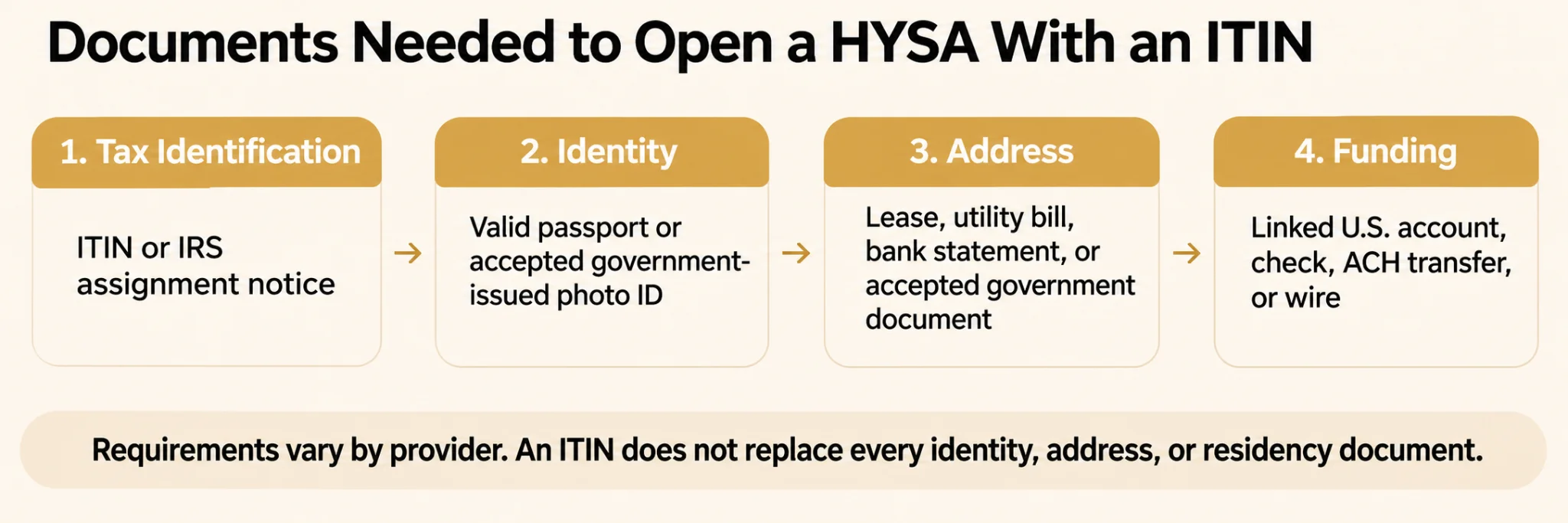
The exact requirements depend on the institution. An applicant should generally prepare:
- Their ITIN or IRS assignment notice
- A valid passport or other accepted photo ID
- A qualifying residential address
- Proof of address
- Date of birth
- Email address and phone number
- Employment or income information
- A way to fund the new account
An ITIN assignment notice may help confirm the number, but it does not always replace photo identification.
Some institutions accept foreign passports or consular identification cards. Others require a U.S. driver’s licence, state identification card, or other U.S.-issued document.
The address rules also matter. Many online banks require a physical U.S. residential address. A post-office box, mail-forwarding address, or overseas address may not qualify.
Proof of address could include a utility bill, lease, bank statement, or government document. The applicant’s name and address should appear clearly and match the application.
How Do You Apply for an ITIN?
Someone who needs a new ITIN generally completes Form W-7 and submits it with a federal tax return unless an IRS exception applies.
The applicant must also provide documents proving identity and foreign status. A valid passport is the only stand-alone document that can establish both. Without one, the IRS generally requires two supporting documents, including one with a photograph.
Applications can be submitted by mail or in person. In-person options include an IRS Taxpayer Assistance Center or an approved Certifying Acceptance Agent.
The IRS states that processing normally takes about seven weeks. It may take nine to eleven weeks during tax season or when the application comes from overseas.
A bank cannot issue an ITIN. The number must come from the IRS before it can be entered in an account application.
See the official IRS ITIN application guidance for the current process.
How to Open a High-Yield Savings Account With an ITIN
Confirm that the provider accepts ITINs
Do not assume that every field marked “Tax ID” accepts an ITIN. Read the eligibility page or contact the bank first.
Ask whether the account can be opened online. Some institutions accept an ITIN only when the customer applies at a branch.
Read the complete eligibility rules
Check the provider’s age, residency, citizenship, address, phone-number, and funding requirements.
ITIN acceptance does not cancel these conditions. A person can have a valid ITIN and still be ineligible for a particular account.
Prepare matching documents
The name, birth date, ITIN, and address should be consistent across the application and supporting documents.
If the bank cannot verify the information electronically, it may ask for uploaded documents or a branch visit.
Submit the application securely
Apply through the provider’s official website, mobile app, or branch. Avoid sending an ITIN through email or entering it into a page reached through an unverified message.
The bank may ask additional questions about employment, tax residency, or the source of the opening deposit.
Fund the account
Funding methods may include an ACH transfer, wire, mobile check deposit, or mailed check. Some online banks require a linked account at another U.S. institution.
Our guide to opening a high-yield savings account covers the standard application and funding process.
High-Yield Savings Account Options That Accept an ITIN
The following products accepted ITINs in qualifying applications when checked on November 6, 2026. Rates are variable, and acceptance of an ITIN does not guarantee account approval.
1. Capital One 360 Performance Savings
Capital One 360 Performance Savings is an online account with no monthly maintenance fee and no minimum balance.
ITIN eligibility: The application accepts an SSN or ITIN. The account is limited to U.S. citizens or lawful permanent residents who are at least 18.
Applicants also need a qualifying U.S. physical address, U.S.-based mobile number, and linked account at a U.S.-chartered bank.
APY: The account offered 3.20% variable APY across all balances as of November 3, 2026.
Fees and minimums: There is no minimum balance or monthly maintenance fee. After approval, the customer has 60 days to fund the account.
Access: Customers can manage the account online, through Capital One’s mobile app, or at a Capital One branch or Café.
What to watch: Many ITIN holders will not meet the citizenship or permanent-residency condition. The ITIN alone is not enough.
2. American Express High Yield Savings
American Express National Bank offers an online HYSA with no monthly maintenance fee or minimum opening deposit.
ITIN eligibility: American Express states that applicants who are not eligible for an SSN can provide an ITIN. It also collects the applicant’s birth date, address, employment information, and other details needed for identity verification.
APY: The account offered 3.20% variable APY when checked. Earnings are calculated daily and credited monthly.
Fees and minimums: There is no minimum opening deposit, minimum balance requirement, or monthly fee.
Access: The account can be funded through electronic transfers, mobile check deposits, eligible American Express accounts, or mailed checks. American Express also provides round-the-clock customer support.
What to watch: The HYSA does not come with an ATM card, debit card, or checks. Money generally needs to be transferred before it can be spent.
3. CIT Bank Platinum Savings
CIT Bank Platinum Savings is a tiered online account offered by CIT Bank, a division of First Citizens Bank.
ITIN eligibility: The online application accepts either an SSN or ITIN. Applicants must also provide an address, phone number, email, and the other information requested during verification.
APY: The standard APY was 3.75% for balances of at least $5,000 and 0.25% for balances below $5,000.
CIT Bank was also offering a temporary 0.60-percentage-point APY increase for six months with code BOOST60. The promotion was scheduled to end on December 15, 2026, but could end earlier.
Fees and minimums: The account requires a $100 opening deposit and has no monthly maintenance fee.
Access: Customers can manage the account online or through the mobile app. Funding options include ACH, wire, mobile check, and mailed check.
What to watch: The account’s strongest standard APY requires at least $5,000. If the end-of-day balance falls below that amount, the entire balance moves into the lower tier.
How Should You Compare ITIN-Friendly Accounts?
ITIN acceptance should be the first filter, not the final decision.
Check the provider’s full residency and address rules. Then compare the APY, balance tiers, minimum deposit, monthly fee, funding methods, transfer times, and customer support.
Pay particular attention to the identification process. An online savings app may offer an attractive APY but rely on an automated system that cannot verify your documents easily. Access to branch or phone support can be valuable when an application requires manual review.
Also confirm that the account is held at an FDIC-insured institution. Our comparison of savings rates and guide to the advantages of online-only savings accounts can help with the wider comparison.
Does an ITIN Affect FDIC Insurance?

No. FDIC coverage is not limited to U.S. citizens or residents.
Eligible deposits held at an FDIC-insured bank can receive protection within the applicable limits. The standard limit is generally $250,000 per depositor, per insured bank, for each account ownership category.
The ITIN helps identify the account holder for tax and account records. It does not reduce the insurance limit. You can verify an institution through the official FDIC BankFind Suite.
Read Are High-Yield Savings Accounts Safe? for more on deposit protection.
Does Applying With an ITIN Affect Your Credit?
Opening a savings account does not normally involve the same hard credit check used for a loan or credit card.
The bank may still review deposit-account screening records, unpaid bank balances, identity information, or previous account activity. These checks can affect approval without changing a traditional credit score.
An application can also be denied because the bank cannot verify the person’s address or identification. That does not automatically mean the applicant has poor credit.
Our guide to how opening a HYSA affects credit explains the difference.
How Are Savings Earnings Reported?
The bank uses the taxpayer identification number connected to the account for federal reporting.
The customer may receive Form 1099-INT when applicable. The legal name and ITIN should match the IRS record. Missing or incorrect tax certification may lead to backup withholding.
Complete the tax form requested by the bank. Do not choose between Form W-9 and Form W-8BEN based only on immigration status. Tax residency follows separate rules.
Speak with a qualified tax professional if you are unsure which certification or reporting requirements apply.
Can You Open a HYSA With an ITIN?
Yes. Capital One, American Express, and CIT Bank are examples of providers that currently accept an ITIN in qualifying savings applications.
Their rules are not identical. Capital One restricts eligibility to U.S. citizens and lawful permanent residents. American Express and CIT Bank apply their own address, identity, and account requirements.
Check every condition before applying. A valid ITIN solves one part of the application. It does not guarantee approval.
Put your dollars into something real
With PureFi, your projected earnings come from shares of real homes with tenants. Choose your properties from your phone, review the documents, and see every fee before you confirm.
Learn more about how PureFi can help you own real estate shares or download the app to get started today.
Up to 6% APY is projected, variable, and not guaranteed. Property shares can lose value. PureFi is not a bank, and its balances and real estate shares are not covered by FDIC insurance or another government deposit scheme.