High-Yield Savings Account vs. Roth IRA
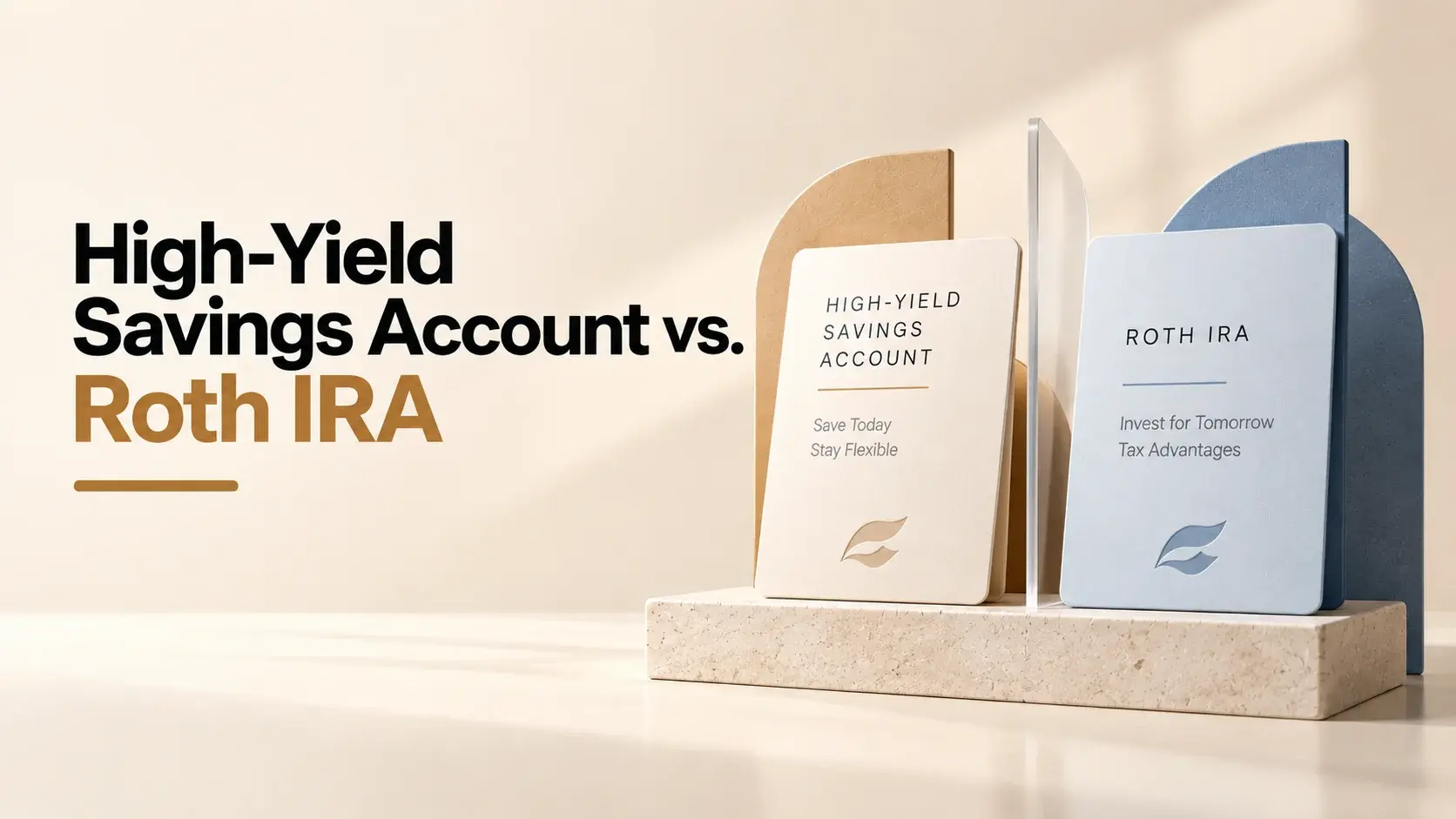
High-Yield Savings Account vs. Roth IRA
A high-yield savings account is generally better for short-term savings, while a Roth IRA is designed for long-term retirement investing.
These accounts do different jobs. A high-yield savings account keeps your funds accessible and pays a variable APY. A Roth IRA provides tax benefits, but its growth depends on the investments held inside it.
In this article, we’ll compare how the two accounts earn, when you can withdraw funds, what tax rules apply, and how your balance is protected.
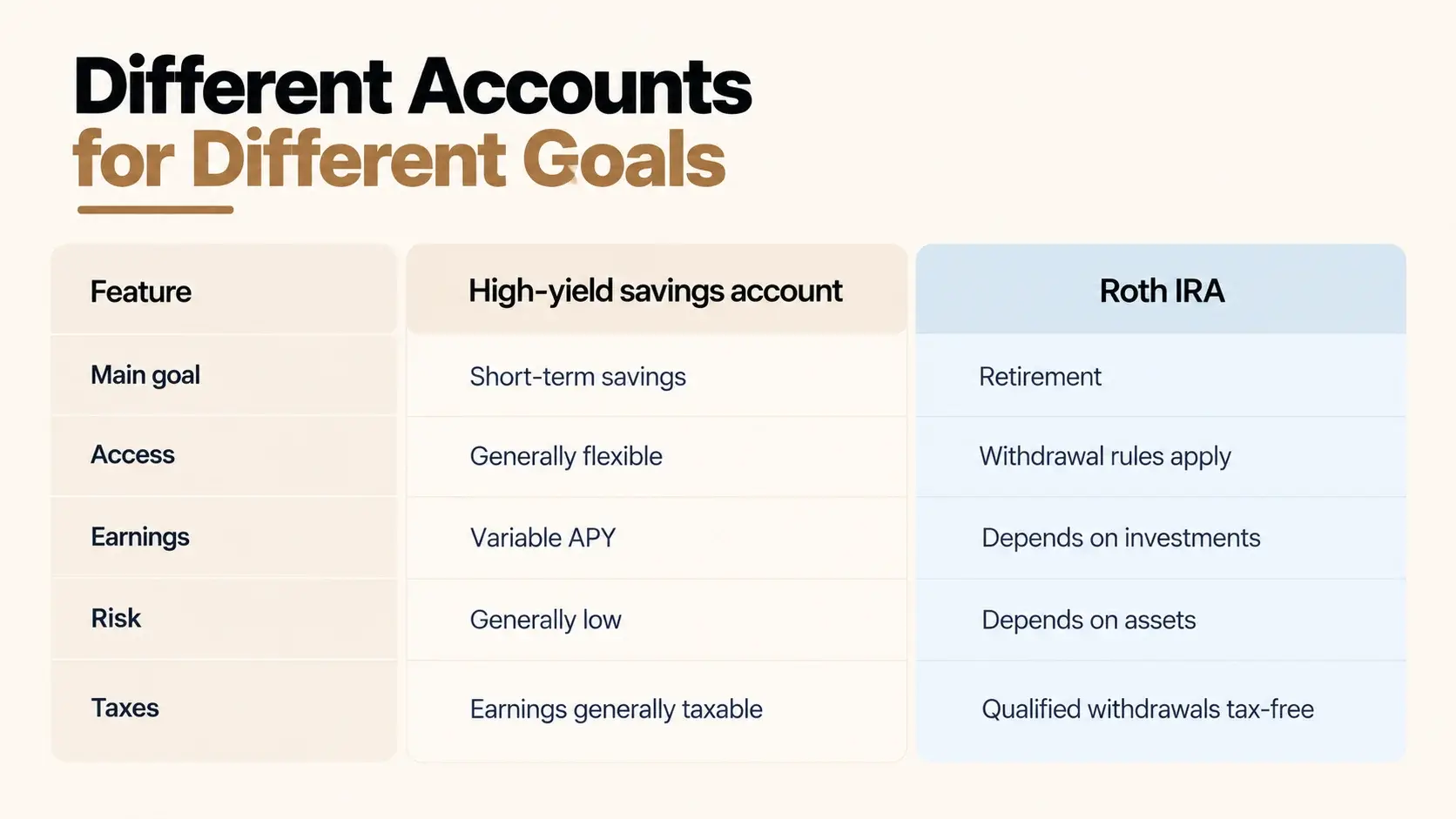
High-Yield Savings Account vs. Roth IRA at a Glance
| Feature | High-yield savings account | Roth IRA |
|---|---|---|
| Main purpose | Emergency funds and short-term goals | Long-term retirement investing |
| Account type | Deposit account | Tax-advantaged retirement account |
| How it earns | Variable APY | Depends on the assets held |
| Access | Withdrawals and transfers are generally available | Different rules apply to contributions and earnings |
| Annual contribution limit | No federal contribution limit | Federal annual limit applies |
| Income limit | No federal income limit | Income may affect eligibility |
| Risk | Low when held at an eligible insured institution | Depends on the investments selected |
| Taxes | Yield is generally taxable | Qualified withdrawals can be tax-free |
| Federal deposit protection | May apply | Investments are not protected against market losses |
The main difference is purpose. A high-yield savings account is built for funds you may need soon. A Roth IRA is built for funds you can leave invested for retirement.
What Is a High-Yield Savings Account?
A high-yield savings account is a deposit account that offers a competitive annual percentage yield, or APY. The account provider calculates earnings using your balance and APY. The earnings are then added to the account. This can help your balance grow over time.
The APY is usually variable. It can rise or fall after you open the account. The provider may also require a certain balance or other conditions to receive the advertised APY.
Most high-yield savings accounts allow you to withdraw or transfer funds when needed. However, transfer times, transaction limits and fees depend on the provider.
Many accounts are managed through an online savings app. Before using any high yield savings app or digital savings platform, check which institution holds the deposits and whether federal protection applies.
A high yield digital savings account may work well for:
- An emergency fund
- A home deposit
- Planned travel
- Education costs
- A car purchase
- Bills expected within the next few years
These are goals where access and balance stability may matter more than long-term growth.
What Is a Roth IRA?
A Roth IRA is a retirement account with specific tax benefits. You add money that has already been taxed. The account can then hold investments such as stocks, bonds, exchange-traded funds, mutual funds or cash.
A Roth IRA is not an investment by itself. Opening the account is only the first step. You must also decide what the account will hold.
If the money remains as uninvested cash, it may not grow in the same way as money placed in investments. The result depends on the provider, available options, fees and assets selected.
A Roth IRA should also not be confused with a general high yield investment platform. It is a regulated retirement account with federal contribution, income and withdrawal rules.
How Do Their Purposes Differ?
A high-yield savings account is designed to hold accessible savings. A Roth IRA is designed to support retirement investing.
High-yield savings accounts are generally used for shorter goals
You may need an emergency fund without warning. You may also be saving for an expense due within one or two years. Placing these funds in the market could expose them to a fall in value just before you need them. A savings account keeps the balance more stable while allowing it to earn.
Roth IRAs are designed for retirement
A Roth IRA may hold investments for several decades. This longer period gives the investments more time to grow and recover from short-term market declines. There is no fixed or guaranteed Roth IRA return. The account could rise or fall depending on what it holds.
How Does Access to Your Money Compare?
A high-yield savings account normally offers easier access. You may be able to withdraw funds, send them to a linked account or access them through an ATM if the provider offers a card. Transfers between different institutions may take time.
A Roth IRA has more detailed withdrawal rules.
Withdrawing Roth IRA contributions
Your regular Roth IRA contributions can generally be withdrawn without federal tax or an early withdrawal penalty. These are the original amounts you added, not the earnings produced inside the account.
Taking contributions out still has a cost. Once the funds leave the account, they stop receiving its long-term tax benefits. You may not be able to add the same amount back if the normal contribution deadline has passed.
Withdrawing Roth IRA earnings
Different rules apply to investment earnings. For a distribution to be qualified, the Roth IRA normally must meet the five-year rule. The account holder must also meet another qualifying condition, such as being at least age 59½.
Other exceptions may apply. If a withdrawal is not qualified, part of it may be taxable and may face an additional federal tax.
The rules can also differ for converted funds. Review the current IRS Roth IRA guidance before making an early withdrawal.
Which Has More Growth Potential?
A Roth IRA generally has greater long-term growth potential because it can hold market-based investments.
Stocks and funds can rise over time, but they can also fall. A Roth IRA invested in the market does not have a stable APY. Its value changes with the investments held inside it.
A high-yield savings account has lower growth potential. The provider pays a variable APY, and the balance does not normally rise or fall with the stock market. This makes the account more predictable. It does not mean the APY will always stay ahead of rising prices. If the cost of goods rises faster than your account grows, your funds can lose buying power.
The right comparison is not simply which account can earn more. It is whether you can accept changing values and how soon you will need the funds.
How Are They Taxed?
The two accounts receive different federal tax treatment.
Taxes on high-yield savings earnings
The yield credited to a savings account is generally taxable as income for the year it is received. The provider may send you a tax form showing what the account earned. You may still need to report the earnings even if you do not receive a form.
Roth IRA tax benefits
Roth IRA contributions do not normally provide an upfront federal tax deduction. The benefit comes later. Qualified withdrawals can be taken tax-free when the rules are met. This includes eligible contributions and investment earnings. This can make a Roth IRA useful for people who expect to leave their funds invested until retirement.
Tax rules depend on the type of contribution, the withdrawal order, your age and how long the account has been open. State rules may also differ.
Roth IRA Contribution Limits
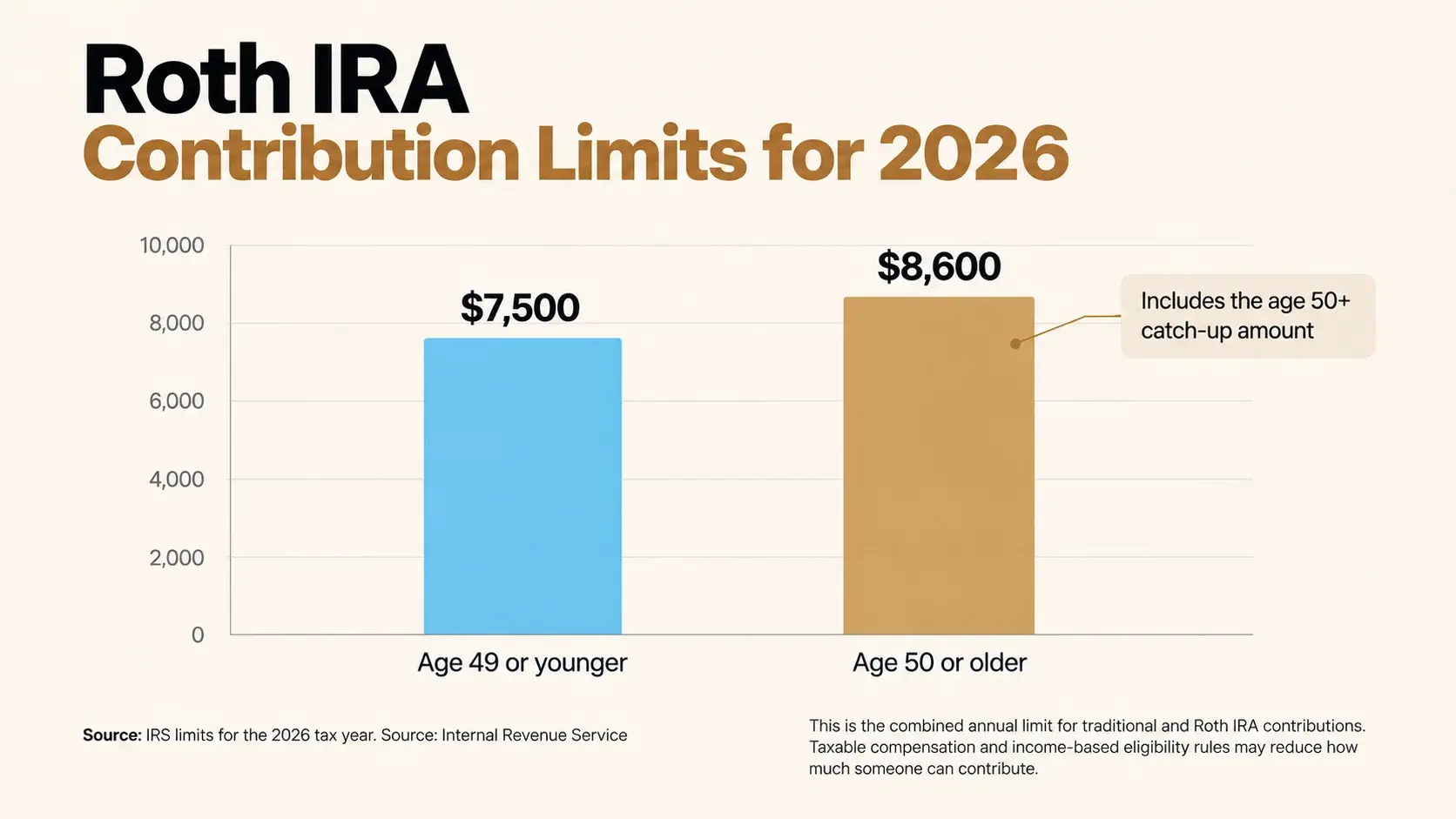
Unlike a high-yield savings account, a Roth IRA has an annual contribution limit. For 2026, the combined limit for traditional and Roth IRA contributions is:
- $7,500 for most eligible contributors
- $8,600 for eligible contributors aged 50 or older
You also need enough taxable compensation to support the contribution. Your income and filing status may reduce the amount you can add directly to a Roth IRA.
These limits can change from year to year. Check the latest IRS contribution limits before contributing. A high-yield savings account does not have a federal annual contribution limit. However, the provider may set deposit or balance rules.
How Does Account Protection Differ?
An eligible high-yield savings account may receive federal deposit protection. The FDIC generally protects eligible deposits up to $250,000 per depositor, per insured bank and per ownership category. The NCUA provides similar protection at federally insured credit unions. FDIC NCUA
This protection applies if the covered institution fails. It does not prevent losses caused by fees, fraud or rising prices.
Roth IRA protection works differently. Stocks, funds and other investments held in a Roth IRA are not protected from market losses. If an investment falls in value, federal deposit coverage does not replace the loss.
A Roth IRA may also hold eligible bank deposit products. Those funds may receive deposit protection when the normal requirements are met. You need to check what the account holds rather than assuming every Roth IRA has the same protection.
Which One Should You Choose?
Your goal and timeline should guide the decision.
Consider a high-yield savings account if:
- You are building an emergency fund.
- You may need the funds within the next few years.
- You want a more stable balance.
- You need simple withdrawals and transfers.
- You do not want your savings exposed to market changes.
Consider a Roth IRA if:
- You are saving for retirement.
- You can leave the funds invested for years.
- You qualify to contribute.
- You understand that investment values can change.
- You want qualified withdrawals to be tax-free.
A Roth IRA may provide more growth potential, but it is not a replacement for accessible emergency savings. A high-yield savings account offers easier access, but it may not provide enough growth for a retirement goal on its own.
Can You Have Both?
Yes. You can have a high-yield savings account and a Roth IRA at the same time. The accounts can support different parts of your financial plan. You might keep emergency funds and planned expenses in savings while using a Roth IRA for retirement.
Having both can also reduce the chance that you will need to withdraw from your retirement account when an unexpected bill arrives.
The right amounts depend on your income, expenses, goals and comfort with risk. You do not need to choose one account for every purpose.
Put your dollars into something real
With PureFi, your projected earnings come from shares of real homes with tenants . Choose your properties from your phone, review the documents, and see every fee before you confirm.
Learn more about how PureFi can help you own real estate shares or download the app to get started today.
Up to 6% APY is projected, variable and not guaranteed. Property shares can lose value. PureFi is not a bank, and its balances and real estate shares are not covered by FDIC insurance or another government deposit scheme.