High-Yield Savings Account for Non-US Citizens
Non-US citizens can open high-yield savings accounts, but eligibility depends on more than citizenship. Banks may ask about residency, immigration category, tax status, address, and identification.
Someone living in the United States with an ITIN and local address will usually have more options than someone applying from abroad. Some online banks accept resident aliens but exclude nonresidents. Others serve only citizens and lawful permanent residents.
Before comparing APYs, confirm that the provider supports your customer category. An attractive account is not useful if its identity system cannot verify your documents.
Can a Non-US Citizen Open a High-Yield Savings Account?
Yes. U.S. banking rules do not prevent non-citizens from opening savings accounts.
Banks must verify the identity of each customer. At a minimum, they normally collect the person’s name, date of birth, address, and an identification number.
For someone who is not a U.S. citizen, that number may be:
- A Social Security number
- An Individual Taxpayer Identification Number
- A passport number and country of issuance
- An alien identification card number
- Another accepted government identification number
The bank decides which forms it accepts. A provider may meet federal identification rules while applying narrower internal eligibility requirements.
For example, one bank may accept any qualifying resident alien with an ITIN. Another may accept an ITIN only from a lawful permanent resident. Some branch banks can review foreign documents that an online application cannot process.
Non-Citizen and Nonresident Do Not Mean the Same Thing
This distinction affects which accounts are available.
A lawful permanent resident holds a green card and may qualify for products that are also available to U.S. citizens.
Another resident alien may live in the United States under a different qualifying status and meet a bank’s residency and tax requirements without being a permanent resident.
A nonresident generally lives outside the United States or does not meet the provider’s U.S. residency definition. This group has fewer online high-yield savings options.
Immigration status and federal tax residency are also separate. A bank may request Form W-9 from one customer and Form W-8BEN from another. Do not choose a tax form based only on a visa or immigration label.
What Documents May Be Required?
The exact list depends on the bank and whether the application is completed online or at a branch.
Common requirements include:
- Valid passport or another government-issued photo ID
- Green card, visa, employment authorisation document, or other immigration document
- SSN or ITIN where required
- Physical U.S. residential address
- Proof of address, such as a lease or utility bill
- U.S. phone number and email address
- Employment or income information
- Appropriate tax certification
- Opening deposit or linked-account details
A bank may ask for two forms of identification. Some accept foreign passports and consular identification cards, including the Matricula Consular.
Online applications rely heavily on electronic verification. A newly arrived resident may have a valid passport and address but little information in U.S. public records. In that case, applying at a branch may be easier.
The CFPB’s newcomer checklist for opening a bank account provides a useful starting point.
Do You Need an SSN?
Not always. Some banks accept an ITIN instead of an SSN. The IRS issues an ITIN to people who need a U.S. taxpayer identification number for federal tax purposes but are not eligible for an SSN.
An ITIN does not provide immigration status or work authorisation. It simply gives the holder a tax identification number.
Other banks may accept a foreign passport number or alien identification number, particularly when the application is completed at a branch.
Acceptance varies by product. A bank may accept foreign identification for checking but require an SSN or ITIN for its online savings account.
Our guide to opening a high-yield savings account with an ITIN covers those requirements in more detail.
How Can a Non-US Citizen Open a HYSA?
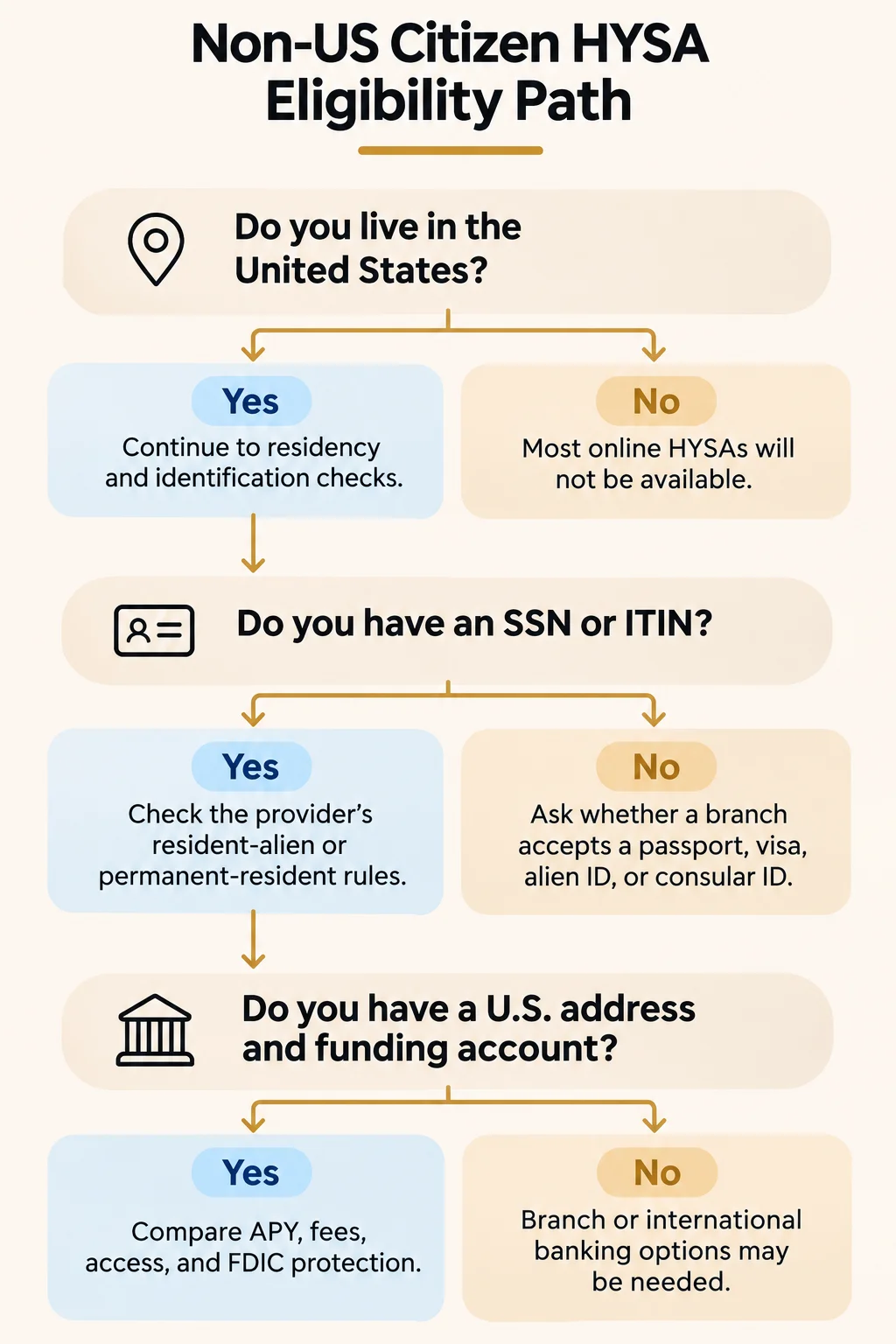
Confirm the provider’s residency rules
Look for terms such as “resident alien,” “lawful permanent resident,” “U.S. person,” and “U.S. physical address.”
Do not rely only on a field that accepts an ITIN. The wider account agreement may still exclude your status.
Check how the bank verifies identity
Find out whether the application accepts a foreign passport, green card, visa, or consular ID. Ask whether a branch visit is possible if online verification fails.
Prepare matching information
The legal name, date of birth, taxpayer identification number, and address should match the documents being submitted.
A difference in spelling or address format can delay the review.
Review the funding rules
Online savings accounts often require an ACH transfer from another U.S. bank. Recently arrived customers may need to open a branch-based checking account first.
Some providers also accept wires, mobile check deposits, or mailed checks.
Complete the tax certification
Provide the tax form requested by the institution. Incorrect or missing certification may cause backup withholding or account restrictions.
Fund and monitor the account
Meet the opening-deposit requirement and confirm when the money becomes available for withdrawal.
Our guide to opening a high-yield savings account explains the standard application process.
High-Yield Savings Options for Non-US Citizens
The following examples were checked in November 2026. APYs are variable, and accepting an ITIN does not guarantee approval.
1. American Express High Yield Savings
American Express National Bank offers an online HYSA with no monthly maintenance fee or minimum opening deposit.
Eligibility: The account agreement allows adults who are U.S. citizens or resident aliens. Applicants need a valid SSN or another TIN, such as an ITIN, and a physical home address in the United States or another listed U.S. jurisdiction.
APY: The account offered 3.20% variable APY when checked.
Fees and minimums: There is no minimum opening deposit, minimum balance requirement, or monthly fee.
Access: Customers can use electronic transfers, mobile check deposits, eligible American Express accounts, or mailed checks. Customer support is available around the clock.
What to watch: The account does not provide checks, an ATM card, or a debit card. Money generally needs to be transferred before spending.
2. CIT Bank Platinum Savings
CIT Bank Platinum Savings is a tiered online savings account. CIT Bank is a division of First Citizens Bank.
Eligibility: The online application accepts an SSN or ITIN. Applicants must also provide a home address, phone number, email, and the other information needed for verification.
Because CIT’s public application does not settle every immigration or residency scenario, non-citizens should confirm their eligibility before moving money.
APY: The standard APY was 3.75% on balances of at least $5,000 and 0.25% below $5,000.
Fees and minimums: The account requires a $100 opening deposit and has no monthly maintenance fee.
Access: Funding options include ACH transfer, wire, mobile check, and mailed check. The account is managed through CIT’s website or app.
What to watch: The entire balance receives the lower tier when it falls below $5,000.
3. Capital One 360 Performance Savings
Capital One 360 Performance Savings is a no-fee online account with no minimum balance.
Eligibility: Capital One accepts an SSN or ITIN, but the account is limited to U.S. citizens and lawful permanent residents.
Applicants must also be at least 18 and have a qualifying U.S. physical address, U.S.-based mobile phone number, and linked account at a U.S.-chartered bank.
APY: The account offered 3.20% variable APY across all balances when checked.
Fees and minimums: There is no monthly maintenance fee or minimum balance. Approved applicants have 60 days to fund the account.
Access: Customers can use the website, app, branches, and Capital One Cafés.
What to watch: A temporary visa holder or another non-citizen who is not a lawful permanent resident will not meet the stated eligibility rule.
What If You Do Not Have an SSN or ITIN?

A branch-based bank may offer more flexibility than a digital savings platform.
PNC, for example, states that certain non-U.S. persons without an SSN or ITIN can apply for its Simple Checking account at a branch using a passport and a second form of identification. The customer may also complete Form W-8BEN.
That is a checking account rather than a high-yield savings account, but it can create a U.S. banking relationship. Once the customer obtains an ITIN and meets another provider’s eligibility rules, they may have more savings options.
Call the branch before visiting. Document requirements can vary by customer and product.
Can You Open a US HYSA While Living Abroad?
Usually, this is much harder. Most online HYSAs require a U.S. physical address, U.S. phone number, taxpayer identification number, and U.S. bank account for funding. Some also require the customer to reside in the country.
Using a friend’s address when you do not live there can violate the account agreement and create tax or compliance problems.
An international bank may offer a U.S. dollar savings product outside the United States. That does not automatically make it a U.S. account or provide FDIC insurance. Coverage generally depends on where the deposit is legally held.
Does FDIC Insurance Cover Non-US Citizens?
Yes. FDIC deposit protection is not limited to U.S. citizens or residents.
Eligible deposits at an FDIC-insured bank are generally protected up to $250,000 per depositor, per insured bank, for each ownership category.
The important issue is the institution and deposit location, not the customer’s passport. A deposit held at an overseas branch may follow different rules.
Verify the bank through the FDIC BankFind Suite. Our guide to whether high-yield savings accounts are safe explains the coverage in more detail.
How Are the Earnings Taxed?
Tax treatment depends on the account holder’s federal tax residency and other circumstances.
The bank may request Form W-9 or Form W-8BEN and may issue Form 1099-INT or Form 1042-S. Withholding can apply when the required certification is missing or incorrect.
Immigration status does not always determine tax residency. Someone unsure about the correct form or reporting obligation should speak with a qualified U.S. tax professional.
How Should You Compare Accounts?
Start with eligibility. Then compare the APY, monthly fees, minimum balance, identification process, funding methods, transfer times, and federal protection.
Customer support matters more when foreign documents require manual review. A slightly lower APY may be reasonable if the institution can verify your application and provide branch or telephone help.
Our comparison of savings rates and guide to the advantages of online-only savings accounts can help with the final comparison.
Can Non-US Citizens Open a HYSA?
Yes, but the answer depends on where the person lives and how the bank defines an eligible customer.
Resident aliens and lawful permanent residents generally have more options. Nonresidents applying from abroad face tighter address, tax-identification, and funding requirements.
Confirm eligibility before comparing APYs. A provider that accepts your documents and offers insured access to your money may be a better choice than one advertising a higher yield you cannot qualify for.
Put Your Dollars Into Something Real
With PureFi, your projected earnings come from shares of real homes with tenants. Choose your properties from your phone, review the documents, and see every fee before you confirm.
Learn more about how PureFi can help you own real estate shares or download the app to get started today.
Up to 6% APY is projected, variable, and not guaranteed. Property shares can lose value. PureFi is not a bank, and its balances and real estate shares are not covered by FDIC insurance or another government deposit scheme.