
High-Yield Savings Account for LLC

An LLC can open a high-yield savings account when the bank or credit union accepts its business structure. The account is opened in the company’s legal name, not the owner’s personal name. It can hold tax reserves, payroll funds, emergency cash, or money set aside for equipment and expansion.
Business savings accounts are less widely available than personal accounts. Before applying, an LLC should check eligibility, document requirements, balance rules, transfer options, fees, and deposit protection.
Can an LLC Open a High-Yield Savings Account?
Yes. Banks and credit unions can offer business savings accounts to single-member and multi-member LLCs. However, a provider that offers personal savings may not support business customers. Others accept only certain entity types, industries, states, or ownership structures.
The LLC should apply for an account intended for businesses. Putting company funds in a personal high-yield account can create bookkeeping problems and may violate the provider’s account agreement. It also makes it harder to show which money belongs to the company.
A multi-member LLC may need to identify several members and show who has authority to manage the account.
Our broader guide explains how business high-yield savings accounts work across LLCs, corporations, partnerships, and sole proprietorships.
Why Keep LLC Savings Separate?
An LLC usually needs an operating account for everyday payments and a separate place for reserves. Checking can cover payroll, suppliers, subscriptions, and card spending. Savings can hold money that is not needed immediately.
This gives the business a clearer view of what is available for current bills and what is assigned to taxes, repairs, slower months, or future purchases. It also produces cleaner records for bookkeeping and tax preparation.
A separate account does not create liability protection by itself. The company must still follow its operating agreement and applicable legal, accounting, and tax requirements.
What Documents Does an LLC Need?
Every provider sets its own requirements. In most cases, the bank needs to confirm that the LLC exists, identify the people who own or control it, and verify that the applicant is allowed to act for the company.
Company documents
An LLC may be asked for:
- Articles or certificate of organization
- Employer Identification Number confirmation
- Operating agreement
- Certificate of good standing
- DBA or fictitious-name registration, when applicable
- Business licence, when required for the company’s activity
- Resolution or written authorization naming the account signer
Information about owners and signers
The application may ask for the following information about relevant members and authorized signers:
- Legal name
- Date of birth
- Residential address
- Government-issued identification
- Taxpayer identification number
- Ownership percentage
- Role within the company
The bank may also need details for one person with significant responsibility for managing the LLC.
FinCEN’s customer due-diligence guidance explains why covered financial institutions collect beneficial-owner and control-person information.
Rules introduced in 2026 may let a bank avoid repeating the complete ownership check whenever an existing verified business opens another account. A new customer should still expect identity and company checks. A digital savings platform may complete most of this process online. More complex LLCs can be sent for manual review.
How to Open a High-Yield Savings Account for an LLC
Check the provider’s eligibility rules
Start by confirming that the provider supports the LLC’s state, industry, number of members, and tax status.
The phrase “business savings account” does not mean that every business can apply. Some providers may exclude particular industries, foreign-owned companies, or LLCs with complex ownership structures.
Review the account terms
Check the live APY and balance requirements. Some accounts apply one APY to the entire eligible balance. Others use tiers or reserve their best APY for a specific balance range.
Look at the standard APY as well as any promotional offer. A temporary promotion should not be treated as the account’s permanent yield.
Prepare the documents
Gather the LLC documents and identification for its owners and signers. Enter the company’s legal name exactly as it appears in its formation records.
Even a small difference in the legal name, business address, or taxpayer identification number can delay verification.
Fund the account
Once approved, connect an account owned by the LLC and make the opening deposit.
Some banks will not accept funding from an unrelated personal account. A provider may also place a temporary hold on a new deposit before making the full balance available.
Our guide to setting up a high-yield savings account covers the general comparison, application, and funding process.
How Do LLC Savings Earnings Work?
A business HYSA earns according to its APY and eligible balance. APY reflects the effects of compounding over one year, making it useful when comparing different accounts.
Suppose an LLC keeps $50,000 in an account with a 3.00% APY for a full year. If the balance and APY remain unchanged, the account would earn approximately $1,500.
Starting balance: $50,000 Example APY: 3.00% Approximate one-year earnings: $1,500 Approximate ending balance: $51,500
Actual earnings may differ because business savings APYs are usually variable. Deposits, withdrawals, fees, balance tiers, and transaction timing can also affect the result.
For more examples, see how much a high-yield savings account can earn.
How Are LLC Savings Earnings Taxed?
An LLC is a legal structure created under state law. Its federal tax classification can be different. The IRS explains that a domestic single-member LLC is generally treated as a disregarded entity unless it elects corporate treatment.
A domestic LLC with two or more members is generally treated as a partnership unless it elects to be taxed as a corporation. This classification affects how the account’s earnings are reported. A bank may issue Form 1099-INT using the taxpayer information appropriate to the LLC’s classification. Earnings may still need to be reported when no form is issued.
The name and taxpayer identification number supplied to the bank should match the information used for federal reporting. A single-member LLC may need to use its owner’s information for some federal tax purposes even when the LLC has its own EIN. Owners should confirm the correct setup with a qualified tax professional.
Is an LLC High-Yield Savings Account FDIC Insured?
An LLC account can qualify for FDIC coverage when it is held at an FDIC-insured bank and meets the coverage requirements. The FDIC includes LLCs in its corporation, partnership, and unincorporated-association ownership category.
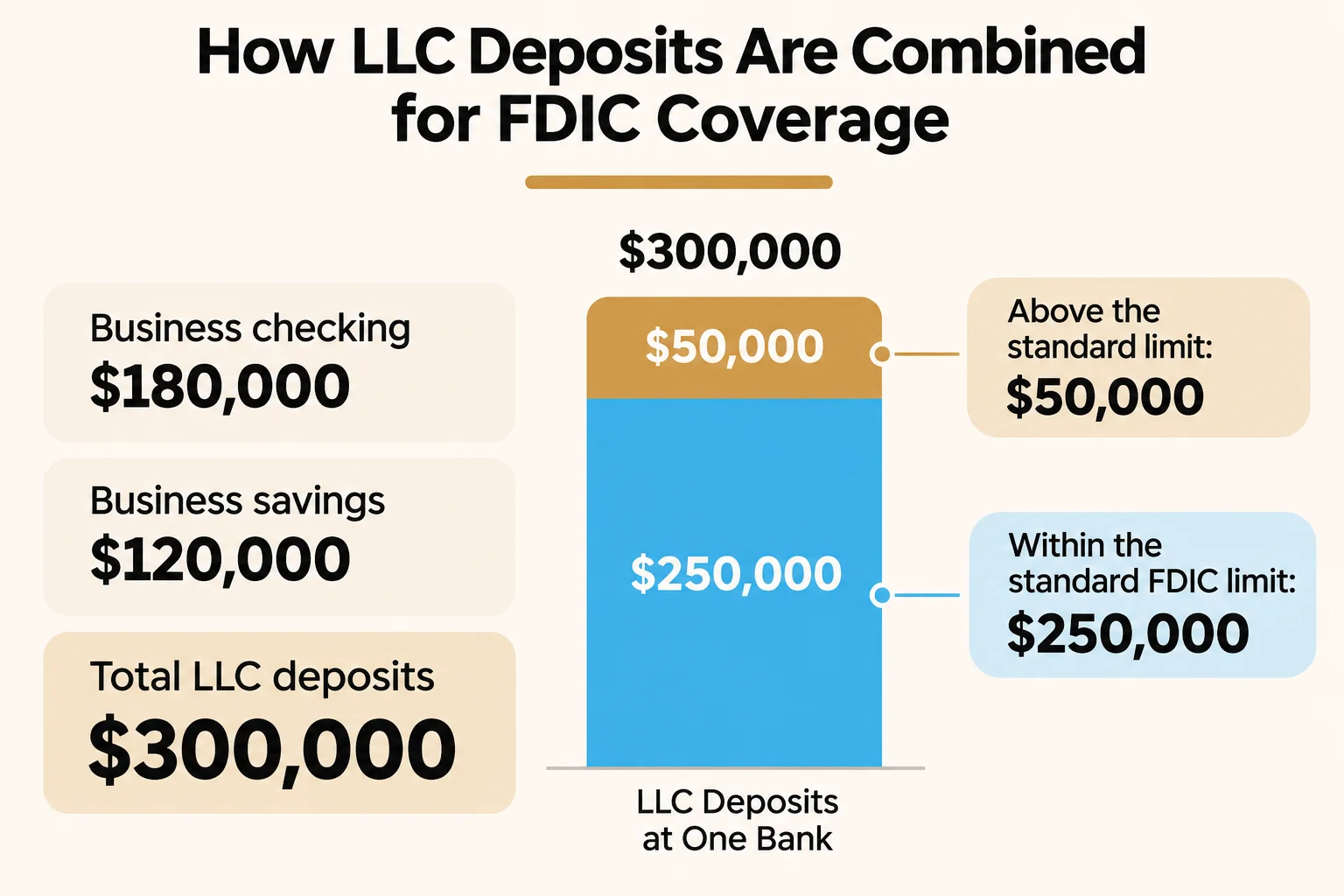
A validly formed LLC engaged in independent business activity generally receives coverage separate from the personal deposits of its members. However, all deposits owned by the same LLC at the same insured bank are added together within that ownership category. The standard limit is $250,000 in total. It is not $250,000 for every member, manager, signer, or account.
Example of combined LLC deposits
Suppose an LLC keeps:
- $180,000 in business checking
- $120,000 in business savings
- $300,000 in total deposits at the bank
Under the standard limit, $250,000 would fall within FDIC coverage. The remaining $50,000 would be above that limit.
Opening several accounts for different purposes does not create separate coverage. The company should confirm the legal owner of each account and check whether two banking brands are part of the same FDIC-insured institution.

The FDIC’s business-account guidance provides the complete rules.
Why Might an LLC Application Be Delayed?
Applications are often delayed because the submitted information does not match official records.
The legal name may be entered differently from the state record. An old address may appear on one document. The applicant may also supply a taxpayer identification number that does not match the name used on the application.
The bank may need proof that the applicant has authority to act for the LLC. This can happen when the operating agreement names another manager or requires approval from more than one member.
Other delays can arise when:
- An owner does not provide identification
- The LLC is not in good standing
- The funding account belongs to someone else
- The provider does not support the company’s industry
- The business has a complex or foreign ownership structure
Reviewing the company’s formation records before applying can prevent many of these problems.
The Bottom Line
An LLC can open a high-yield savings account when it meets the provider’s business requirements. The account should be opened in the company’s legal name and funded with company money.
Owners should prepare the formation, tax, ownership, and signer documents before applying. The best choice is not necessarily the account with the largest APY. Fees, balance tiers, transfer speed, account permissions, customer support, and deposit protection can matter just as much.
The account should earn on company reserves while keeping them available when the business needs them.
Put your dollars into something real
With PureFi, your projected earnings come from shares of real homes with tenants. Choose your properties from your phone, review the documents, and see every fee before you confirm.
Learn more about how PureFi can help you own real estate shares or download the app to get started today.
Up to 6% APY is projected, variable, and not guaranteed. Property shares can lose value. PureFi is not a bank, and its balances and real estate shares are not covered by FDIC insurance or another government deposit scheme.


