
High-Yield Savings Account for Kids
A high-yield savings account for kids gives a child’s money a place to earn while an adult helps manage it. Families can use the account for allowances, birthday money, regular deposits, or future expenses.
Most children cannot open an account alone. A parent, guardian, or another eligible adult normally joins as a co-owner or custodian.
The largest advertised APY is not always the best deal. Youth accounts often limit their highest yield to a small balance. Parents should also check ownership, fees, access, deposit protection, and what happens when the child becomes an adult.
How Does a Kids High-Yield Savings Account Work?
A children’s savings account works like another deposit account. Money is added to the balance, the provider applies its stated APY, and earnings are credited according to its schedule.
The main difference is ownership. The child may be a joint owner, the beneficial owner of a custodial account, or simply the person for whom a parent is saving.
The adult can usually transfer money, monitor activity, and set up recurring deposits. The child’s access depends on their age and the provider’s rules. A young child may only be able to view the balance. A teenager may receive wider digital or ATM access.
Youth APYs are normally variable. A bank or credit union can change them after the account opens.
Some accounts apply one APY to the full balance. Others offer a strong rate only on the first $500 or $1,000. Our guide to how much a high-yield savings account earns explains how balance and APY affect growth.
How Can a Savings Account for Kids Be Structured?
The account title determines who owns the money and who can withdraw it.
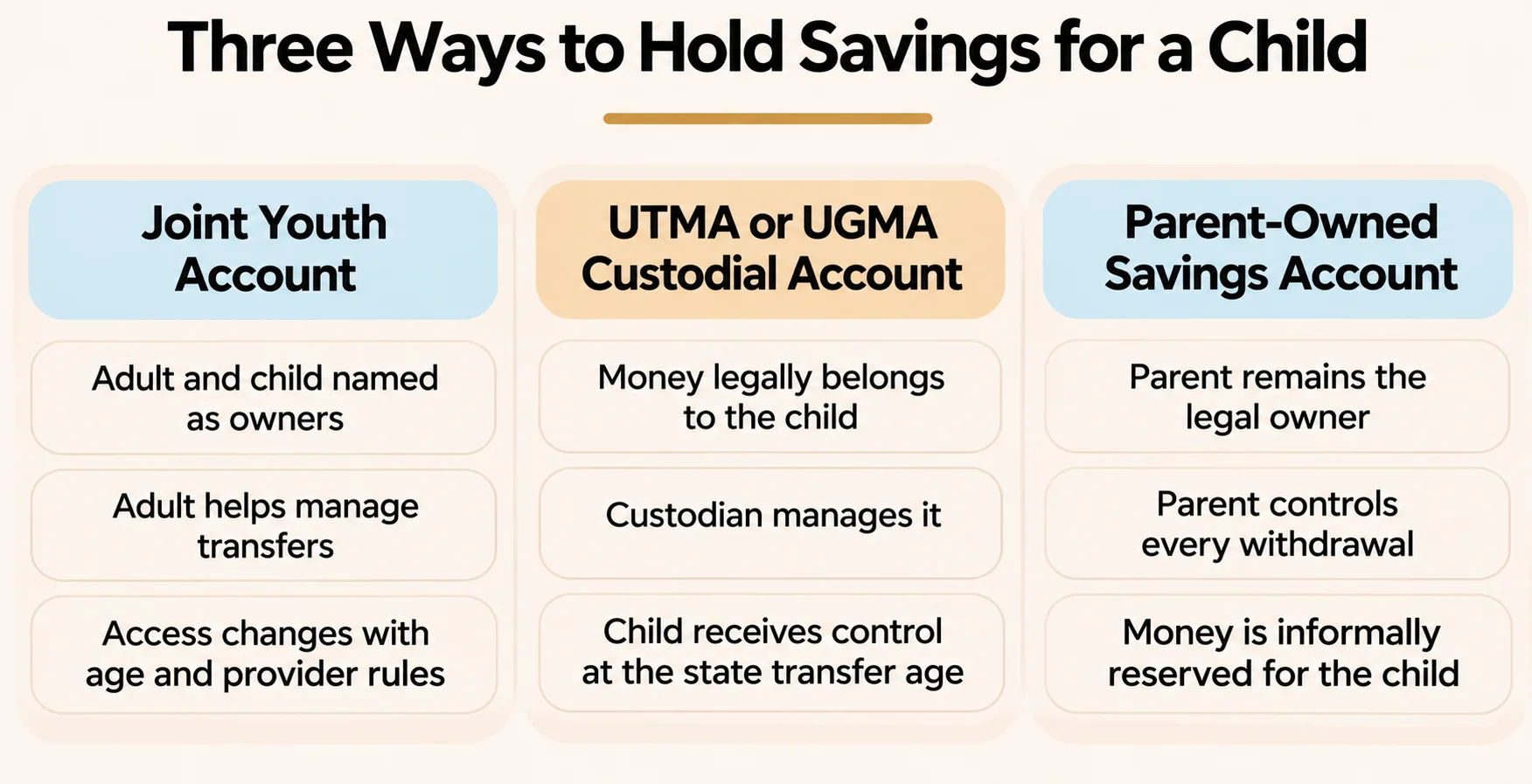
Joint youth savings account
A joint youth account lists the child and adult as owners. The adult usually controls transfers and account settings while the child is young.
Both owners may have legal rights to the balance, depending on the agreement. When the child turns 18, the account may stay jointly owned, convert automatically, or require a new adult account.
UTMA or UGMA custodial account
A Uniform Transfers to Minors Act or Uniform Gifts to Minors Act account belongs legally to the child. The custodian manages it until the child reaches the transfer age set by state law.
Money placed into the account is generally an irrevocable gift. The custodian must manage it for the child’s benefit. Once the child reaches the required age, control passes to them.
This structure can have legal, tax, and financial-aid consequences. Parents should check their state’s rules or seek professional advice.
Parent-owned savings account
A parent can also open a high-yield digital savings account in their own name and reserve the balance for the child.
This is simple, but it is not legally the child’s account. The parent owns the money, controls every withdrawal, and receives the related tax reporting.
What Are the Benefits?
A competitive APY
A stronger APY can help money from gifts and regular deposits earn more than it would in a low-yield account.
The deposits will usually have a bigger effect than a small APY difference, especially when the starting balance is low. For example, adding $25 each month contributes $300 a year before account earnings.
Practical financial education
A child can see deposits arrive, watch earnings appear, and track progress toward a goal. This makes concepts such as saving, spending, and compounding easier to explain.
A high yield savings app may let the child view the account while the adult keeps control of transfers.
Automatic contributions
Parents can schedule weekly or monthly transfers. Some providers also make it easy for grandparents and relatives to add money.
Read Can You Add to a Traditional Savings Account Regularly? for more on recurring deposits.
Federal deposit protection
Eligible bank deposits receive FDIC protection. Federally insured credit unions provide similar coverage through the NCUA.
The standard limit is generally $250,000 per depositor, per insured institution, for each ownership category. Custodial arrangements may receive pass-through coverage when account records correctly identify the child as the owner.
Our guide to whether high-yield savings accounts are safe explains what deposit insurance covers.
Who Is Eligible?
Age rules vary. Some accounts are designed for children aged 12 or younger. Others cover anyone under 18, while a few remain available into early adulthood.
The adult may need to be a parent or legal guardian. Some providers also allow a grandparent or another eligible family member.
Credit-union accounts come with membership rules. Eligibility could depend on location, employment, family membership, or joining an approved organisation.
The application will normally ask for information about both owners. Common requirements include:
- The child’s legal name and date of birth
- The child’s Social Security number or accepted taxpayer identification number
- A birth certificate, passport, or another accepted child ID
- The adult’s government-issued photo ID
- The adult’s taxpayer identification number
- Residential address and contact information
- Proof of guardianship where required
- Opening deposit or linked-account details
Not every bank accepts an ITIN for the adult or child. Check before beginning the application.
How Can a Parent Open the Account?
Start by deciding who should legally own the money. A joint account, custodial account, and parent-owned account do not provide the same rights.
Next, compare the APY on the balance you expect to hold. If an account pays 5% on the first $500 and almost nothing above that, it may become less competitive as the balance grows.
Check the monthly fee, opening deposit, balance requirements, membership rules, and adult-access controls. Also find out what happens when the child reaches the maximum age.
Once the account is selected, gather the documents for both owners and complete the application. Some providers allow the entire process online. Others require a branch visit or appointment.
After approval, make the opening deposit and consider adding a recurring transfer. Our guide to opening a high-yield savings account covers the standard process.
Current High-Yield Savings Accounts for Kids

These examples were checked on November 6, 2026. APYs are variable, and application or membership approval may be required.
1. Capital One Kids Savings Account
Capital One Kids Savings is a joint account for one child under 18 and one adult.
APY: The account offered 2.50% APY across all balances when checked.
Fees and minimums: There is no monthly maintenance fee or minimum balance.
Eligibility: If the child is 12 or younger, the adult must be their parent or legal guardian. Capital One asks for the child’s Social Security number and information for the adult owner.
Access: The adult can transfer money, create an automatic savings plan, and manage account details. The child receives separate digital access to view the balance. Transfer permissions vary by age.
What to watch: The account remains jointly owned after the child turns 18. The child must open a different account if they want sole ownership.
See the official Capital One Kids Savings page for current terms.
2. Alliant Kids Savings Account
Alliant offers Kids Savings for children aged 12 or younger. A parent, grandparent, or guardian joins as a joint owner.
APY: The account offered 3.01% APY with an average daily balance of at least $100.
Fees and minimums: Alliant provides the required $5 opening deposit. There is no monthly maintenance fee.
Eligibility: The adult joint owner must become an Alliant member. Children aged 13 to 17 can instead open Alliant’s regular High-Rate Savings with an adult joint owner.
Access: Parents can transfer allowances and gifts, monitor activity, and create supplemental savings accounts for separate goals.
What to watch: The balance must average at least $100 during the month to receive earnings.
See the official Alliant Kids Savings page.
3. BECU Early Saver
BECU Early Saver is a joint account for children and teenagers under 18. A parent or legal guardian must be the adult co-owner.
APY: BECU offered 5.12% APY on the first $500 and 0.20% on the portion above $500.
Fees and minimums: There is no monthly maintenance fee or ongoing minimum balance. Opening online may require a $10 deposit.
Eligibility: BECU membership is required. The adult needs photo identification. The child may need an SSN, birth certificate, or photo ID.
Access: Parents manage digital access for younger children. Teenagers receive wider online and mobile functions. The account converts to an eligible adult savings product at 18.
What to watch: The strongest APY only applies to $500. A larger balance will have a lower blended APY.
See the official BECU Early Saver page.
4. First Tech Start Up Savings
First Tech Start Up Savings is a youth account opened with a parent or guardian as joint owner.
APY: Balances from $0.01 to $999.99 offered 4.00% APY. Balances of $1,000 or more received 0.05% APY when checked.
Fees and minimums: The opening deposit is $25. There is no monthly maintenance fee. First Tech membership also requires a $5 member share.
Eligibility: A parent or guardian must be present and become a joint owner. A First Tech representative must open the account.
Access: The account focuses on saving rather than unrestricted independent spending.
What to watch: Reaching $1,000 moves the account into a much lower APY tier. Parents should review the current rate table before adding a larger deposit.
See the official First Tech Start Up Savings page.
Is a High-Yield Savings Account Good for Kids?
A high-yield savings account can give a child a protected place to receive gifts, build a balance, and learn how regular deposits work.
Choose the ownership structure before comparing APYs. Then check the rate tiers, fees, adult controls, eligibility, digital access, and transition rules.
The best account is the one that continues to work as the child’s balance and level of independence grow.
Put your dollars into something real
With PureFi, your projected earnings come from shares of real homes with tenants. Choose your properties from your phone, review the documents, and see every fee before you confirm.
Learn more about how PureFi can help you own real estate shares or download the app to get started today.
Up to 6% APY is projected, variable, and not guaranteed. Property shares can lose value. PureFi is not a bank, and its balances and real estate shares are not covered by FDIC insurance or another government deposit scheme.


