
How to Earn Passive Income Online With a High-Yield Savings Account

A high-yield savings account can generate low-maintenance earnings after you open and fund it. The provider calculates your earnings using the account balance and current APY, although that APY can change. You can usually transfer or withdraw your funds when needed, and eligible bank deposits may receive government-backed protection.
The amount earned depends on your balance, APY, time, deposits, withdrawals, and fees. A digital savings platform can make the process easier, but you still need to understand where the yield comes from and what protection applies.
Can a High-Yield Savings Account Generate Passive Income?
A high-yield savings account can generate passive income in the everyday sense of the term. Once the account is funded, it can continue earning without daily trading, asset management, or active work.
The account provider calculates the earnings and adds them to your balance according to its schedule. If you leave those earnings in the account, future calculations can use the larger balance.
However, a high-yield account is better described as low maintenance than completely hands-off. Its APY may rise or fall. Fees, balance requirements, and transfer rules can also change. You should review the account occasionally to confirm that it is still competitive and suitable for your needs.
“Passive income” is not being used here as a formal tax classification. In the United States, bank savings earnings are generally taxable when they are credited and available to you. Rules differ by country and account type, so check the requirements that apply to you.
For more information about the account structure, see what a high-yield savings account is.

How Passive Earnings From a High-Yield Account Work
Three main elements determine how much a savings account can earn: the balance, the APY, and time.
Your balance generates earnings
The provider applies its current rate to the eligible balance in your account. When two accounts have the same APY and conditions, the one with the larger balance will normally generate more earnings.
For example, a $10,000 balance produces more annual earnings than a $1,000 balance at the same APY. Adding money regularly can therefore increase both the balance and the amount generated by future calculations.
APY includes compounding
APY stands for annual percentage yield. It shows how much an account could earn over one year if the balance and rate remained unchanged.
APY includes the effect of compounding. This makes it more useful for comparing accounts that calculate or add earnings at different times. One provider may calculate earnings daily, while another may add them monthly. APY gives you a more consistent figure for comparison.
Credited earnings can generate more earnings
When credited earnings remain in the account, the next calculation may use a slightly larger balance. This is compounding.
The effect may look small at first, especially with a low balance. It becomes more noticeable as the balance grows and the money remains in the account for longer. Regular deposits can make an even larger difference because they increase the amount generating future earnings.
How Much Passive Income Can You Earn?
The amount depends on the account’s APY and the balance you maintain. The following table uses an illustrative 4.00% APY.
| Starting balance | Estimated earnings over one year |
|---|---|
| $1,000 | $40 |
| $5,000 | $200 |
| $10,000 | $400 |
| $25,000 | $1,000 |
| $50,000 | $2,000 |
These estimates assume the balance and APY remain unchanged for one year. They do not include withdrawals, fees, taxes, or additional deposits.
A variable APY may change before the year ends. Some providers also apply different APYs to different balance tiers. Always confirm whether the advertised APY applies to your full balance and whether you need to meet any requirements to receive it.
You can see more examples in our guide to how much a high-yield savings account can earn.
How to Start Earning With a High-Yield Savings Account
You do not need to manage a complex investment portfolio to begin. The process normally involves choosing an account, completing identity checks, and transferring funds.
1. Compare the complete account terms
Start with the APY, but do not stop there. Check whether the APY is variable, promotional, or limited to a particular balance range.
You should also review:
- Monthly account fees
- Minimum opening deposit
- Minimum balance requirements
- Transfer limits and processing times
- Withdrawal methods
- Deposit protection
- Eligibility requirements
A slightly lower APY with no monthly fee may produce better net earnings than a higher APY attached to recurring charges.
2. Open and verify the account
Most online accounts require basic personal information and an identity check. The documents needed depend on the provider and the country in which you live.
Confirm that the website or app is legitimate before uploading documents or transferring money. For a bank account, verify the institution’s deposit insurance status rather than relying only on marketing language.
Our guide on how to open a high-yield savings account explains the process in more detail.
3. Transfer your opening balance
Once the account is approved, connect an eligible funding source and transfer the amount you want to save. Check when the balance becomes eligible to earn and whether the provider holds incoming transfers for a set period.
There may be no minimum required to open the account, but some providers require a certain balance to receive their highest APY.
4. Automate regular deposits
An online savings app may allow you to schedule weekly, biweekly, or monthly transfers. Automation can build the balance without requiring you to remember each deposit.
Choose an amount that fits your cash flow. A smaller deposit that continues every month is usually more useful than an aggressive schedule that you regularly cancel.
5. Leave credited earnings in the account
Keeping credited earnings in the account allows compounding to continue. Withdrawals reduce the balance used for future calculations, so separate daily spending money from funds intended to generate earnings.
What Affects the Amount You Earn?
The advertised APY is important, but it is only one part of the calculation.
Your average balance
Providers normally calculate earnings using the balance held during a particular period. If you frequently withdraw money, your average balance may be lower than the figure shown immediately after a deposit.
Regular contributions increase the balance available for future calculations. This is why the contribution schedule often matters more than a small difference between two APYs.
Changes to the APY
Most high-yield savings accounts use a variable APY. The provider may raise or lower it in response to market conditions, competition, and funding needs.
A high APY today does not guarantee the same yield next year. Before projecting several years of earnings, account for the possibility that the rate will change.
Read why high-yield savings account rates change for a closer explanation.
Fees and balance requirements
Monthly fees reduce net earnings. Their effect can be significant when the balance is small.
Suppose an account generates $80 during the year but charges $5 each month. The annual fees would total $60, leaving only $20 before taxes. A no-monthly-fee account would allow more of the generated amount to remain in the balance.
Some providers also reduce the APY when the balance falls below a specified amount. Others reserve their best APY for a limited balance range.
Our guide to high-yield savings accounts with no monthly fees explains which conditions to check.
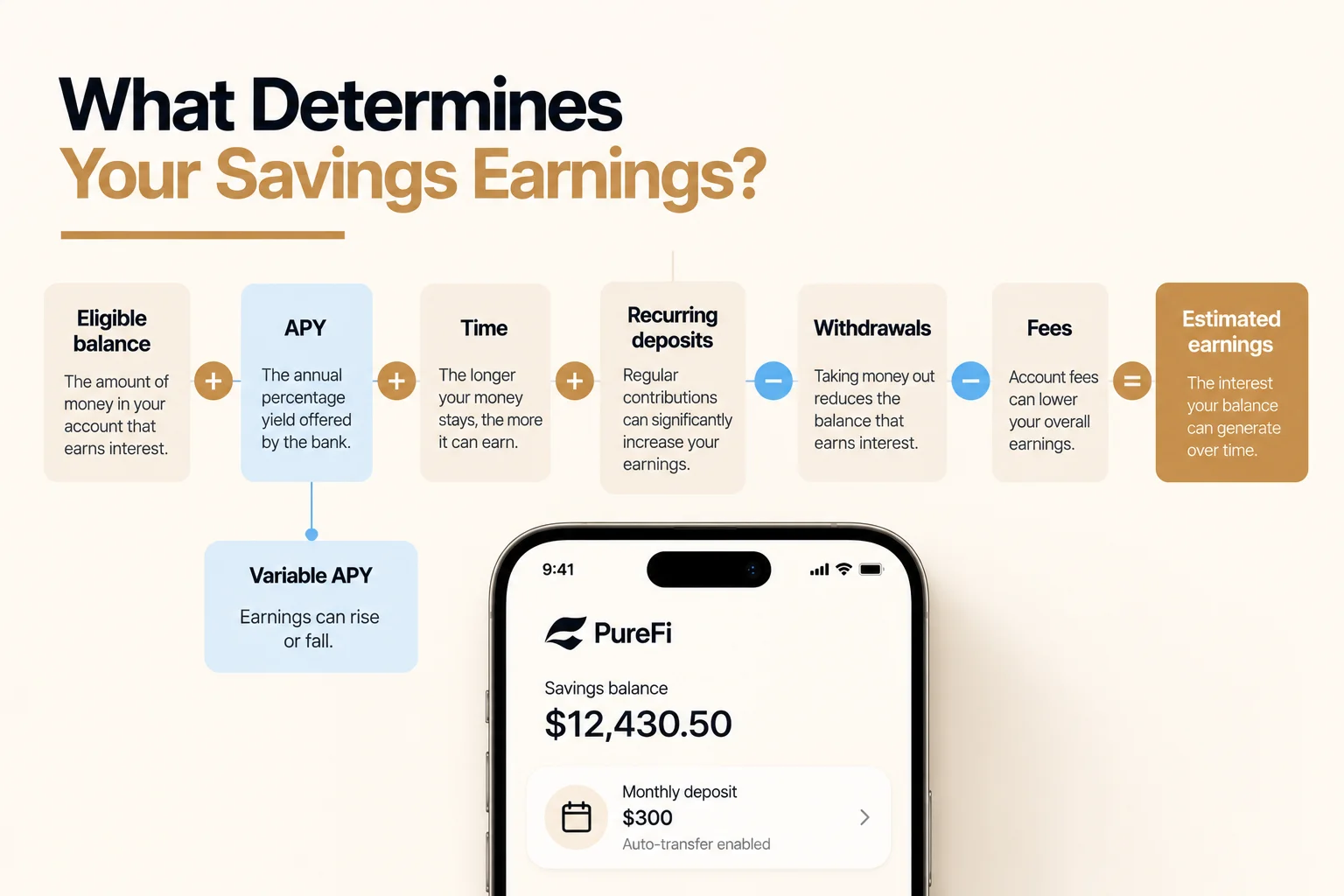
Deposits and withdrawals
Every additional deposit increases the amount available to generate future earnings. Every withdrawal reduces it.
This does not mean you should avoid using your savings when you need them. Access is one of the main reasons people choose a savings account. It simply means that frequent withdrawals will affect the amount earned.
Taxes
Taxes can reduce the amount you keep. The rules depend on your country, residency, and account type.
Keep account statements and tax documents provided by the institution. If you are unsure how the earnings should be reported, speak with a qualified tax professional in your jurisdiction.
Is a High-Yield Savings Account Truly Passive?
A high-yield account does not require daily management, but it should not be forgotten after it is opened.
Review the APY and terms periodically. Check whether a promotional period has ended, a fee has been introduced, or a minimum balance rule has changed. Also keep your contact information, beneficiary details, and linked accounts updated.
A high-yield savings app can reduce manual work by automating deposits and displaying your balance and credited earnings. The account can remain low maintenance as long as you continue checking that it meets your needs.
Protection and Access Still Matter
A competitive APY is not useful if you cannot access the funds when needed or do not understand how the balance is protected.
Eligible deposits at an FDIC-insured US bank are generally protected up to $250,000 per depositor, per insured bank, for each account ownership category. Credit unions may provide similar protection through the NCUA.
Deposit insurance protects eligible funds if the insured institution fails. It does not guarantee the APY, prevent inflation, cover every type of financial app, or reimburse losses on investments.
Before transferring money, confirm the provider’s legal structure, custody arrangement, transfer process, and protection. A high-yield digital savings account and a high-yield investment platform may display similar projected figures while carrying very different risks.
For more detail, read are high-yield savings accounts safe.
How PureFi Generates Projected Earnings
With PureFi, your projected earnings come from shares of real homes with tenants. Choose your properties from your phone, review the documents, and see every fee before you confirm.
Learn more about how PureFi can help you own real estate shares or download the app to get started today.
Up to 6% APY is projected, variable, and not guaranteed. Property shares can lose value. PureFi is not a bank, and its balances and real estate shares are not covered by FDIC insurance or another government deposit scheme.


