Do High-Yield Savings Accounts Have Debit Cards for Spending?
Most high-yield savings accounts don’t include a traditional debit card. These accounts are built to hold money and generate yield, not handle everyday purchases. Some providers offer an ATM card, but it may only support cash withdrawals and balance checks. Others require you to transfer money to a linked checking account before you can spend it.
The right setup depends on how quickly you need access, which fees apply, and whether you want your savings separated from your regular spending.
Why Most High-Yield Savings Accounts Do Not Have Debit Cards
Checking accounts are designed for frequent transactions. You can usually connect a debit card, pay bills, withdraw cash, and make purchases without moving money into another account.
A high-yield savings account serves a different purpose. It gives you a place to hold money that you do not plan to spend every day. This could include an emergency fund, a home deposit, or money reserved for a future expense.
Because of this difference, many providers do not issue debit cards with their savings products. Instead, they let you withdraw money through electronic transfers. This extra step can also create some separation between savings and everyday purchases.
The lack of a card does not mean your money is locked. It only means you may need to move it before spending it.
A high-yield digital savings account may let you initiate transfers through a website or mobile app. Some transfers arrive on the same day, while others take several business days. The timing depends on the provider, the receiving institution, and the transfer method.
Customers who need a card for daily purchases may prefer to keep a checking account alongside their savings account. Our guide to checking and savings accounts explains why the two account types are often used together.
Debit Card Versus ATM Card: What Is the Difference?
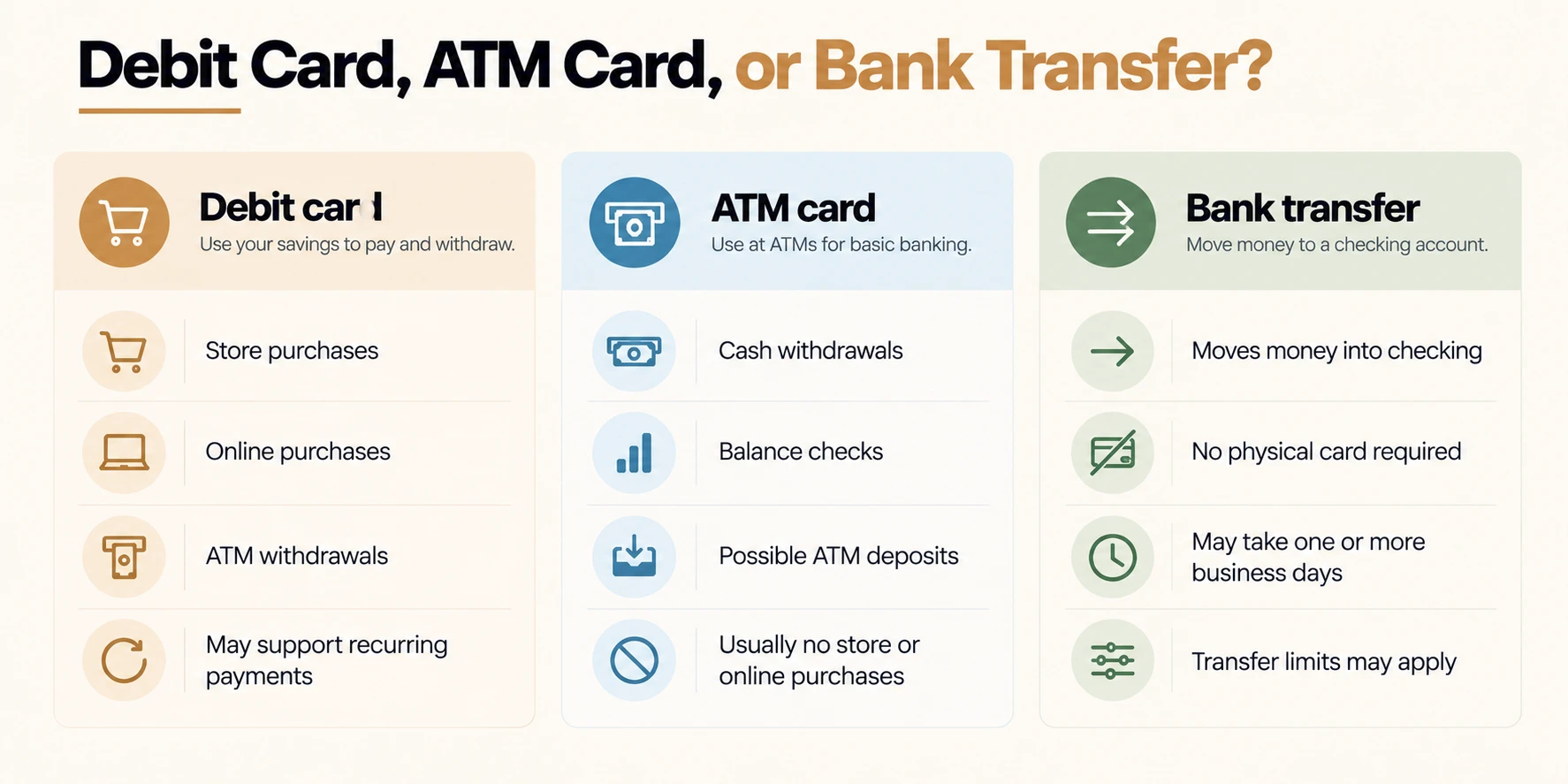
Banks sometimes use “debit card” and “ATM card” as though they mean the same thing. The two cards may offer different forms of access.
What a Debit Card Does
A debit card is normally connected directly to a bank account. When you make a purchase, the amount is deducted from the available balance.
Depending on the card and provider, you may be able to use it for:
- Purchases at stores
- Online shopping
- Recurring payments
- Digital wallet payments
- ATM withdrawals
Debit cards usually carry a payment-network logo, such as Visa or Mastercard. This allows the card to be used at merchants that accept the network.
If a savings account includes a debit card, you should confirm whether purchases come directly from savings or from a connected checking balance. Some financial apps show several balances in one interface, but the card may only spend from one designated account.
What an ATM Card Does
An ATM card is primarily intended for cash access. It may let you withdraw money, check your balance, or make deposits at supported machines.
Unlike a debit card, an ATM card may not work for purchases at stores or online. It may also be limited to the provider’s own ATM network.
This distinction matters when comparing accounts. “Card access” does not always mean you can use the card for everyday spending. Check the account and card terms to see exactly which transactions are supported.
Can You Use a Savings Debit Card for Everyday Purchases?
If a provider issues a purchase-enabled debit card, you may be able to use it for everyday transactions. That does not necessarily mean the account is designed to replace checking.
Savings accounts may lack some features that make checking accounts suitable for regular spending. For example, the account may not support checks, bill payments, cash deposits, or overdraft services.
The provider may also set lower card limits or restrict certain transactions. Common restrictions can include:
- Daily purchase limits
- Daily ATM withdrawal limits
- Limits on international transactions
- Restrictions on recurring payments
- Holds on hotel, rental car, or fuel purchases
Merchant holds deserve particular attention. Some businesses temporarily authorize more than the final purchase amount. This can reduce the available balance until the transaction settles.
What Fees Should You Check?
Card access can make an account more convenient, but it can also introduce additional charges.
Start by reviewing the account’s monthly fee and minimum balance rules. Then check the separate card and ATM disclosures.
Possible charges include:
- Card issuance or replacement fees
- Out-of-network ATM fees
- ATM operator surcharges
- Foreign transaction fees
- Currency conversion costs
- Expedited transfer fees
- Fees for requesting an official check
A provider may advertise fee-free ATM access while the ATM operator still charges its own fee. Look for accounts that provide access to a large surcharge-free network or reimburse a certain amount of ATM fees each month.
International use needs a separate review. A card may charge a percentage of every foreign purchase or cash withdrawal. Our guide to foreign transaction fees explains how these charges work.
A high-yield savings app should show its fees clearly before you open the account. If the card terms are difficult to find, contact the provider before relying on the card for travel or emergencies.
Is a Money Market Account More Likely to Offer a Card?
A money market deposit account may be more likely to include an ATM card, debit card, or limited check-writing access. This makes it an option for people who want a competitive yield with more direct ways to reach their money.
However, the name alone does not guarantee card access. Some money market accounts still require electronic transfers. Others have minimum balance rules or monthly fees.
Compare the following features:
- Current APY
- Minimum opening deposit
- Balance required to earn the advertised APY
- Debit or ATM card availability
- Check-writing access
- ATM network
- Monthly fees
- Transaction limits
Money market accounts and money market funds are also different products. A money market deposit account is a bank or credit-union deposit product. A money market fund is an investment product.
Our money market account versus high-yield savings account comparison covers the differences in access, yield, and account features.
What About Cash Management Accounts?
Cash management accounts are another option for people who want saving and spending features in one place.
These accounts are commonly offered by financial technology companies, brokerages, and investment platforms. They may include a debit card, ATM access, bill payments, electronic transfers, and automated movement of money between different balances.
The provider offering the interface may not be a bank. When deposit coverage is available, it may be provided by one or more partner banks. Customers should check where their money is held, which institution provides the card, and how coverage applies.
A cash management account may suit someone who values convenient access more than a traditional separation between checking and savings. However, features and protections vary significantly between providers.
Read our guide to cash management accounts before comparing them with a conventional savings product.
Should You Choose a HYSA With a Debit Card?
A card is useful when fast access is a priority. It may help if you are building an emergency fund and want the option to withdraw cash without waiting for a bank transfer.
However, card availability should not outweigh every other account feature.
A high APY may add little value if the account charges monthly fees, limits access to a small ATM network, or requires a large minimum balance. On the other hand, an account without a card may still work well when it offers fast transfers to your existing checking account.
Think about how you expect to use the money.
A card may be useful if:
- You need direct ATM access
- You do not keep a separate checking account
- You want a backup payment method
- The provider offers strong card controls
- The fees and transaction limits are reasonable
An account without a card may work better if:
- You want to separate savings from spending
- You already have a checking account
- You rarely withdraw from savings
- The provider offers fast electronic transfers
- The card-enabled alternatives have lower yields or higher fees
A reliable online savings app should make transfers easy even when it does not provide a card. It should also show transfer status, expected arrival times, and any applicable fees before you confirm.
Our guide on how to pick a high-yield savings account covers the broader features worth comparing.
PureFi Cards Are Coming Soon!

PureFi cards are coming soon. Once available, they will provide another way to access and use your balance through the PureFi platform.
Card and on-ramp or off-ramp services will be provided through licensed partners. Availability may differ by country or jurisdiction. Card fees, transaction limits, supported currencies, ATM access, and launch locations will be shared when the service becomes available.
Put your dollars into something real
With PureFi, your projected earnings come from shares of real homes with tenants. Choose your properties from your phone, review the documents, and see every fee before you confirm.
Learn more about how PureFi can help you own real estate shares or download the app to get started today.
Up to 6% APY is projected, variable, and not guaranteed. Property shares can lose value. PureFi is not a bank, and its balances and real estate shares are not covered by FDIC insurance or another government deposit scheme.