
Do Credit Unions Have High-Yield Savings?

Yes, some credit unions offer high-yield savings accounts. They may describe them as high-yield share accounts, premium savings accounts, or money market share accounts. These products can offer competitive APYs, but membership rules, balance tiers, fees, and access vary by institution.
Before opening one, check which balances qualify for the advertised yield and whether the credit union carries federal NCUA share insurance. A credit union account can be a useful alternative to a bank or digital savings platform, but the name alone does not tell you how much you will earn or how easily you can access your funds.
Do Credit Unions Offer High-Yield Savings Accounts?
Credit unions can offer high-yield savings accounts, although not every credit union does. A credit union is a member-owned, not-for-profit cooperative. Surplus income may be returned through higher savings rates, lower loan costs, or reduced fees.
This structure can support competitive yields, but it does not guarantee more than an online bank. Each institution sets its own APYs and conditions.
Credit unions also use different terminology. A savings account may be called share savings, while its earnings may be called dividends. Shoppers can still compare products by APY, fees, balance rules, and access.
How Does Credit Union High-Yield Savings Work?
A credit union high-yield account works much like bank savings. You deposit funds, the institution applies an APY to the qualifying balance, and earnings are added according to its schedule. Transfers are usually available through online banking or a mobile app.
You Become a Credit Union Member
Opening an account normally makes you a member. Many credit unions require a basic share savings account with a small balance that must remain there while you use other products.
The membership balance can be separate from the amount required to earn the best APY. Check both requirements before applying.
Your Eligible Balance Earns Dividends
APY shows the potential annual return after compounding, assuming the balance and rate remain unchanged. Compounding and crediting schedules vary.
Many savings APYs are variable. The credit union can raise or lower the rate after the account opens. Economic conditions, market rates, funding needs, and the institution’s pricing decisions can all contribute to a change. Our guide to whether high-yield savings account rates change explains this in more detail.
What Are the Membership Requirements?
Credit unions have a field of membership that determines who can join. The requirement comes from their cooperative structure. According to the federal financial education site MyCreditUnion.gov, common ways to qualify include:
- Working for an eligible employer
- Having a qualifying family relationship
- Living, working, studying, or worshipping in a covered area
- Belonging to an approved school, association, labor union, place of worship, or other group
Some institutions have a narrow field of membership, while others accept people across a large region. Applicants may also qualify by joining a partner organization, which may charge a fee or request a donation.
Applicants may need to provide identification, a tax identification number, contact details, and a funding source. The credit union may also review previous account activity through a consumer-reporting service. This does not necessarily involve a hard credit inquiry.
The membership agreement should explain the required share, fees, transfer rules, and consequences of falling below the required balance.
What Should You Compare Before Opening an Account?
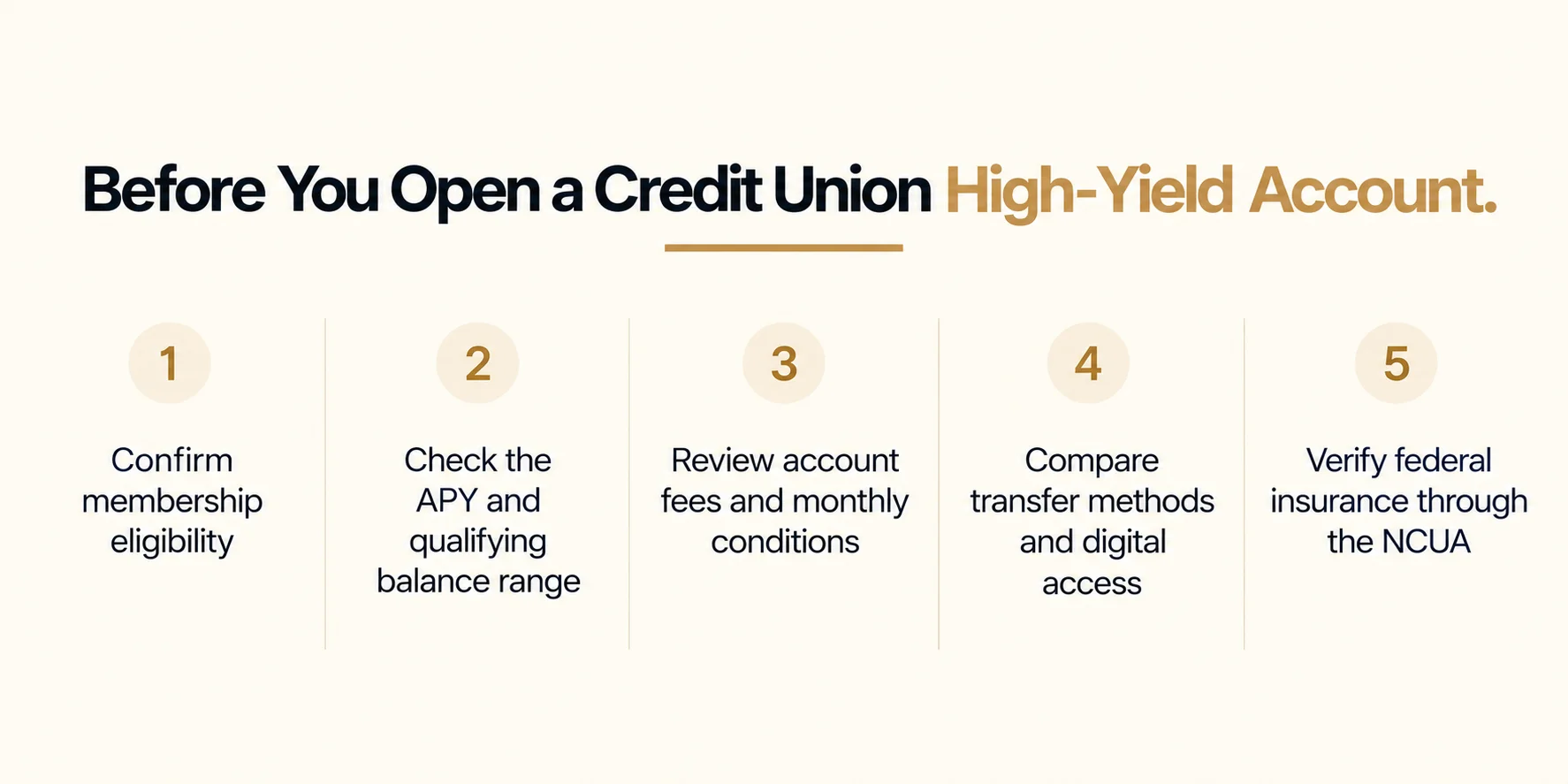
The highest advertised APY is not automatically the best deal. A high yield digital savings account may place conditions on the rate, and those conditions determine what you actually earn.
APY and Balance Tiers
Check whether the headline APY applies to the full balance. The best yield may stop at a stated cap, require a minimum balance, or apply only to one tier.
Confirm whether the APY is ongoing or promotional. If it expires, compare the standard APY that follows.
Fees and Qualification Rules
Review the monthly fee, opening deposit, membership share, and any charge for falling below a balance threshold.
The top APY may depend on a linked checking account, qualifying card purchases, electronic statements, or recurring deposits. Decide whether those conditions fit the way you already manage money. A slightly lower APY with fewer restrictions may leave you with better net earnings. See our guide to high-yield savings accounts with no monthly fees for more points to review.
Access and Digital Tools
A high yield savings app should make it easy to view balances, arrange transfers, and review documents. Also check transfer limits, processing times, ATM availability, and participation in shared branch or ATM networks.
If you use an online savings app, confirm how to deposit checks, receive help, and withdraw a larger amount.
You can estimate the effect of the APY and your planned balance with our guide to how much a high-yield savings account earns.
How Does NCUA Share Insurance Work?
The National Credit Union Administration administers the National Credit Union Share Insurance Fund. The fund is backed by the full faith and credit of the United States and protects eligible share deposits if a federally insured credit union fails.
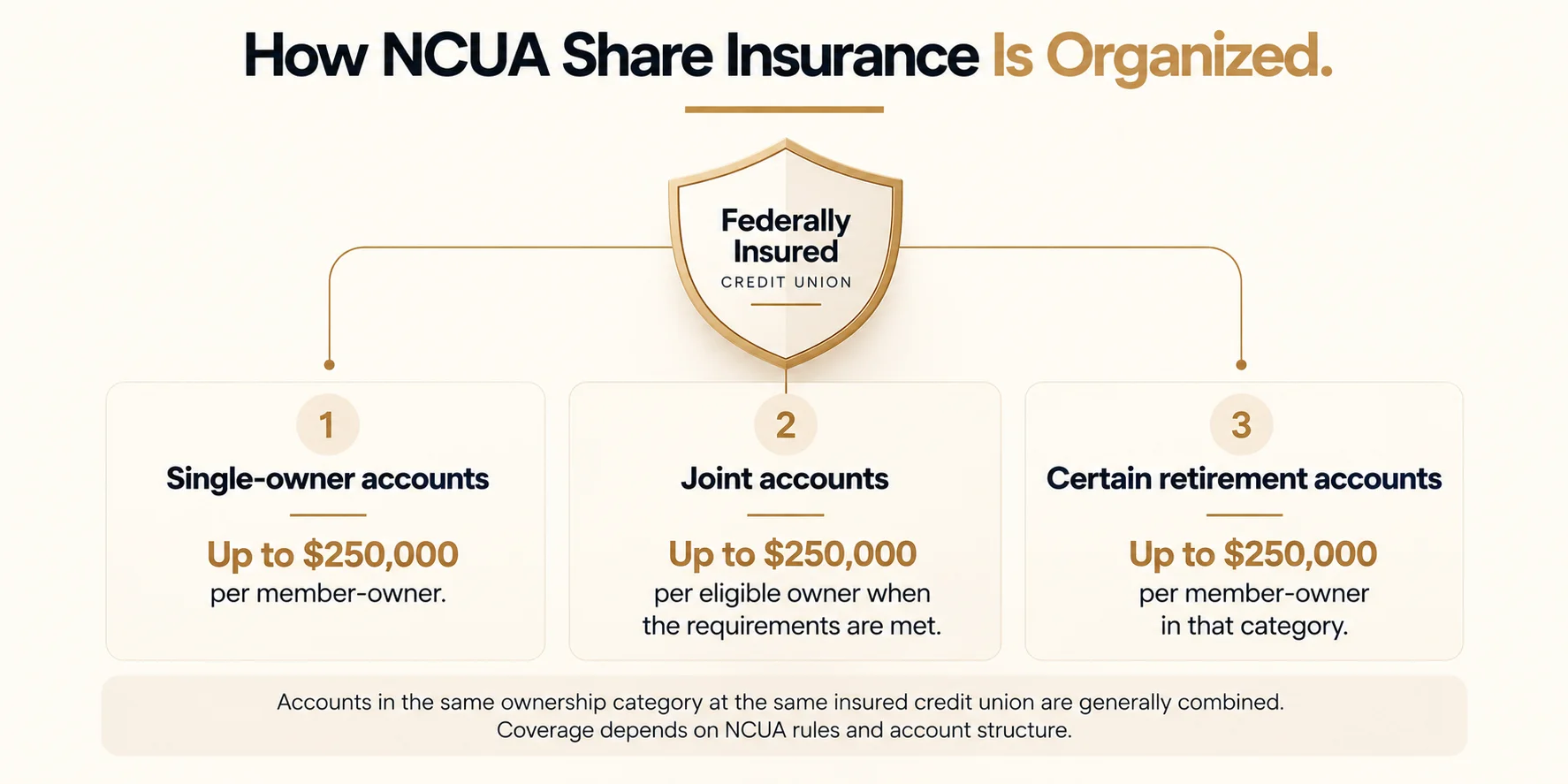
Standard coverage is generally up to $250,000 per member-owner, per federally insured credit union, for each ownership category. Categories include single-owner, joint, certain retirement, and qualifying trust accounts when NCUA requirements are met.
Opening several single-owner accounts at the same credit union does not multiply the coverage. The balances in the same ownership category are generally added together. Accounts held at a different federally insured credit union are insured separately.
NCUA protection can cover share savings, share draft accounts, money market share accounts, and share certificates. It does not cover stocks, bonds, mutual funds, annuities, or other investments, even if they appear inside the credit union’s app.
All federal credit unions and most state-chartered credit unions are federally insured, but customers should still verify the specific institution. Look for the official NCUA sign and check the credit union through NCUA resources. Some state-chartered credit unions use private insurance instead. The NCUA share-insurance guidance explains the applicable categories and limits.
Credit Union vs Bank High-Yield Savings
Credit unions and banks can both offer high-yield savings, but their ownership, eligibility, and federal insurance systems differ.
| Feature | Credit union savings | Bank savings |
|---|---|---|
| Ownership | Member-owned cooperative | Investor-owned institution |
| Eligibility | Field-of-membership rules may apply | Usually available to any eligible applicant |
| Common account term | Share savings | Savings deposit |
| Federal protection | NCUA at federally insured credit unions | FDIC at insured banks |
| APY | Set by the individual credit union | Set by the individual bank |
| Digital and branch access | Varies by institution | Varies by institution |
Neither option is automatically better. Compare the APY for your balance, earning requirements, fees, transfer options, customer service, and federal protection.
If the terminology is unfamiliar, our guide to the difference between a dividend rate and annual percentage yield explains why APY provides a more complete comparison.
Who May Benefit From Credit Union High-Yield Savings?
A credit union account may suit someone who qualifies for membership, finds a competitive APY, and wants eligible funds protected through the NCUA. Cooperative ownership, local service, and shared branch access may provide additional value.
It may be less convenient if membership is restrictive, the best yield has difficult conditions, or the digital tools are limited. Frequent large or urgent transfers make processing limits especially important.
Before choosing, decide what role the account will serve. Funds needed soon call for reliable access and principal protection. Longer-term goals may justify comparing products with different risk levels. Our overview of what a high-yield savings account is explains where this account can fit.
How Is PureFi Different From Credit Union Savings?
PureFi is not a credit union or a bank, and it does not offer an NCUA-insured share savings account. It is a high-yield investment platform that lets users buy shares of income-producing residential properties through a mobile experience.
With PureFi, your projected earnings come from shares of real homes with tenants. Choose your properties from your phone, review the documents, and see every fee before you confirm.
Learn more about how PureFi can help you own real estate shares or download the app to get started today.
Up to 6% APY is projected, variable, and not guaranteed. Property shares can lose value. PureFi is not a bank, and its balances and real estate shares are not covered by FDIC insurance or another government deposit scheme.


