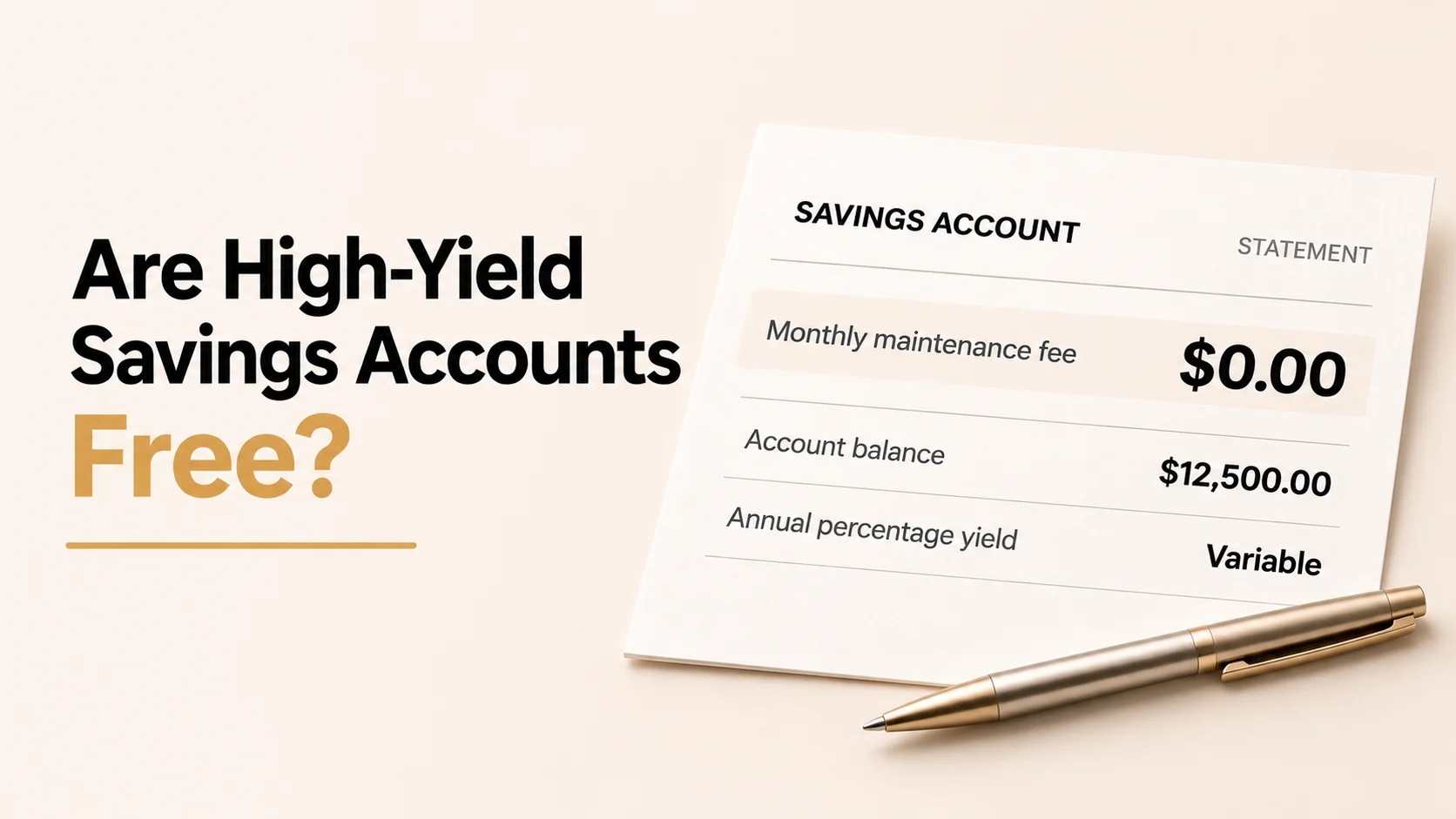
Difference Between Annual Percentage Rate and Annual Percentage Yield
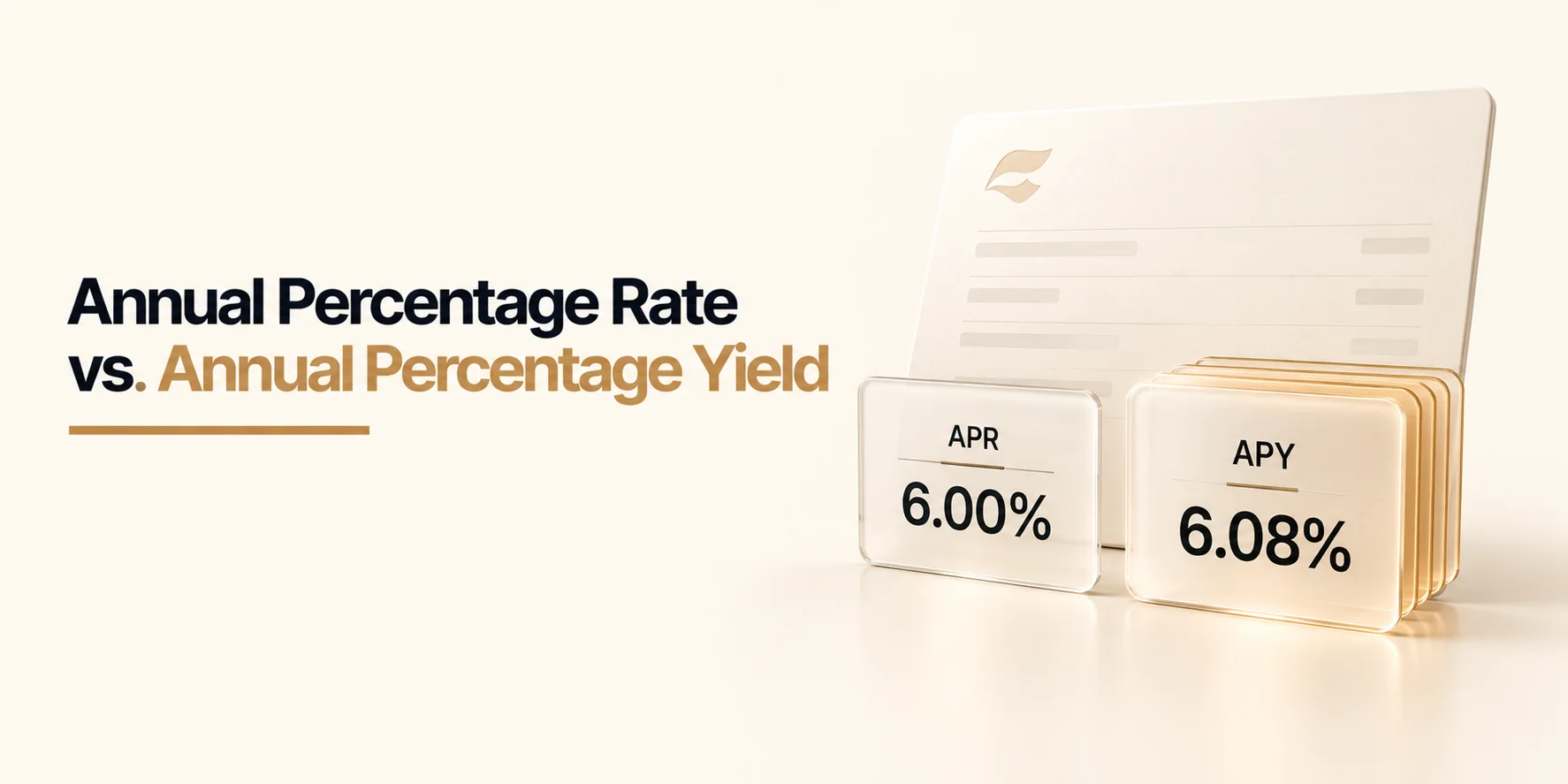
APR and APY are both annual percentages, but they measure different sides of a financial transaction. Annual percentage rate, or APR, usually shows the cost of borrowing. Annual percentage yield, or APY, shows how much a balance could earn after compounding. You will typically see APR on credit cards and loans, while banks and digital savings platforms use APY for savings products.
Understanding the difference helps you compare products accurately, estimate real costs or earnings, and avoid choosing an account based on a percentage that doesn’t tell the whole story.
APR vs APY at a Glance
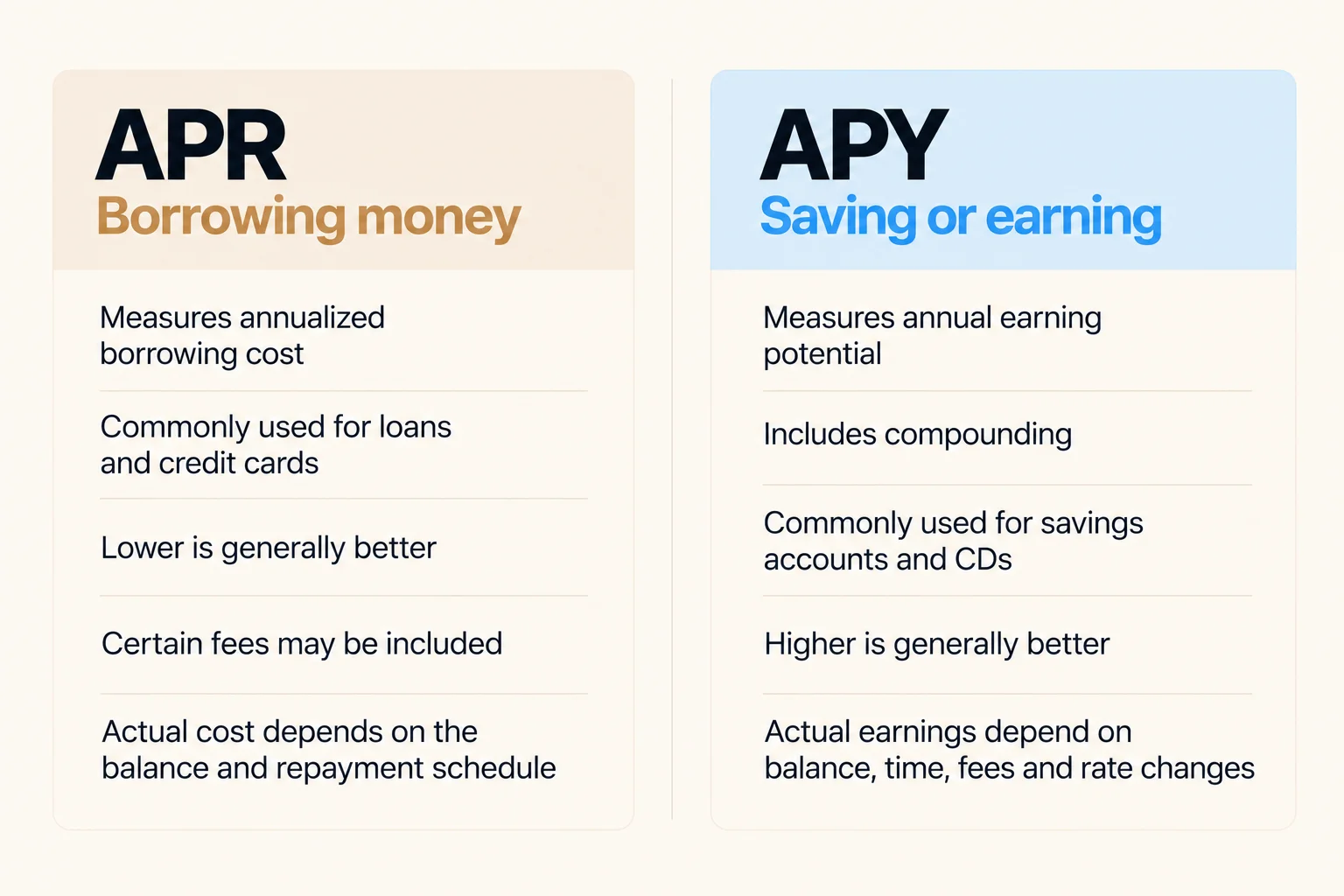
The simplest distinction is that APR usually applies when you borrow, while APY usually applies when you save or earn.
| Feature | APR | APY |
|---|---|---|
| Full name | Annual percentage rate | Annual percentage yield |
| Main purpose | Shows an annualized borrowing cost | Shows potential annual earnings |
| Common products | Credit cards, mortgages and loans | Savings accounts, CDs and earning platforms |
| Compounding reflected in the percentage | Usually not shown as an effective annual result | Yes |
| Fees | Certain fees may be included depending on the product | Account fees are usually reviewed separately |
| Preferred direction | A lower APR is generally better for borrowers | A higher APY is generally better for savers |
| Can it change? | Yes, when the product has a variable APR | Yes, when the account has a variable APY |
What Is APR?
APR stands for annual percentage rate. It is mainly used to describe the cost of borrowing money.
You may see APR when applying for:
- A credit card
- A personal loan
- An auto loan
- A mortgage
- A line of credit
- A balance transfer
APR converts borrowing costs into an annual percentage so that consumers can compare credit products. Depending on the product and applicable disclosure rules, the APR may include certain finance charges or fees in addition to the advertised base rate.
A lower APR will generally cost less than a higher APR when the borrowed amount, fees, repayment schedule and other terms are the same. However, APR does not tell you the exact dollar amount you will pay.
The final cost can also depend on how much you borrow, when you make payments, whether the APR changes and whether additional charges apply. A short loan with a higher APR may still cost fewer dollars than a long loan with a lower APR because the balance is outstanding for less time.
For that reason, compare both the APR and the total repayment estimate before choosing a credit product.
What Is APY?
APY stands for annual percentage yield. It shows how much an eligible balance could earn over one year when compounding is included.
You will commonly find APY on:
- Traditional savings accounts
- High-yield savings accounts
- Money market deposit accounts
- Certificates of deposit
- Some digital earning platforms
APY assumes the balance and rate remain unchanged for the stated period. If either one changes, the actual amount earned will differ from the estimate.
Compounding is already included in APY. When earnings are added to an account and remain there, future calculations may use the larger balance. An account that calculates earnings more frequently can therefore produce a different annual result from an account with the same base rate but a different calculation schedule.
APY gives savers a consistent way to compare those results. If two accounts have the same requirements and fees, the account with the higher APY should generate more earnings over a year.
For a broader explanation of this type of account, read what a high-yield savings account is.
How Are APR and APY Calculated?
APR and APY can start with the same periodic rate but produce different annual percentages because APY includes compounding.
A simplified APR example
A basic annualized calculation multiplies the periodic rate by the number of periods in one year.
Periodic rate × Number of periods = Simplified APR
Suppose a borrowing product applies a 1% monthly rate:
1% × 12 = 12% APR
This example shows the basic relationship. Formal APR calculations can be more detailed. Depending on the product, they may account for qualifying fees, finance charges, the amount borrowed and the payment schedule.
This is especially important for mortgages and installment loans. Two products with the same headline borrowing rate may have different APRs if one includes higher qualifying fees.
A simplified APY example
APY accounts for compounding during the year.
APY = (1 + Periodic rate)ⁿ − 1
In this formula, n is the number of compounding periods in one year.
Using the same 1% monthly rate:
APY = (1 + 0.01)¹² − 1
APY = 12.68%
The APY is higher than 12% because every monthly calculation can build on earnings credited during earlier months.
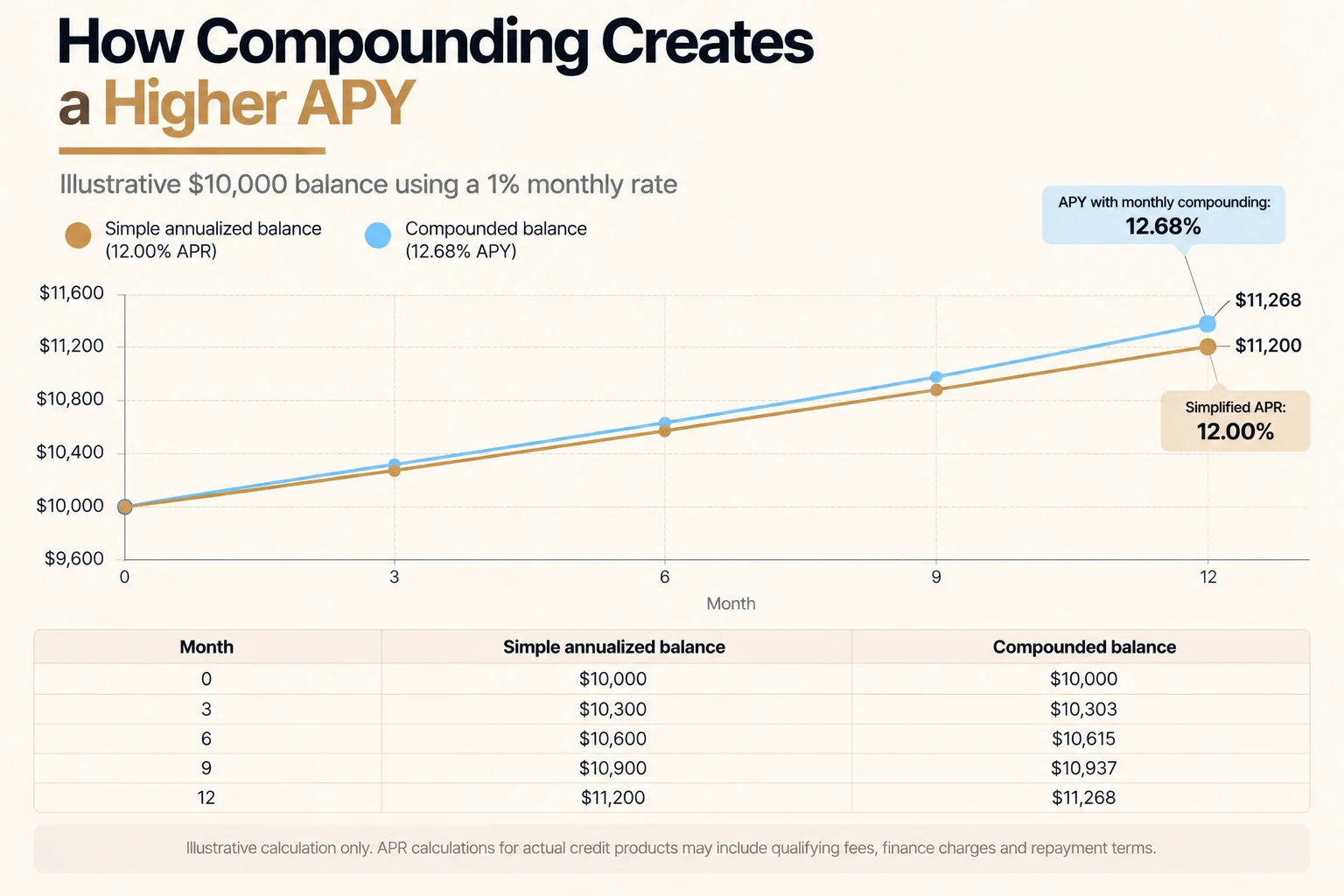
The example does not mean every account crediting earnings monthly will produce a 12.68% APY. The result depends on the actual periodic rate. It simply shows why multiplying a monthly rate by 12 does not produce the same figure as an annual yield that includes compounding.
Our guide to calculating high-yield savings account earnings includes more balance-based examples.
Where Are APR and APY Commonly Used?
Knowing which products use each figure prevents an incorrect comparison.
APR is used for borrowing
Credit card providers use APR to disclose the annualized cost of carrying a balance. A single card may have separate APRs for purchases, cash advances, balance transfers and missed-payment penalties.
Personal and auto loan providers also display APR. The percentage can help borrowers compare offers, but the loan term still matters. Extending repayment can lower the monthly payment while increasing the total amount paid.
Mortgage APR may include certain costs beyond the headline borrowing rate. This is why the mortgage APR may appear higher than the rate used to calculate the monthly principal and borrowing charge.
APY is used for earning
Banks and credit unions display APY on savings accounts, certificates of deposit and money market deposit accounts. A high-yield digital savings account may also present APY through its website or app.
APY helps compare annual earning potential, but it should be reviewed alongside the account requirements. A provider may advertise a strong APY that only applies to a certain balance range or after specific conditions are met.
A certificate of deposit may keep its APY fixed for a stated term. A savings account usually uses a variable APY that the provider can change.
Why Does the Difference Between APR and APY Matter?
APR and APY influence opposite financial decisions.
When borrowing, a lower APR is generally preferable because it can reduce the annualized cost. When saving, a higher APY is generally preferable because it can increase potential earnings.
However, comparing a 5% APR directly with a 5% APY does not reveal whether one product is better. One percentage describes a borrowing cost. The other describes potential earnings. They may also treat fees and compounding differently.
The percentage alone can hide important conditions. Before making a decision, check whether the figure is:
- Fixed or variable
- Available to all customers
- Limited to a promotional period
- Restricted to a certain balance
- A confirmed rate or a projection
- Affected by fees or other requirements
For example, a high APY may look attractive, but a monthly fee could reduce the amount you keep. A low APR may appear inexpensive, but a long repayment term or large origination fee could increase the total cost.
The correct comparison therefore depends on both the percentage and the product terms.
How to Compare APRs and APYs Properly
Start by identifying whether you are borrowing, saving or investing. Compare APR with APR for borrowing products and APY with APY for earning products.
For a loan or credit card, review:
- APR
- Fees and finance charges
- Repayment term
- Monthly payment
- Variable-rate conditions
- Total repayment estimate
For a savings account or online savings app, review:
- APY
- Compounding schedule
- Monthly fees
- Minimum balance
- Rate tiers
- Transfer access
- Deposit protection
Calculate the expected dollar cost or earnings whenever possible. A percentage becomes easier to understand when you can see what it means for your actual balance.
Suppose one savings account offers 4.00% APY with no monthly fee, while another offers 4.25% APY but charges $10 per month. The second account does not automatically provide a better result. The balance must generate enough additional earnings to offset $120 in annual fees.
You should also check whether the percentage is guaranteed. Variable APRs and APYs may change. A projected APY from a high yield investment platform can change for different reasons because it may depend on asset performance rather than a bank deposit rate.
See why high-yield savings account rates change for more information about variable APYs.
Does APY Show Exactly How Much You Will Earn?
APY provides a standardized annual estimate, not a promise that every customer will receive the advertised amount.
Your actual earnings can change because of:
- Additional deposits
- Withdrawals
- APY changes
- Monthly fees
- Balance tiers
- Promotional periods
- Taxes
- Account closure
If you add funds during the year, you may earn more than an estimate based only on the opening balance. If you withdraw funds or the provider lowers the APY, you may earn less.
Suppose you maintain $10,000 for a full year at an unchanged 4.00% APY. The estimated annual earnings would be approximately $400. If the APY falls during the year or the balance drops, the actual amount would be lower.
Our guide to how much a high-yield savings account can earn provides more examples.
Put your dollars into something real
With PureFi, your projected earnings come from shares of real homes with tenants. Choose your properties from your phone, review the documents, and see every fee before you confirm.
Learn more about how PureFi can help you own real estate shares or download the app to get started today.
Up to 6% APY is projected, variable, and not guaranteed. Property shares can lose value. PureFi is not a bank, and its balances and real estate shares are not covered by FDIC insurance or another government deposit scheme.