
Can You Write Checks From a High-Yield Savings Account?
Most high-yield savings accounts do not include personal checks. These accounts are built to hold money and generate earnings, not manage frequent payments. A few providers may offer check writing, but it is more common with checking and money market accounts.
No checks does not mean your money is locked. You can usually transfer funds to checking, send an electronic transfer, use online bill pay, or request an official bank check. The available options depend on the provider, so check the account terms before you need to make a payment.
Why Do Most HYSAs Not Include Checks?
A checking account is designed for money that regularly enters and leaves. It normally supports personal checks, card purchases, recurring bills, cash withdrawals, and transfers.
A high-yield savings account serves a different purpose. It gives money a place to earn while it waits for a future expense. This could be an emergency fund, home deposit, tax payment, travel budget, or another planned cost.
Many HYSAs are offered through online banks. These providers may focus on electronic deposits and transfers instead of paper services. Removing checkbooks can also reduce administrative costs and make it harder for customers to use savings as an everyday spending account.
An account can still have an account number and routing number without supporting personal checks. Those details may only be available for incoming deposits, transfers between accounts, or other approved electronic transactions.
The APY does not tell you whether check writing is available. Two accounts can offer similar yields while providing completely different access methods.
Is Check Writing From a HYSA Prohibited?
There is no current federal rule that makes all check writing from savings accounts illegal. The bank or credit union decides whether a particular account includes that feature.
Before April 2020, Federal Reserve Regulation D limited certain convenient transfers and withdrawals from savings deposits to six per month. Checks payable to other people were included in that limit.
The Federal Reserve later deleted the six-transfer limit from the definition of a savings deposit. Financial institutions can now allow more transfers, but they are not required to offer unlimited transactions or check writing. A provider may retain its own limits through the account agreement.
The practical question is therefore not whether checks are broadly permitted. It is whether your specific high yield digital savings account issues them and agrees to process them.
How Does Check Writing Work When a Savings Account Offers It?
If the account supports checks, you may be able to order a checkbook from the provider. The checks will show the routing number, account number, and an individual check number.
Writing the check does not remove money immediately. The payment reaches your account when the recipient deposits or cashes it and the financial institutions process it.
That gap matters. A check written on Monday may not reach the account until Friday or even later. You need to leave enough available money in the account until it clears.
Checks do not always clear in the order they were written. A larger check written later could arrive first. This can make the balance harder to track when several checks are outstanding.
A check may also be converted into an electronic transfer. According to the Consumer Financial Protection Bureau, some businesses use the information printed on a check to create an electronic payment. The paper check may then be returned or destroyed instead of moving through the traditional check-clearing process.
Review each transaction on your statement. If a check was converted, it may appear differently from an ordinary processed check.
What Can You Use Instead of a Check?
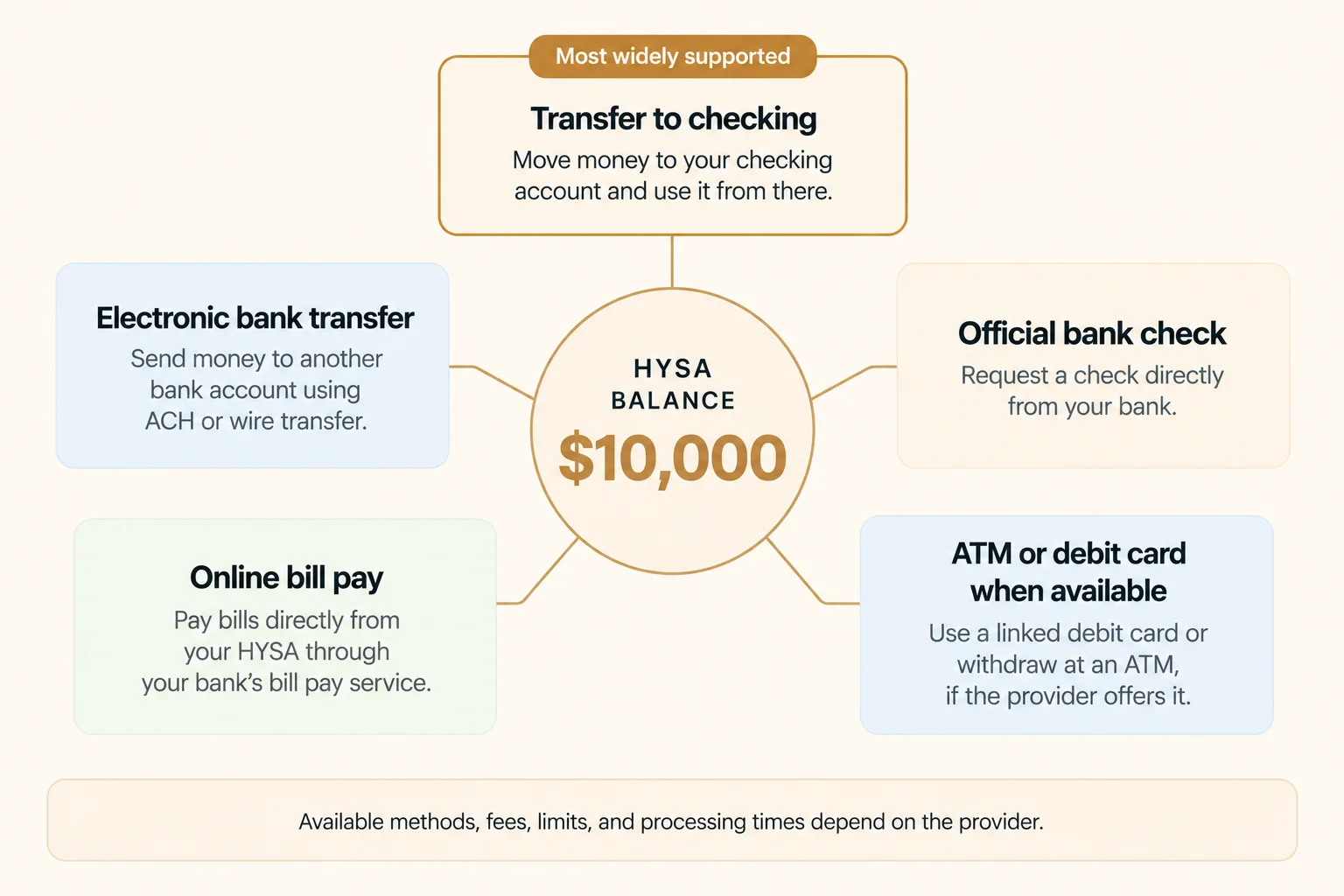
Not having personal checks rarely prevents access to HYSA funds. It changes how you move the money.
Transfer the Money to Checking
This is the most widely supported option.
Link your checking account to the HYSA. Transfer the amount you need, wait for it to appear in the available checking balance, and then write the check from checking.
Transfers between accounts at the same institution may be immediate. External transfers often take one or more business days. Weekends, holidays, daily cut-off times, and account reviews can add time.
This approach gives each account a clear role. Savings holds money and generates earnings. Checking handles payments.
Our high-yield savings account versus checking account guide explains how the two accounts differ in access, fees, and everyday use.
Send an Electronic Transfer
A high yield savings app may let you send money to another account electronically. In most cases, the receiving account must belong to you. Some providers also support approved third-party payments.
Before sending a transfer, check the expected arrival date, transfer limit, and available balance. A recent deposit may appear in the account while still being held.
Read Can You Withdraw From a High-Yield Savings Account? for more detail on transfer times and withdrawal restrictions.
Request an Official Bank Check
Some banks can issue an official check from your savings balance. This may be called a cashier’s check, bank check, or official check.
The bank creates the check rather than giving you a reusable checkbook. This can be useful for a large one-time payment, such as a home deposit, vehicle purchase, or contractor invoice.
Online providers may mail the check to you or directly to the recipient. Check the delivery estimate before relying on it. There may also be an issuance fee, expedited-delivery charge, or address-verification step.
Use Online Bill Pay
An account may include bill pay even when it does not provide personal checks. You enter the company, amount, and payment date through the provider’s website or app.
The provider may send the payment electronically. If the recipient cannot accept electronic payments, the provider may print and mail a check on your behalf.
This is not the same as writing a personal check. You do not control the check number or physically deliver it. You must also allow enough time for processing and mailing.
Use a Debit or ATM Card

Some savings accounts include an ATM card. A smaller number provide a debit card that supports merchant purchases.
An ATM card may only let you withdraw cash and check the balance. It might not work in shops, online, or for recurring payments.
Our guide to whether high-yield savings accounts have debit cards explains what different forms of card access provide.
Are Money Market Accounts More Likely to Offer Checks?
A money market deposit account is more likely to include check-writing privileges than a standard HYSA. Some products also offer a debit card, ATM access, or bill pay.
That does not mean every money market account includes these features. Some only support electronic transfers. Others limit the number of checks, require a minimum check amount, or charge fees when the balance falls below a set level.
| Feature | Typical HYSA | Money market account |
|---|---|---|
| Personal checks | Usually unavailable | Available with some accounts |
| Electronic transfers | Common | Common |
| ATM or debit card | Varies | More commonly available |
| Bill payment | Varies | May be available |
| Variable APY | Common | Common |
| Everyday spending | Usually unsuitable | More flexible, but still not always designed for daily use |
A money market account may suit someone who needs occasional checks without keeping the entire balance in checking. A HYSA may be enough if you are comfortable transferring money before spending it.
Our money market account versus high-yield savings account comparison covers the differences in access, fees, and account features.
Put Your Dollars Into Something Real
With PureFi, your projected earnings come from shares of real homes with tenants. Choose your properties from your phone, review the documents, and see every fee before you confirm.
Learn more about how PureFi can help you own real estate shares or download the app to get started today.
Up to 6% APY is projected, variable, and not guaranteed. Property shares can lose value. PureFi is not a bank, and its balances and real estate shares are not covered by FDIC insurance or another government deposit scheme.


