
Can You Pay Bills From a High-Yield Savings Account?
You may be able to pay bills from a high-yield savings account, but it depends on the provider. Some accounts accept direct electronic debits. A smaller number include an online bill-payment service. Others only allow you to transfer money to a linked checking account.
That last option is often the simplest. Savings holds the money until you need it. Checking handles the actual payment. Before setting up a bill from your HYSA, confirm which transactions the account supports, how long they take, and whether any limits or fees apply.
How Can You Pay Bills From a HYSA?
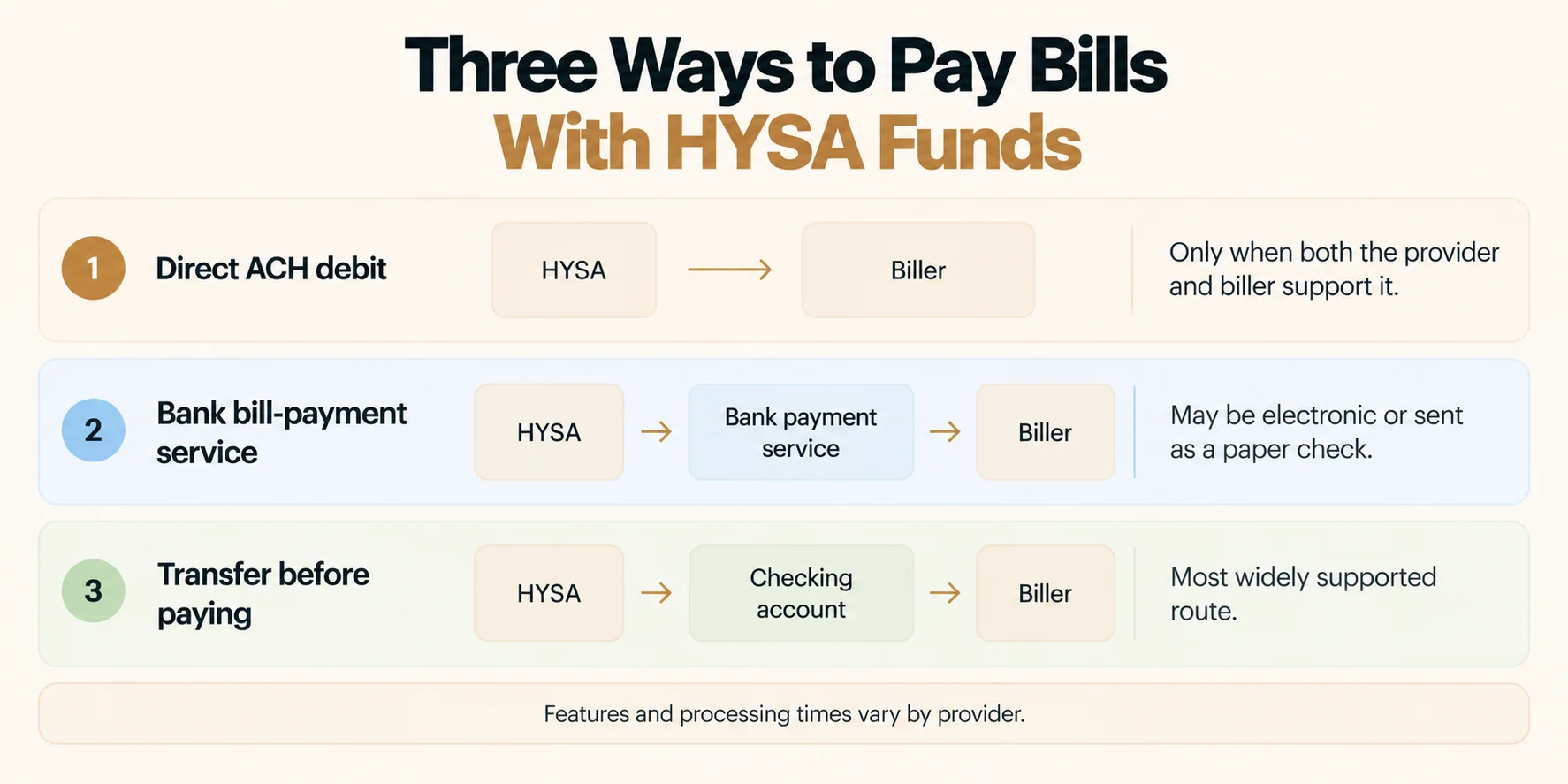
There are three main ways to use HYSA funds for a bill. Not every account offers all three.
Authorize a Direct ACH Debit
Some billers let you enter a bank account number and routing number instead of paying with a card. The biller then sends an electronic request to withdraw the payment from your account.
This may work with a HYSA if:
- The savings provider accepts outgoing ACH debits
- The biller accepts savings-account details
- The available balance covers the full payment
- The account does not block third-party debits
Do not assume the payment will work simply because your HYSA has an account and routing number. Some providers allow transfers initiated by the customer but reject withdrawals initiated by an outside company.
For a recurring payment, you normally authorize the biller in advance. Under the Consumer Financial Protection Bureau’s Regulation E rules for preauthorized transfers, recurring electronic withdrawals from a consumer account must be authorized in writing or through a similarly authenticated electronic process. The company obtaining the authorization must provide a copy to the customer.
Keep that authorization. It should show the payment schedule, the company taking the money, and any terms that apply.
Use the Bank’s Bill-Payment Service
Some banks and credit unions include an online bill-payment tool. You choose the company, enter the amount, and select a payment date.
The bank may send the payment electronically. If the biller cannot receive electronic payments, the bank may print and mail a check instead. A mailed check needs more time, so the date you submit the request is not necessarily the date the biller receives the money.
Bill pay is common with checking accounts but less common with savings. An online savings app may show a transfer menu without offering a true bill-payment service. Check how the provider describes the feature before relying on it.
Transfer the Money to Checking First
For most customers, this is the cleanest approach. Move enough money from the HYSA to a linked checking account. Wait until the amount appears in the available balance. Then pay the bill from checking by card, ACH, check, or the bank’s bill-payment service.
This setup gives each account a clear job. The HYSA holds money and earns a yield. The checking account handles rent, utilities, subscriptions, card payments, and other regular expenses.
Transfers within the same bank may be immediate. An external transfer can take one or more business days. Schedule the transfer early rather than assuming the money will arrive on the bill’s due date.
Our guide to checking and savings accounts explains why the two products are often used together.
Can You Set Up Autopay From a HYSA?
Autopay may work if the provider allows direct ACH debits. You give the biller permission to withdraw either a fixed amount or the amount due each month.
The main problem is timing. A payment can arrive when part of the balance is still on hold or after you have moved money elsewhere. If the available balance is too low, the payment may be returned.
The biller may charge a late or returned-payment fee. The savings provider may also charge a fee, depending on its terms.
Variable bills need more attention than fixed ones. A $50 monthly subscription is easy to plan for. An energy bill that changes from $80 to $240 is not. Leave enough available money to cover normal changes, or review the bill before the scheduled debit.
Regulation E also gives consumers a way to stop a preauthorized electronic transfer. The customer generally needs to notify the financial institution at least three business days before the scheduled payment. A bank can require written confirmation after an oral request, so check its process before the deadline.
Why Is Checking Usually Better for Bills?
A checking account is built for money that moves often. It normally supports debit-card spending, bill payments, checks, direct deposits, recurring debits, ATM withdrawals, and transfers.
A high-yield digital savings account is built for money you want to keep separate and allow to earn. It may provide fewer payment tools because everyday spending is not its main purpose.
Paying every bill from savings can also make the balance difficult to follow. Several automatic withdrawals may be scheduled at different times, while new deposits could still be pending. The number shown as the total balance may not always be the amount ready to leave the account.
Keeping bills in checking creates a clearer system:
- Savings holds reserves and money for planned goals.
- Checking holds the amount needed for upcoming expenses.
- A scheduled transfer can refill checking before bills are due.
A high-yield savings account and checking account can therefore work as a pair rather than competing options.
What Can Stop a HYSA Bill Payment?
Even when a provider permits bill payments, several things can prevent one from going through.
The Account Rejects Third-Party Debits
A provider may let you send money to your own checking account while refusing debit requests from utility companies, lenders, or subscription services.
This is common with products designed mainly for saving. Review the account agreement or ask the provider whether third-party ACH debits are supported.
The Money Is Not Yet Available
A recent deposit can appear in the total balance while still being unavailable for withdrawal. New accounts, large deposits, checks, and transfers from a newly linked bank may be held for additional time.
Do not schedule a bill based only on the displayed total. Check the available balance.
The Request Arrives Too Late
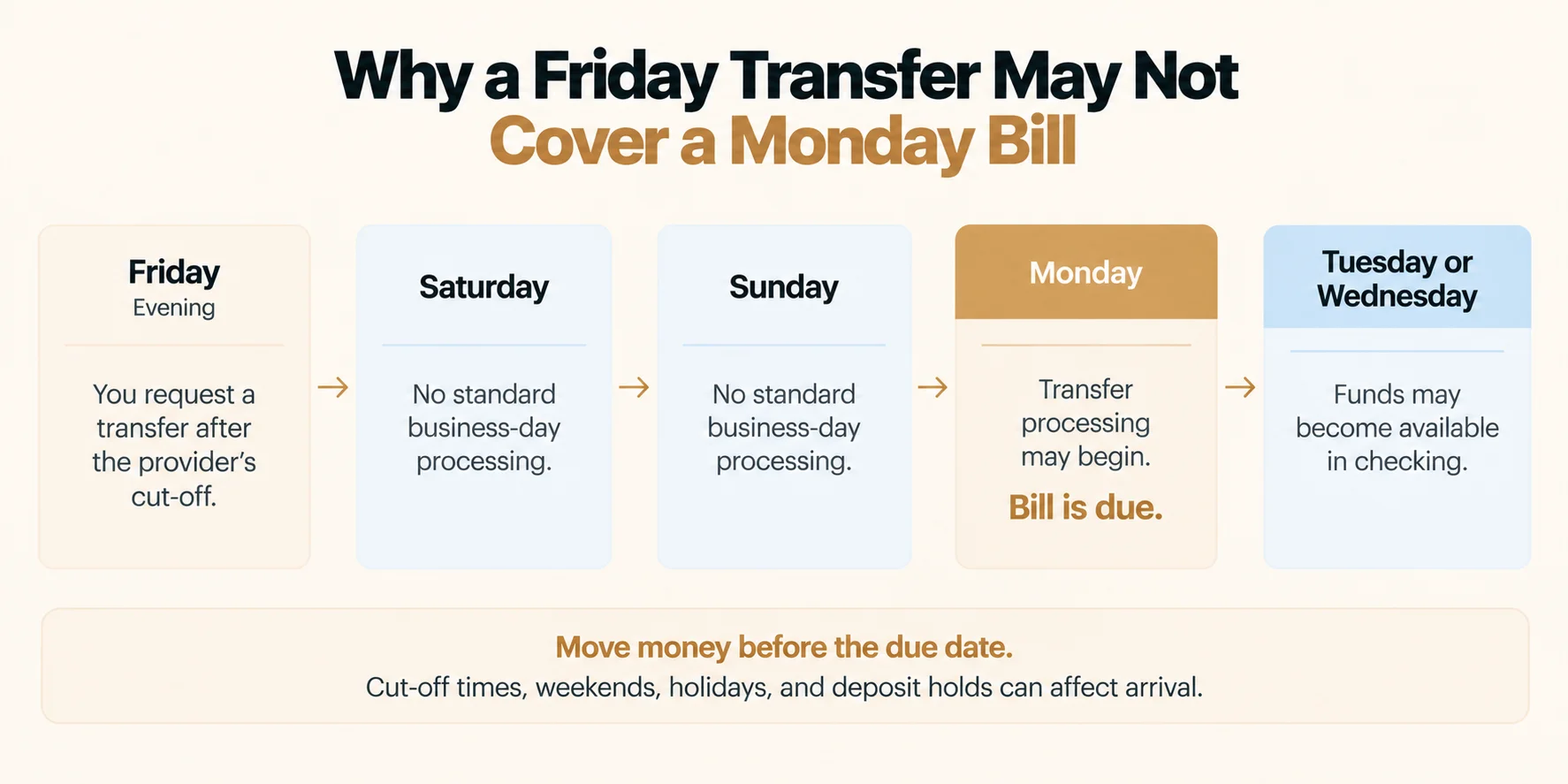
Electronic transfers are affected by processing windows, weekends, and bank holidays. A transfer requested late on Friday may not begin moving until Monday. A holiday can add another day.
If you must transfer the money to checking first, allow time for both transactions: the transfer from savings and the later payment to the biller.
The Provider Sets Its Own Limits
The Federal Reserve deleted the old federal rule that limited certain savings-account transfers to six per month. The change took effect in April 2020. Financial institutions can still keep their own withdrawal rules, transaction limits, or charges.
Check for daily transfer limits, monthly limits, maximum transaction amounts, and restrictions on recently opened accounts.
The Biller Does Not Accept Savings Accounts
A biller’s payment form may ask whether the account is checking or savings. Others only accept checking details or payment cards.
If the biller cannot use your HYSA, transfer the money to checking instead of trying to enter the account as the wrong type. Incorrect information can cause a failed payment.
How Long Does a HYSA Bill Payment Take?
There is no single payment time for every account.
| Payment method | Common timing | Main issue to check |
|---|---|---|
| Direct ACH debit | Commonly scheduled in advance | Processing date may differ from the due date |
| Electronic bank bill pay | Often one or more business days | Bank and biller processing times |
| Mailed bill-pay check | Several business days | Printing, delivery, and biller handling |
| HYSA-to-checking transfer | Often one to three business days | Weekends, holidays, and account holds |
| Debit-card payment | Usually immediate authorization | Most HYSAs do not provide a debit card |
| Domestic wire | Often the same business day | Cut-off times and fees |
Treat these as general estimates. The provider’s own timeline controls.
A good digital savings platform should show when a transfer was requested, when it began processing, and when it is expected to arrive. If a high yield savings app only says “pending,” you may need to contact support before assuming the bill can be paid.
For more detail on accessing the balance, read Can You Withdraw From a High-Yield Savings Account?.
Can You Pay a Bill With a HYSA Debit Card?
Most HYSAs do not include a purchase-enabled debit card. Some provide an ATM card, but that card may only support cash withdrawals and balance checks.
Even when a card is available, confirm whether it can handle online purchases and recurring payments. “Card access” does not automatically mean full debit-card functionality.
You should also check card limits, replacement fees, foreign transaction costs, and whether card payments reduce the savings balance directly.
Our guide to whether high-yield savings accounts have debit cards covers these differences.
Should You Pay Bills Directly From Your HYSA?
Direct payment can work when you only have one or two predictable bills, the provider supports ACH debits, and you keep enough available money in the account.
It is less suitable when you have several automatic payments, bills that change each month, or expenses that must be paid immediately. In those cases, checking gives you more payment options and makes the monthly cash flow easier to see.
Customers who want earnings and payment tools in one account can also consider high-yield checking or a cash management account. These products may include bill pay, checks, transfers, and debit cards. Their fees, earning conditions, protection, and account structures vary.
A high-yield investment platform is different again. Investments may need to be sold before the money can be used. Their value can also change. Do not treat an investment balance as a bill-payment account unless the platform provides a separate payment feature through an authorized partner.
The practical choice is simple: use savings to hold the money when that helps you earn and stay organized. Use checking for payments when reliability and direct access matter more.
Put Your Dollars Into Something Real
With PureFi, your projected earnings come from shares of real homes with tenants. Choose your properties from your phone, review the documents, and see every fee before you confirm.
Learn more about how PureFi can help you own real estate shares or download the app to get started today.
Up to 6% APY is projected, variable, and not guaranteed. Property shares can lose value. PureFi is not a bank, and its balances and real estate shares are not covered by FDIC insurance or another government deposit scheme.


