
Can You Open a Joint High-Yield Savings Account?

Yes, many banks and credit unions allow two people to open a joint high-yield savings account. Both applicants become legal owners. They can usually add money, view transactions, and make withdrawals from the same balance.
Not every provider supports joint ownership. Some online banks only offer individual accounts. Others require both people to apply together or allow an existing customer to invite a joint owner.
Before applying, both people should understand what joint ownership permits. A joint owner does not simply receive permission to view the account. That person may be able to withdraw the full balance or close the account.
Who Can Open a Joint HYSA?
Joint accounts are not limited to married couples. Depending on the provider, they may be available to:
- Married or unmarried partners
- Parents and adult children
- Siblings and other relatives
- Household members
- Two people saving for a shared expense
Both people must meet the provider’s eligibility rules. These can include minimum-age, residency, identification, tax-status, and contact-information requirements.
Credit unions may add a membership requirement. Each applicant may need to qualify through their location, employer, family relationship, or membership in an affiliated organization.
What About an Adult and a Minor?
Opening an account with a child works differently. Some institutions allow an adult and minor to share an account. Others require a custodial account managed by an adult for the child.
A custodial account is not the same as a standard joint account. The adult manages the money, but the funds belong to the child. Control normally transfers to the child at an age established by applicable law.
Check the product type before applying. Do not choose a standard joint account when the real goal is to manage money on behalf of a minor.
Our guide to joint high-yield savings accounts explains the basic ownership structure in more detail.
What Do Both Applicants Need?
Each applicant normally provides their own information. A bank or credit union may request:
- Legal name and date of birth
- Residential address and contact details
- Government-issued identification
- Tax identification information
- Details for the account used to make the first deposit
Banks must verify the identities of their customers. FinCEN guidance states that a bank’s procedures must allow it to form a reasonable belief that it knows each customer’s true identity. Verification can use documents, electronic records, database checks, or a combination of methods.
Each Owner Completes Their Own Checks
One applicant cannot always complete the entire process for the other. The second person may receive an invitation and need to create separate login credentials, submit identification, and approve the account agreement.
Prepare both sets of information before starting. Differences in an applicant’s name, address, or date of birth can delay the application.
How Do You Open a Joint High-Yield Savings Account?
Opening a joint HYSA is similar to opening an individual account. The main difference is that both owners must be added and verified.
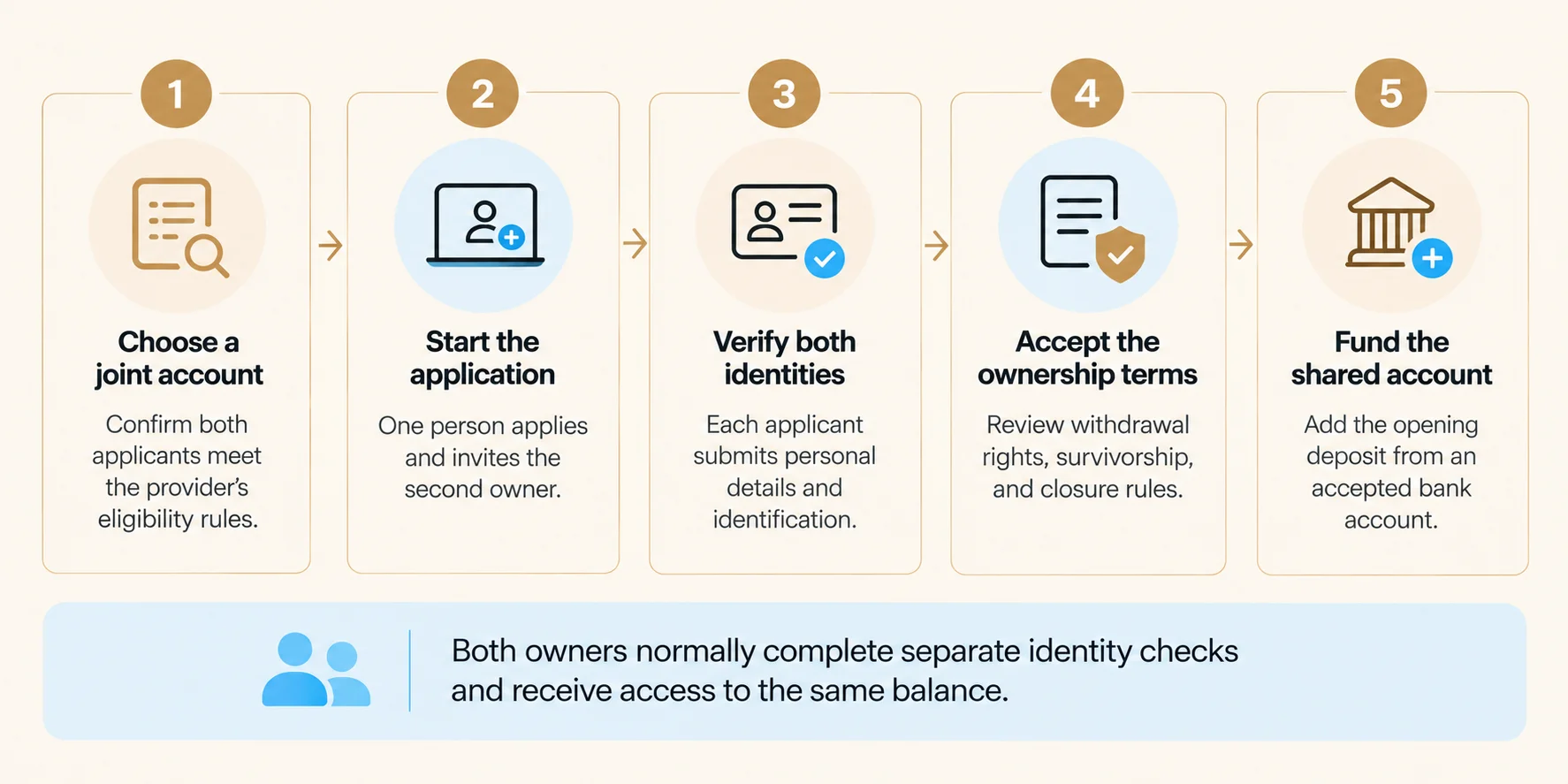
Confirm That Joint Ownership Is Available
Start with the product terms. Look for wording such as “joint account,” “co-owner,” or “add joint owner.”
Do not assume that every product from the same provider supports joint ownership. A bank may offer joint regular savings accounts while limiting its highest-yield product to individuals.
Confirm that the advertised APY, fees, minimum deposit, and access features also apply to joint customers.
Decide Who Will Start the Application
Some providers let both people apply together. Others ask one person to start the application and invite the second owner.
The first person may be listed as the primary applicant. This can affect administrative records or tax reporting, but it does not necessarily give that person greater access to the money.
Each applicant should use their own email address, phone number, password, and authentication method. Sharing one login makes it difficult to see who approved a transaction and creates an avoidable security risk.
Complete Both Identity Checks
Each applicant enters their personal details and completes the provider’s verification process.
A high yield savings app may ask each person to upload an ID, take a selfie, enter a one-time code, or answer identity questions. Automated verification can take minutes. Applications sent for manual review may take longer.
If one applicant cannot be verified, the provider may pause or reject the joint application.
Review the Ownership Terms
Read the account agreement before accepting it. Pay close attention to withdrawals, account closure, owner removal, disputes, and what happens after an owner dies.
Many joint accounts include rights of survivorship. This generally means that the surviving owner keeps the account after the other owner dies.
Another arrangement is ownership as tenants in common. Under that structure, the deceased owner’s share may pass through their estate. The available options and their legal effect depend on the account title, provider, and state law.
Add the Opening Deposit
After approval, one or both owners can fund the account. Accepted methods may include an electronic transfer, direct deposit, mobile check deposit, or another bank-supported option.
An online savings app may not accept physical cash. The provider may also require the first deposit to come from an account owned by one of the applicants.
Check the minimum opening deposit and the hold policy. Money can appear in the total balance before it becomes available for withdrawal.
Our guide to opening a high-yield savings account covers the general application and funding process.
How Does Shared Access Work?
A joint HYSA normally contains one combined balance. The provider does not keep each owner’s contributions in a separate section.
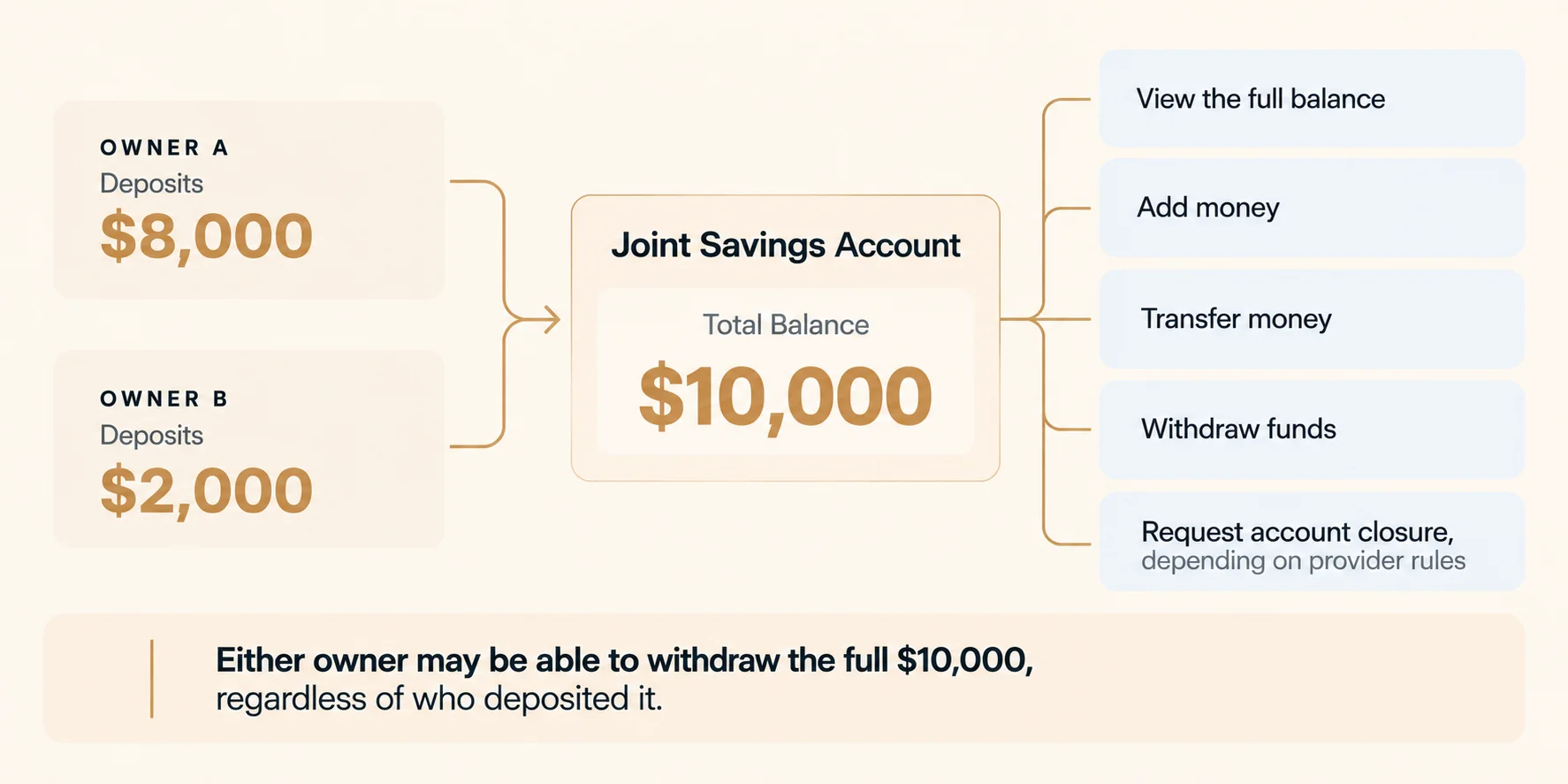
Either Owner May Access the Full Balance
Suppose one person deposits $8,000 and the other adds $2,000. The account now holds $10,000. Either owner may be able to withdraw all $10,000, even though they contributed different amounts.
The CFPB explains that people named on a joint bank account can generally make transactions, transfer funds, withdraw money, or close the account. The exact permissions depend on the account agreement and applicable state law.
This is why a joint account should only be opened with someone you trust. A private agreement about who owns each contribution may not stop the provider from processing a withdrawal requested by either owner.
Both Owners Need Their Own Access
Each owner should be able to view the balance and transaction history through separate login credentials.
A well-designed digital savings platform should also provide transaction alerts, transfer updates, and records showing which owner initiated an action.
Check whether both owners receive the same administrative controls. Some providers allow either person to change contact details or link an external account. Others reserve certain actions for the primary applicant.
How Should You Manage a Joint HYSA?
Joint access works more smoothly when both people agree on what the money is for. The account might hold an emergency reserve, a home deposit, annual household costs, or funds for another shared goal.
Agree on how much each person will contribute and when withdrawals are allowed. This agreement will not change the bank’s rules, but it can prevent misunderstandings.
Use Alerts and Separate Logins
Both owners should receive notifications for withdrawals, new deposits, failed login attempts, linked accounts, and changes to contact information.
If alerts only go to the primary owner, the other person should check the account regularly. Neither owner should rely on the other to monitor every transaction.
Track Pending Transfers
Electronic transfers can remain pending for several business days. Record scheduled withdrawals so one person does not rely on money that is already due to leave.
Check the available balance rather than only the total. Recently deposited money may still be subject to a hold.
Our guide to withdrawing from a high-yield savings account explains how processing times and deposit holds affect access.
Agree on a Minimum Balance
Both owners can decide that the balance should not fall below a particular amount. For example, they might keep at least $5,000 in the account unless both agree that an emergency justifies using it.
This is an agreement between the owners. It does not prevent either person from withdrawing money when the account terms give both people full access.
Review the APY and fees as well. The APY normally applies to the combined balance, not separately to each person’s contribution. It may change after the account is opened.
Can One Owner Remove the Other?
Removing a joint owner is usually more difficult than adding one. One person often cannot convert the account into an individual account without the other owner’s consent.
The CFPB notes that removing a spouse from a joint bank account generally requires that person’s consent. The provider’s terms and state law can affect the exact process.
If the owners no longer want to share the account, the provider may require them to close it and open separate accounts. Before closing:
- Cancel pending transfers and automatic deposits.
- Divide the balance as agreed.
- Download statements and transaction records.
- Request confirmation that the account is closed.
Separate accounts may be more suitable when two people have different goals or do not want to share full withdrawal rights. They can still contribute to a smaller joint fund for shared expenses.
Our guide to multiple high-yield savings accounts covers the practical uses of keeping more than one account.
What Should You Compare Before Applying?
Start with ownership and access. Find out whether either owner can withdraw the full balance or close the account without the other person’s approval.
Then check whether both people receive separate login credentials, transaction alerts, and customer support. A high APY is less useful if one owner cannot monitor the account properly.
Compare the opening deposit, monthly fees, balance requirements, transfer limits, withdrawal methods, and deposit holds. A high-yield digital savings account should make these details available before either person applies.
At an FDIC-insured bank, qualifying joint deposits may receive coverage under the joint ownership category. The FDIC requires qualifying co-owners to have equal withdrawal rights. Coverage also depends on the other joint deposits each owner holds at the same insured bank.
A high-yield investment platform is not the same as a joint savings account. Investments may change in value and can follow different ownership and withdrawal rules.
Choose the account based on how both people will manage and access the money, not simply the headline yield.
Put Your Dollars Into Something Real
With PureFi, your projected earnings come from shares of real homes with tenants. Choose your properties from your phone, review the documents, and see every fee before you confirm.
Learn more about how PureFi can help you own real estate shares or download the app to get started today.
Up to 6% APY is projected, variable, and not guaranteed. Property shares can lose value. PureFi is not a bank, and its balances and real estate shares are not covered by FDIC insurance or another government deposit scheme.


