
Can a Nonprofit Open a High-Yield Savings Account in 2026?
A nonprofit can open a high-yield savings account, but only if the bank or financial provider accepts organizations. Many accounts advertised online are personal products. Their terms may exclude charities, foundations, associations, and other legal entities.
A nonprofit normally needs a business or organizational savings account opened in its legal name. The bank may ask for an Employer Identification Number, formation documents, board approval, and information about authorized signers. Tax treatment also depends on whether the nonprofit has received tax-exempt status and how it earns the money.
Can a Nonprofit Open a High-Yield Savings Account?
Yes. A nonprofit may qualify for a high-yield savings account designed for businesses, charities, associations, or other organizations.
The account must belong to the nonprofit rather than one of its directors, employees, founders, or volunteers. Organizational money should not be placed in someone’s personal high-yield digital savings account, even if that account offers a better APY.
Using a personal account can create several problems:
- The money may legally appear to belong to the individual
- Other officers may not have proper access
- Transactions can be harder to document
- The provider’s account terms may be violated
- Donor, grant, and operating funds may become mixed with personal money
- Financial reviews and tax filings may become more difficult
The first step is therefore not finding the highest APY. It is finding a provider that permits the nonprofit’s legal entity type.
What Type of Account Does a Nonprofit Need?
A nonprofit usually needs a business or organizational savings account. Banks may classify the account under a corporation, association, foundation, charity, club, religious organization, or other entity category.
The exact label matters less than the account ownership. The nonprofit’s legal name should appear as the owner, and only approved representatives should be added as signers.
Why Personal and Organizational Accounts Are Different
A personal savings account is opened using an individual’s Social Security number and identity information. An organizational account normally uses the nonprofit’s EIN and formation documents.
A personal online savings app may not support multiple authorized users, board-approved controls, or the records needed for nonprofit accounting. Some consumer providers do not accept entities at all.
A nonprofit should read the account eligibility rules before beginning an application. “Online account” does not automatically mean “available to every type of customer.”
For a general explanation of these accounts, read What Is a High-Yield Savings Account?.
What Documents Does a Nonprofit Need?
Requirements vary by institution and entity type. A bank may request some or all of the following:
- Employer Identification Number
- Articles of incorporation or formation documents
- Bylaws or operating rules
- IRS determination letter, if available
- Business address and contact information
- Board resolution approving the account
- Names of authorized signers
- Government-issued identification for each signer
- Information about the people who control the organization
- A certificate of good standing where required
- Estimated deposits and expected account activity
The IRS states that an organization must be legally formed before applying for an EIN. An EIN is also required when an organization applies for federal tax-exempt status. Nonprofits can obtain an EIN directly from the IRS.
A newly formed nonprofit may not have its IRS determination letter yet. Whether it can open an account before receiving that letter depends on the bank. The organization may still need its EIN, formation documents, and board authorization.
How Can a Nonprofit Open the Account?
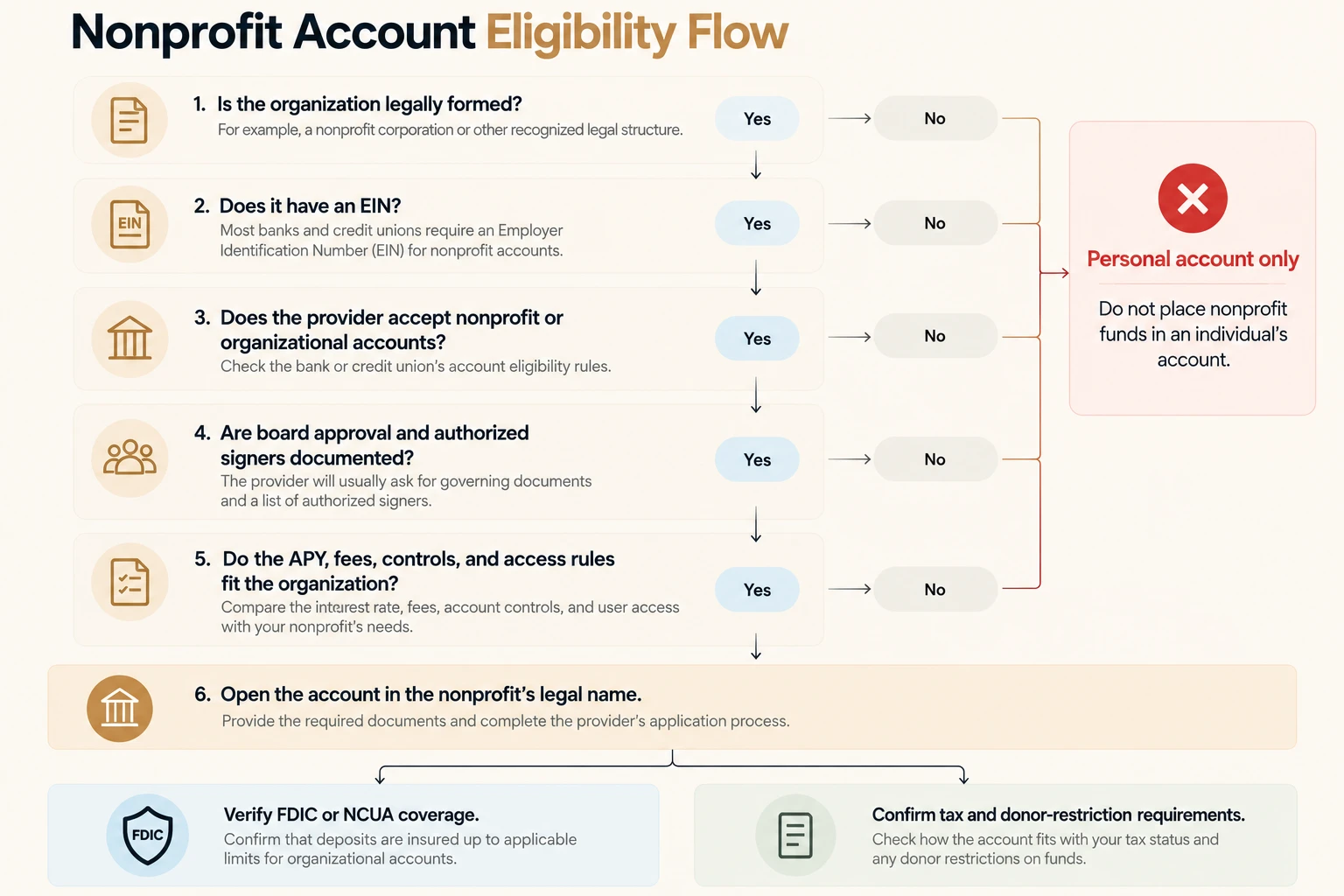
1. Confirm the Organization’s Legal Status
Make sure the legal name, address, EIN, and formation records are consistent. Remember that forming a nonprofit under state law does not automatically provide federal tax-exempt status.
2. Review the Provider’s Eligibility Rules
Confirm that the account accepts nonprofit corporations or unincorporated associations. Do not assume a consumer account will accept an organization.
3. Approve the Account Internally
The board or another authorized governing body may need to approve:
- The selected bank
- The type of account
- The initial deposit
- The people allowed to access the account
- Whether one or two approvals are required for transfers
Keep the resolution with the nonprofit’s financial records.
4. Gather the Required Documents
Collect the EIN confirmation, formation documents, bylaws, tax-exemption letter, signer identification, and board resolution before applying.
5. Fund the Account From a Nonprofit-Owned Source
The opening deposit should come from another account belonging to the organization where possible. This creates a clearer record of how funds moved.
6. Add the Account to the Accounting System
Record the opening balance, bank details, account purpose, authorized users, and reconciliation process.
Our guide on how to set up a high-yield savings account explains the standard opening and funding process.
What Account Features Should a Nonprofit Compare?
The highest advertised APY is only one part of the decision. A nonprofit also needs controls that fit how its team manages money.
APY and Balance Conditions
Check:
- Whether the advertised APY applies to organizational accounts
- The minimum opening deposit
- The minimum balance required to earn the APY
- Whether different balance tiers receive different APYs
- Whether the rate is introductory or ongoing
- Whether the provider can change the APY
- The maximum balance the provider accepts
A consumer account and a nonprofit account at the same bank may have different APYs and conditions.
Fees and Transaction Rules
Review monthly maintenance fees, wire fees, ACH fees, excessive transaction charges, and minimum-balance rules. A competitive APY can lose much of its value if the nonprofit regularly pays account fees.
See High-Yield Savings Accounts With No Monthly Fees for the main costs to compare.
Administrative Controls
A nonprofit may need more than one person to access the account. Useful features include:
- Separate user profiles
- Different permission levels
- Dual approval for large transfers
- Downloadable statements
- Transaction alerts
- Audit logs
- Direct accounting integrations
- The ability to remove a signer quickly
A basic high-yield savings app may not provide these controls. The nonprofit should compare the administrative tools as closely as the APY.
Access to Funds
Operating reserves must be available when the organization needs them. Check how long ACH transfers take, whether outgoing wires are available, and whether transfer limits could delay payroll or program spending.
Some online accounts do not provide checks, cards, cash deposits, or branch support. That may be acceptable for reserve funds but inconvenient for daily operations.
Is a Nonprofit Savings Account FDIC Insured?
An eligible nonprofit deposit can receive FDIC coverage when it is held at an FDIC-insured bank.
The FDIC places accounts owned by corporations, partnerships, and unincorporated associations in a specific ownership category. These deposits are generally insured up to $250,000 per legal entity, per insured bank. The entity must be engaged in an independent activity rather than existing only to increase deposit-insurance coverage.
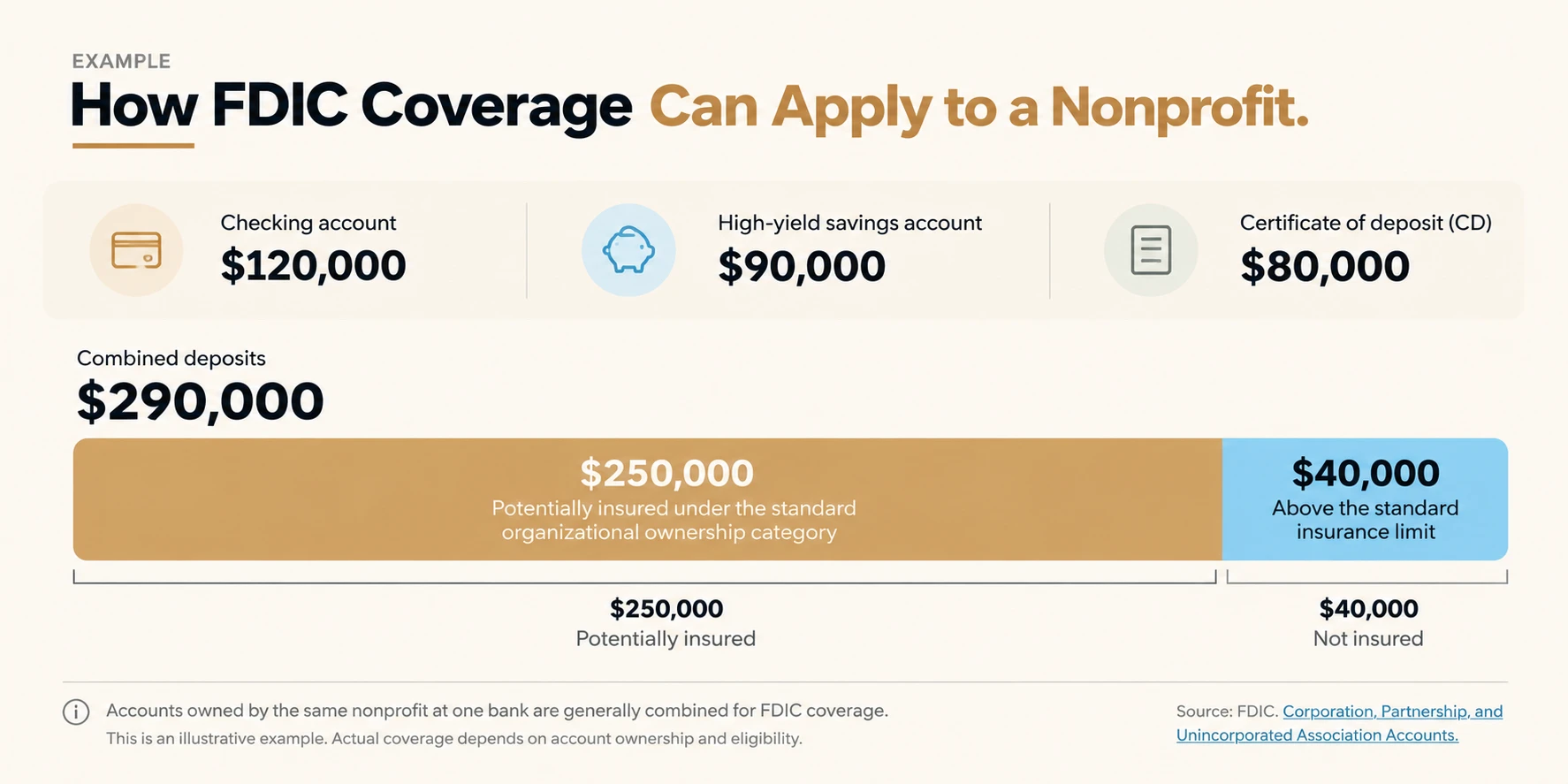
Accounts owned by the same nonprofit at one bank are normally added together. Opening a checking account, savings account, and CD at the same bank does not automatically create three separate $250,000 limits.
For example, suppose a nonprofit holds the following at one insured bank:
- Checking account: $120,000
- High-yield savings account: $90,000
- CD: $80,000
- Total deposits: $290,000
Under the standard corporation, partnership, and unincorporated-association category, the accounts would generally be combined. Up to $250,000 may be insured, leaving $40,000 above the standard limit.
The number of board members, employees, donors, or signers does not multiply coverage. Organizations with larger cash reserves should review the official FDIC rules for corporations, partnerships, and unincorporated associations.
A federally insured credit union may provide NCUA coverage instead. The nonprofit should verify the institution and account type before transferring money.
Are Savings Earnings Taxable for a Nonprofit?
The answer depends on the organization’s tax status and circumstances.
“Nonprofit” and “tax-exempt” are not interchangeable. A group may be organized as a nonprofit under state law without having received federal tax-exempt recognition from the IRS.
For many federally tax-exempt organizations, ordinary passive earnings from bank deposits are generally excluded when calculating unrelated business taxable income. The IRS includes passive investment earnings among the common exclusions described in its guidance on unrelated business income exceptions.
However, that general rule has exceptions. Different treatment may apply when:
- The organization uses borrowed money to produce the earnings
- Payments come from a controlled organization
- The nonprofit regularly conducts an unrelated commercial activity
- The entity is a private foundation
- State or local tax rules apply
- The account contains restricted grant or donor funds
A tax-exempt organization with $1,000 or more in gross income from an unrelated business may need to file Form 990-T. The IRS provides current guidance through its unrelated business income tax resource.
Even when savings earnings are not subject to UBIT, the organization should record them accurately. They may still need to appear in its accounting records and annual information return.
A nonprofit accountant or tax adviser should review the organization’s specific status. Account-opening staff cannot determine how federal or state tax rules apply to the nonprofit.
Should a Nonprofit Save or Invest Its Funds?
Savings and investing serve different purposes.
A savings account may suit operating reserves and money required within a short period. It provides predictable access and may include federal deposit protection.
Investments may offer greater long-term growth potential, but their value can fall. They may also introduce governance, liquidity, reporting, and donor-restriction issues.
Before using a high-yield investment platform, a nonprofit should review:
- Its bylaws
- Board authority
- Written investment policy
- State nonprofit laws
- Donor and grant restrictions
- Time frame for using the money
- Ability to accept a loss
- Tax and reporting requirements
Our guide to savings vs investing explains the difference between holding cash and accepting investment risk.
Coming Soon at PureFi
PureFi currently supports individual accounts only. Business, charity, foundation, nonprofit, and NGO accounts are not available at this time.
An organization should not open or operate a PureFi account through an individual director, employee, volunteer, or representative. The account structure must match the legal owner of the funds.
Organizational accounts are coming soon.


