Can a Business Have a High-Yield Savings Account?
Yes, a business can have a high-yield savings account when the bank or credit union accepts business customers. These accounts let companies keep reserve funds separate from daily operating cash while earning a variable APY.
Business HYSAs are less common than personal accounts. Some providers only accept individuals, even when their personal account offers a competitive yield. Others offer separate products for sole proprietors, LLCs, partnerships, and corporations.
Before applying, check the provider’s eligibility rules, required documents, transaction limits, fees, and deposit protection. Do not open a personal HYSA for business money unless the provider expressly allows that use.
What Is a Business High-Yield Savings Account?
A business HYSA is a deposit account opened in the name of a business. It works much like a personal high-yield savings account, but its ownership and verification requirements are different.
The business holds the account. Authorized people manage it on the company’s behalf. These may include an owner, partner, director, officer, treasurer, or employee with approved account access.
The account can hold money that is not needed for daily payments, such as:
- Emergency operating reserves
- Tax funds
- Payroll reserves
- Planned equipment purchases
- Seasonal cash
- Money for expansion or a future office
- Proceeds waiting to be used
A business HYSA should not replace the company’s checking account. Checking is better suited to vendor payments, card spending, payroll, and frequent transfers. Savings gives surplus cash a place to earn until the business needs it.
Which Businesses Can Open a HYSA?
Eligibility depends on the provider. A bank may accept some business structures while excluding others.
Sole Proprietorships
A sole proprietor may be able to open a business savings account using an Employer Identification Number, Social Security number, or another accepted tax identifier.
The provider may also request a business licence or a “doing business as” registration when the business trades under a name different from the owner’s legal name.
LLCs and Corporations
An LLC or corporation normally applies in its registered legal name. The bank may request formation documents, an EIN, ownership information, and proof that the applicant is authorized to act for the company.
A provider can support single-member LLCs without accepting businesses with several owners. Read the eligibility rules instead of assuming all LLCs are treated alike.
Partnerships
Partnerships may need to provide a partnership agreement and identify the partners or other individuals who own or control the business.
The agreement can also help the bank confirm who has authority to open and manage the account.
Nonprofits and Other Organizations
Some banks accept registered nonprofits, associations, and other organizations. Others limit online applications to conventional for-profit businesses.
The requirements may include formation documents, a board resolution, tax-status information, and details about the people authorized to manage the account.
Our guide to whether a nonprofit can open a high-yield savings account covers those requirements separately.
Why Would a Business Use a High-Yield Savings Account?
The main reason is to earn on cash that would otherwise sit in a low-yield operating account.
A company may need to keep a large balance available for taxes, payroll, repairs, inventory, or slower trading periods. Moving part of that balance into savings can increase earnings without committing it to a fixed term.
It Separates Spending Cash From Reserves
Keeping every dollar in one checking account makes it difficult to see what is available for daily use.
A separate savings balance creates a clearer boundary. The checking account covers current obligations, while the HYSA holds money assigned to future needs.
This separation does not stop authorized users from transferring the funds. It simply makes the purpose of the money easier to track.
It Keeps Funds Available
A HYSA does not normally have a fixed maturity date. The business can request a withdrawal when it needs the money.
Access may not be immediate. External transfers can take one or more business days, and the provider may set daily or monthly transfer limits. A company should keep enough money in checking to cover obligations that cannot wait.
It Can Support Cash Planning
A business can create a regular transfer from checking to savings after revenue arrives. Another option is to move a fixed percentage of receipts into separate reserves for taxes or future expenses.
The account should support the company’s cash plan rather than forcing it. A slightly higher APY may not be useful if the transfer process is slow or the minimum balance is too high.
What Documents Does a Business Need?
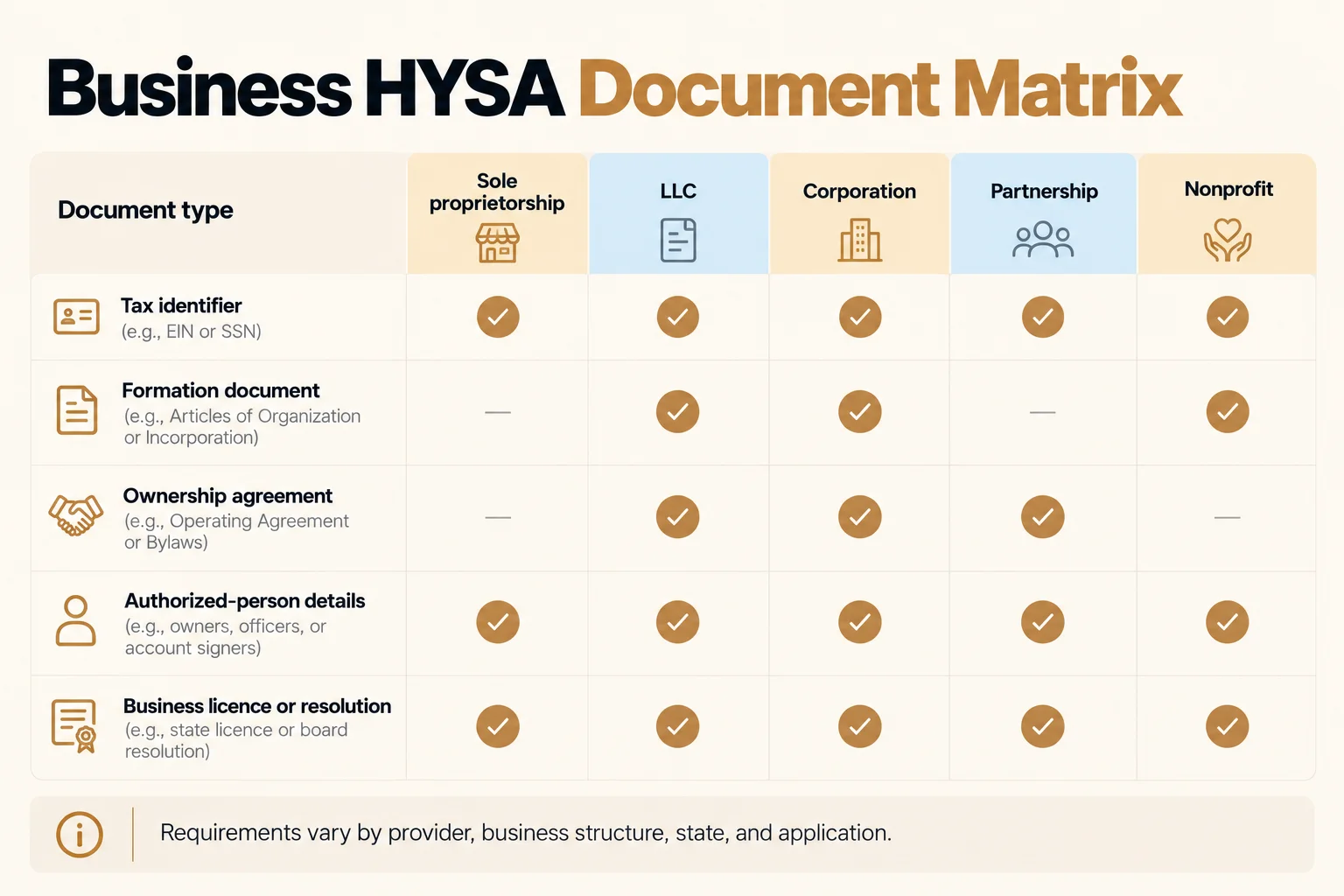
Requirements vary by provider and business structure. The following table shows common examples.
| Business type | Documents commonly requested |
|---|---|
| Sole proprietorship | Owner’s ID, tax identifier, business licence, and DBA registration when applicable |
| LLC | Articles of organization, EIN, operating agreement, and ownership information |
| Corporation | Articles of incorporation, EIN, bylaws, and corporate resolution |
| Partnership | Partnership agreement, EIN, and partner information |
| Nonprofit | Formation documents, EIN, board resolution, and tax-status documents |
The bank may also ask for the business address, industry, expected account activity, source of funds, annual revenue, and reason for opening the account.
The U.S. Small Business Administration notes that an EIN is used to open a business bank account. It also recommends opening a business account once the company begins accepting or spending money.
A digital savings platform may complete the entire application online. More complex ownership structures can require manual review or additional documents.
Why Does the Bank Ask About Business Owners?
Banks must understand who owns and controls a legal entity opening an account.
FinCEN’s Customer Due Diligence Rule generally requires covered financial institutions to identify relevant beneficial owners. This commonly includes individuals who own at least 25% of the legal entity and one person with significant responsibility for controlling or managing it.
The bank may request each relevant person’s name, date of birth, address, tax identification details, and identification document.
In 2026, FinCEN issued relief allowing covered institutions to limit repeated beneficial-owner verification in certain circumstances after the legal entity’s first account is opened. Banks may still collect updated details when existing information is unreliable or their risk-based procedures require it.
Bank verification is separate from Corporate Transparency Act reporting. Current FinCEN rules exempt U.S. companies from filing beneficial ownership reports with FinCEN, but that exemption does not prevent a bank from requesting ownership information when opening an account.
How Do You Open a Business HYSA?
Start by confirming that the provider accepts your business type. Check whether the application is available nationwide or limited to particular states.
Next, review the live APY and the balance needed to receive it. A provider may apply one rate to the entire balance, use balance tiers, or cap the amount eligible for the highest APY.
Prepare the business and ownership documents before starting. The application may time out if several people need to locate identification or formation records.
The opening process will usually involve:
- Entering the business’s legal and contact details
- Identifying owners and authorized account users
- Uploading the requested documents
- Accepting the account and access terms
- Connecting a business checking account
- Making the opening deposit
Do not fund the account from an unrelated personal account unless the provider allows it. Banks may restrict incoming transfers to accounts owned by the same business.
Our general guide to opening a high-yield savings account explains the account-comparison and funding steps in more detail.
What Account Features Should a Business Compare?
APY matters, but it should not be the only deciding factor.
Start with access. Check how quickly money can move back to checking, whether outgoing wires are available, and whether the provider sets transfer limits. A high yield savings app should display the available balance separately from pending deposits.
Then review account permissions. A single-owner business may only need one login. A larger company may need separate users, approval limits, dual authorization, and transaction records showing which person took each action.
Also compare:
- Monthly maintenance fees
- Minimum opening deposit
- Balance needed to earn the advertised APY
- Incoming and outgoing transfer limits
- Wire and expedited-transfer charges
- Deposit methods
- Customer-support hours
- Account statements and bookkeeping exports
Our guide to high-yield savings accounts with no monthly fees explains why a no-fee label does not describe every possible account charge.
How Does FDIC Coverage Apply to Business Savings?
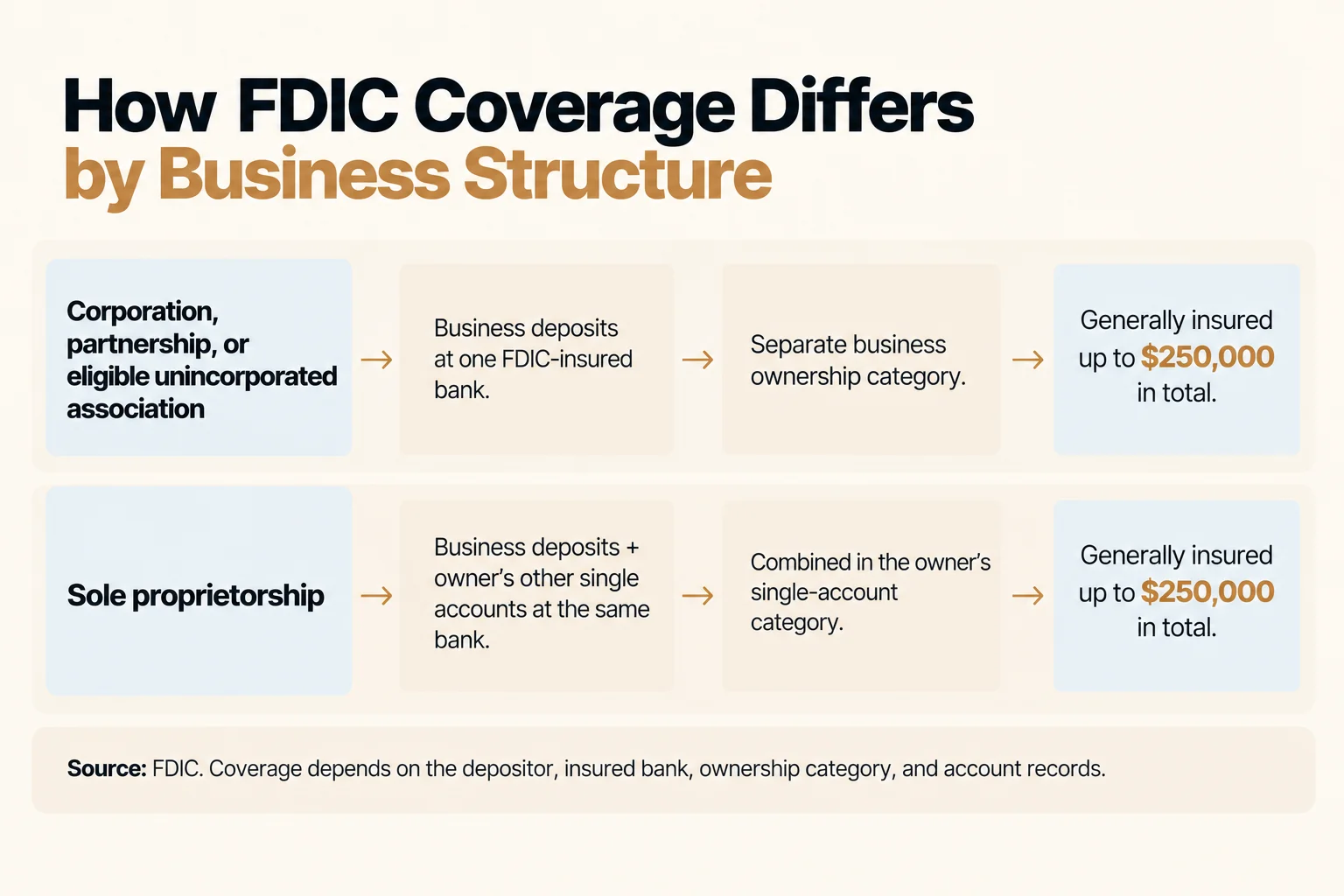
Eligible business deposits at an FDIC-insured bank can receive federal deposit protection. The calculation depends on the legal structure and ownership category.
Deposits owned by a corporation, partnership, or unincorporated association engaged in an independent activity are generally insured separately from the personal deposits of owners or shareholders. The standard limit is $250,000 for the organization’s combined deposits in that ownership category at the same insured bank.
Sole proprietorships are treated differently. The FDIC generally combines sole-proprietorship deposits with the owner’s other single accounts held at the same bank.
Opening several accounts under different business names does not automatically create additional coverage. Verify the bank, legal owner, ownership category, and total deposits held at that institution.
Put Your Dollars Into Something Real
With PureFi, your projected earnings come from shares of real homes with tenants. Choose your properties from your phone, review the documents, and see every fee before you confirm.
Learn more about how PureFi can help you own real estate shares or download the app to get started today.
Up to 6% APY is projected, variable, and not guaranteed. Property shares can lose value. PureFi is not a bank, and its balances and real estate shares are not covered by FDIC insurance or another government deposit scheme.