Best High-Yield Savings Accounts for an Emergency Fund
The best emergency-fund account is not always the one with the highest APY. It must also let you reach the money when something goes wrong.
A competitive high yield digital savings account can keep emergency cash earning while it waits. However, slow transfers, monthly fees, balance requirements, or difficult rate conditions can make an account less useful.
We compared five accounts based on current APY, fees, opening requirements, deposit protection, and access. Rates are accurate as of October 2026 and may change.
What Makes a HYSA Suitable for an Emergency Fund?
An emergency fund has one job: cover an expense you did not plan for. The account should therefore protect the balance and provide a reliable withdrawal route.
No Monthly Maintenance Fee
A monthly charge removes money from the reserve whether you use the account or not. This matters most while the balance is still small.
A no-fee account can still charge for optional services such as outgoing wires, stop payments, paper checks, or expedited transfers. Our guide to high-yield savings accounts with no monthly fees explains what to check.
Fast Access to the Balance
An account may allow withdrawals without providing instant access. External transfers often take one or more business days. Weekends, holidays, and security reviews can add time.
An optional ATM card or fast internal transfer to checking can make emergency money easier to reach. Read Can You Withdraw From a High-Yield Savings Account? for more on withdrawal methods.
Eligible Deposit Protection
A bank should be an FDIC member, or a credit union should carry NCUA coverage. Protection normally applies within federal limits and ownership categories.
You should still verify the institution rather than relying on the app’s branding. Our guide to whether high-yield savings accounts are safe covers this step.
A Realistic APY
The headline APY should apply to the balance you expect to hold. Check for deposit conditions, balance tiers, promotional periods, and caps.
A slightly lower APY with easier access may be more useful than a top rate tied to requirements you might miss.
Best Emergency-Fund HYSAs at a Glance
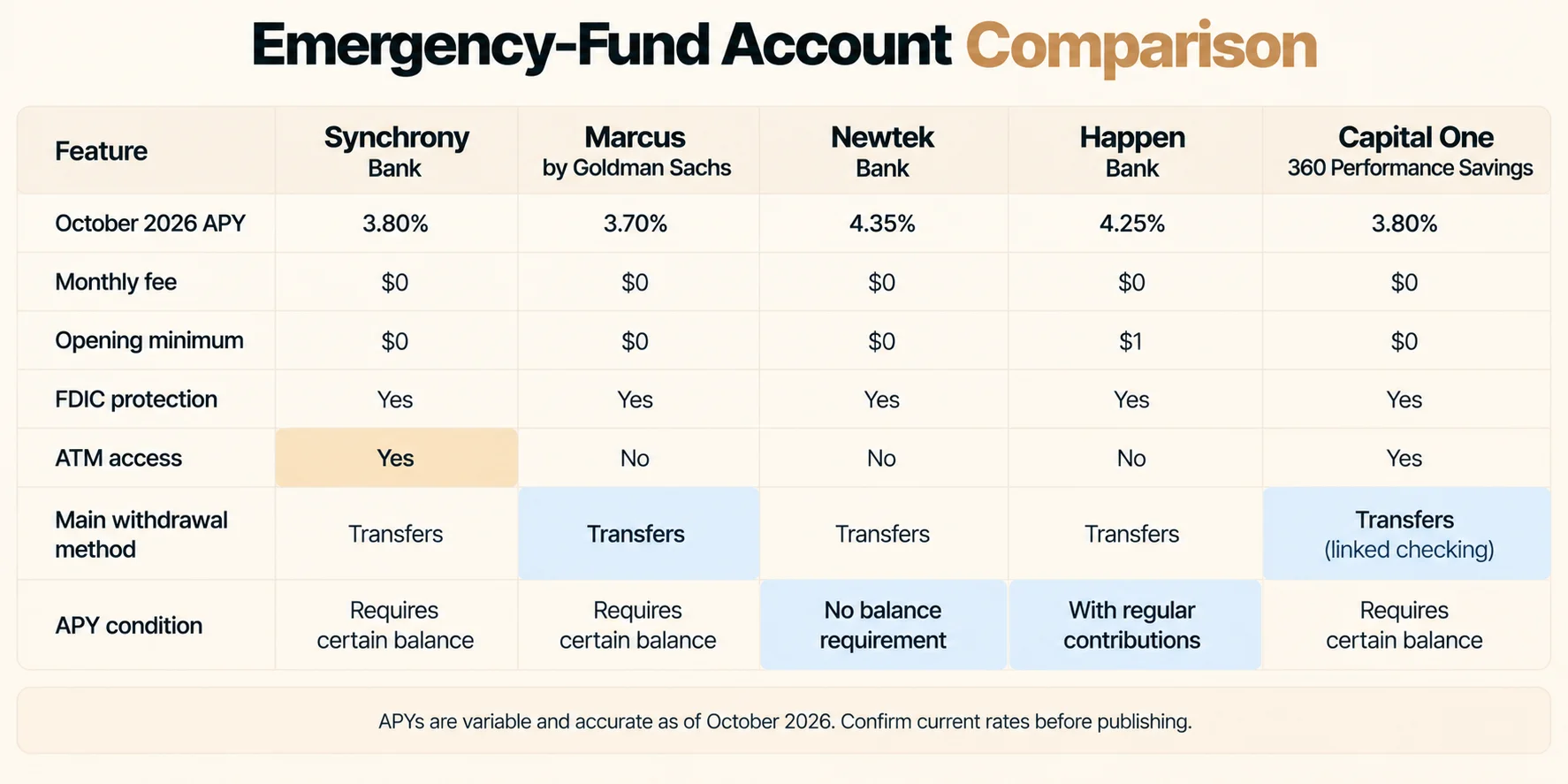
| Account | APY in October 2026 | Monthly fee | Opening minimum | Access advantage |
|---|---|---|---|---|
| Synchrony High Yield Savings | 3.55% | $0 | $0 | Optional ATM card |
| Marcus Online Savings | 3.50% | $0 | $0 | Eligible same-day transfers |
| Newtek Personal High Yield Savings | 4.20% | $0 | $0 | Higher APY without monthly activity |
| Happen High-Yield Savings | Up to 4.20% | $0 | $0 | Strong APY with regular deposits |
| Capital One 360 Performance Savings | 3.20% | $0 | $0 | Fast access when paired with checking |
Rates are variable. Confirm the current APY, eligibility rules, and transfer terms before opening an account.
1. Synchrony High Yield Savings: Best for ATM Access
Synchrony’s High Yield Savings Account offered 3.55% APY in October 2026. It has no monthly service fee, minimum opening deposit, or ongoing minimum balance.
Its main emergency-fund advantage is the optional ATM card. Customers can withdraw cash from machines displaying the Plus or Accel logos. Synchrony does not charge an ATM fee and refunds up to $5 in domestic ATM fees per statement cycle. ATM owners may still impose their own charges.
The card is intended for ATM transactions. It should not be treated as a full purchase-enabled debit card. Customers can also use electronic transfers, direct deposits, mobile check deposits, incoming wires, and mailed checks to add money. Checks cannot be written from the HYSA.
Eligible deposits receive FDIC protection within applicable limits. Synchrony may suit someone who wants direct cash access without keeping the entire emergency fund in checking.
2. Marcus Online Savings: Best for Larger Transfers
Marcus Online Savings offered 3.50% APY in October 2026. The account has no monthly maintenance fee and no minimum opening deposit.
Marcus does not provide an ATM card or direct cash withdrawals. Access mainly happens through transfers to a linked bank account.
Its main strength is transfer capacity. Eligible customers can make same-day transfers of up to $100,000 when requests meet Marcus’s timing and account requirements. The receiving bank can still affect when the money becomes available. This can make Marcus useful for a larger emergency fund. It may cover expenses such as urgent home repairs, medical bills, or a period without income.
Customers who may need physical cash immediately should keep a smaller buffer in checking. Marcus works better when a bank transfer is fast enough for the expected emergency. Eligible deposits are held by Goldman Sachs Bank USA and receive FDIC protection within applicable limits.
3. Newtek Personal High Yield Savings: Best for a Higher APY
Newtek Personal High Yield Savings offered 4.20% APY in October 2026. It does not require a minimum opening deposit or charge a monthly maintenance fee.
The advertised APY does not depend on monthly card purchases or a recurring direct-deposit requirement. This makes the account easier to maintain than products with several qualification rules.
The tradeoff is access. Newtek’s savings account does not highlight an ATM card or direct debit-card spending. Customers generally need to move money electronically to another bank before using it. That transfer step may be acceptable when an expense can be paid within one or two business days. It is less suitable for someone who regularly needs same-day cash.
Newtek Bank is an FDIC member, so eligible balances receive protection within applicable limits. This account may suit someone who wants a stronger APY and is comfortable keeping a separate checking balance for immediate expenses.
4. Happen High-Yield Savings: Best for Regular Contributions
Happen Bank offered up to 4.20% APY in October 2026. The account has no monthly maintenance fee or minimum opening balance.
The highest APY is conditional. Customers must make at least $250 in qualifying deposits during the previous evaluation period. When that requirement is missed, a lower APY applies.
This structure can work well for someone who is still building an emergency fund. A scheduled monthly transfer of $250 or more may satisfy the condition while steadily increasing the reserve.
It may be less attractive once the fund is complete. A customer who stops making regular deposits could lose the highest rate even while maintaining a large balance. Happen Bank provides online account management, and eligible deposits receive FDIC protection.
Before opening the account, check how the evaluation period works, which deposits qualify, and when the lower APY takes effect.
5. Capital One 360 Performance Savings: Best for Checking Access
Capital One 360 Performance Savings offered 3.20% APY as of October 24, 2026. It has no monthly maintenance fee or minimum opening deposit. The savings account does not provide direct debit-card access. Its main advantage appears when it is paired with Capital One checking.
A customer can move money internally from savings to checking and then use the checking debit card, ATM network, or bill-payment tools. Internal transfers are generally more convenient than waiting for money to reach another bank. This setup can keep emergency savings separate without placing it several business days away.
Capital One also provides online and mobile management, account alerts, and customer support seven days a week. Eligible savings deposits receive FDIC protection within applicable limits.
The APY is lower than Newtek or Happen, but access and simplicity may matter more when the money is reserved for emergencies.
How Much Should You Keep in an Emergency HYSA?
There is no single target that fits everyone. Start with necessary expenses rather than total income. Include housing, utilities, basic food, transport, insurance, debt minimums, medication, and other costs that cannot be paused.
Use this calculation:
Essential monthly expenses × number of months covered = emergency-fund target
For example:
$3,000 × 4 months = $12,000 emergency-fund target
Someone with stable employment and two household incomes may choose a smaller reserve. A freelancer, single-income household, or person with irregular medical costs may want more.
Keep a small buffer in checking for payments that cannot wait. The larger reserve can stay in the HYSA and earn.
A high yield savings app should show the available balance, pending transfers, daily limits, and expected arrival date. If those details are difficult to find, the account may be inconvenient during an emergency.
Which Emergency-Fund Account Should You Choose?
Choose Synchrony when ATM access matters. Choose Marcus when larger bank transfers are more useful than cash withdrawals. Newtek may suit someone who wants a higher APY without monthly activity requirements.
Happen works best when regular contributions naturally meet its deposit condition. Capital One may be the easier option when savings and checking are kept at the same bank.
Our guide to picking a high-yield savings account covers the broader comparison process.
Do not move an emergency reserve based on a small APY difference alone. Check how long withdrawals take, what fees apply, and whether the access method works for the expenses you are preparing to cover.

Keep Emergency Cash Separate From Investments
PureFi is a high yield investment platform, not a bank or insured emergency savings account. Our users purchase shares of rented homes, and those shares can change in value.
Money needed for immediate emergencies should not depend on selling an asset at the current market price. PureFi may be considered for money beyond the emergency reserve when the user understands the risks.
Put your dollars into something real
With PureFi, your projected earnings come from shares of real homes with tenants. Choose your properties from your phone, review the documents, and see every fee before you confirm.
Learn more about how PureFi can help you own real estate shares or download the app to get started today.
Up to 6% APY is projected, variable, and not guaranteed. Property shares can lose value. PureFi is not a bank, and its balances and real estate shares are not covered by FDIC insurance or another government deposit scheme.