
Are Savings Accounts Good for the Long Term?
A savings account can support a long-term financial plan, but it is rarely the complete solution. Its yield comes from the provider’s advertised APY, which may change over time. Funds are generally accessible through transfers or withdrawals, while eligible bank deposits may receive government-backed protection.
The tradeoff is growth: inflation can reduce purchasing power even when the balance increases. A digital savings platform may offer a stronger projected yield, but its structure and protections can differ from those of a bank. The right choice depends on the goal, time horizon, liquidity needs, and tolerance for loss.
Are Savings Accounts Good for Long-Term Goals?
Savings accounts are effective when preserving a dollar amount matters more than maximizing growth. They work well for emergency reserves, planned purchases, tax payments, and the portion of a portfolio that must remain accessible. They can also hold funds as a long-term goal approaches and the account holder no longer wants to expose the full amount to market volatility.
They are less effective when the goal is several decades away and requires substantial real growth. A savings account may provide stability, but its yield may not be high enough to offset inflation, taxes, or the rising future cost of the goal. The answer depends on when the money will be used and what level of uncertainty the saver can accept.
Why Savings Accounts Can Remain Useful for Years
The balance does not follow market prices
A conventional savings balance does not rise and fall with stock, bond, or property prices. That makes the account useful for money with a fixed purpose. If a payment is due on a known date, avoiding a market loss immediately before that date may be more important than pursuing a higher return.
Funds remain relatively accessible
Liquidity is valuable even when a goal is years away. Financial plans change, and unexpected costs can appear before the original target date. Savings accounts normally allow funds to be transferred without selling an asset. The account holder should still check transfer times, daily limits, withdrawal methods, and any charges for expedited or international transfers.
Eligible deposits can receive protection
A savings account at an eligible bank or credit union may be covered within applicable FDIC or NCUA limits. This protection applies if the insured institution fails. It does not lock in the APY or protect the future buying power of the balance.
Our guide to high-yield savings account safety explains the difference between deposit coverage, account security, and return risk.
Inflation Is the Main Long-Term Risk
The number shown in an account is its nominal balance. What matters for a long-term goal is the amount of goods and services that balance can purchase. Inflation raises prices over time, so a balance can grow while losing purchasing power.
A useful approximation is to subtract inflation from the account’s APY. If an account earns a 3.00% APY while inflation runs at 4.00%, the real yield is approximately negative 1.00%. The account holder has more dollars at the end of the year, but those dollars buy slightly less in aggregate. The exact result can also be affected by taxes and changes in the rate during the year.
The US Consumer Price Index increased 3.4% over the 12 months ending August 2026, according to the Bureau of Labor Statistics. Inflation will change, and the rate experienced by an individual household may differ from the national figure. APY should therefore not be reviewed in isolation.
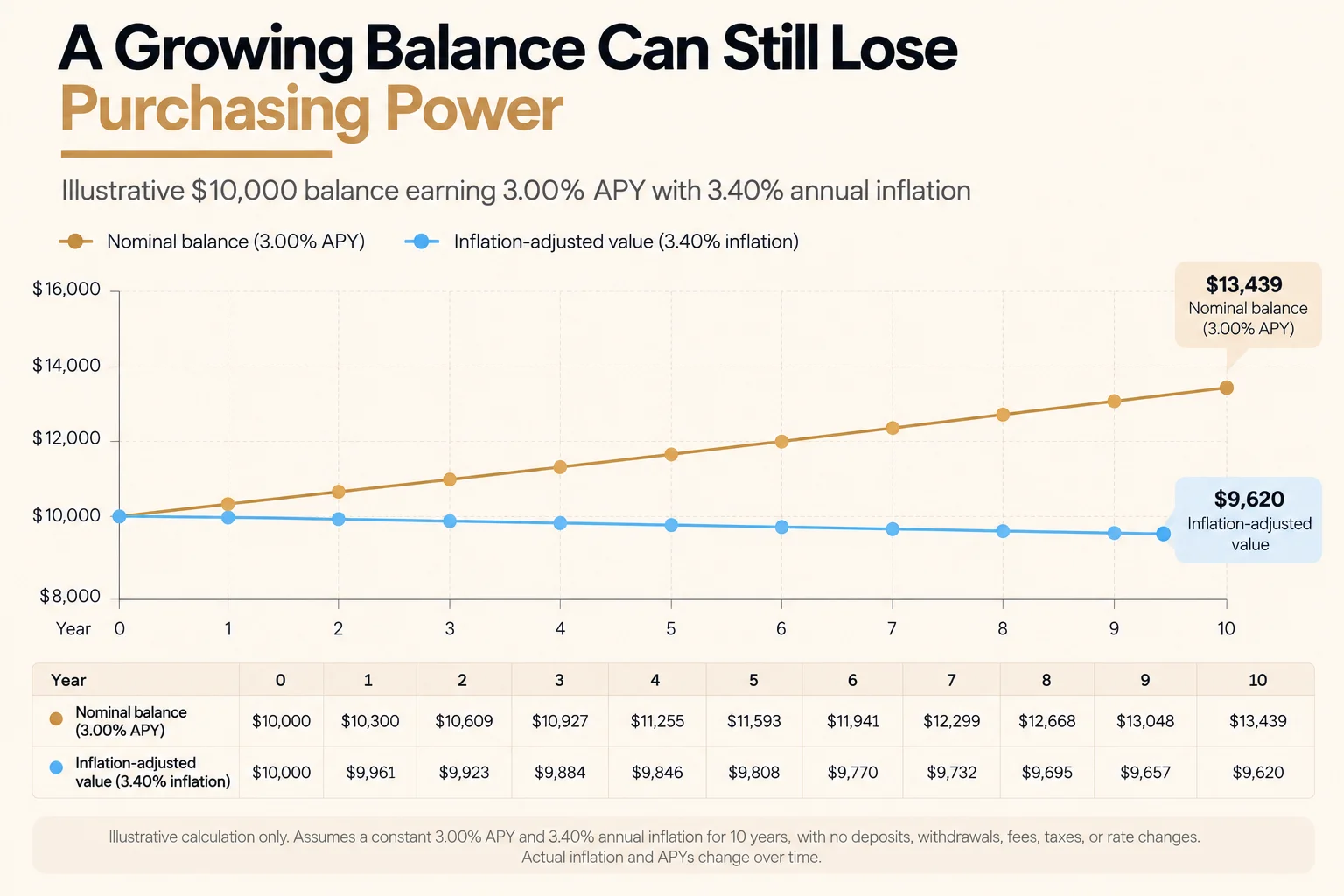
A high-yield account can narrow the gap, but it cannot guarantee a positive real yield. Providers can revise variable APYs as market conditions and their funding needs change. See why high-yield savings account rates change for a closer look at variable-rate accounts.
Account Features That Affect Long-Term Growth
Choosing a high-yield digital savings account requires more than finding the largest number on a comparison page. The following features determine how the account performs in practice.
| Feature | Why it matters over time |
|---|---|
| APY | Shows the annual yield after compounding, assuming the rate and balance conditions remain unchanged. |
| Rate type | A variable APY can rise or fall. A promotional APY may apply only for a limited period or to certain balances. |
| Fees | Monthly charges and transfer costs reduce net earnings, especially when the balance is small. |
| Balance rules | Some accounts require a minimum balance or apply different APYs to different balance tiers. |
| Transfer access | Processing times and limits determine whether the funds will be available when the goal becomes due. |
| Protection | Deposit insurance, custody arrangements, and investment risk are different protections and should not be treated as interchangeable. |
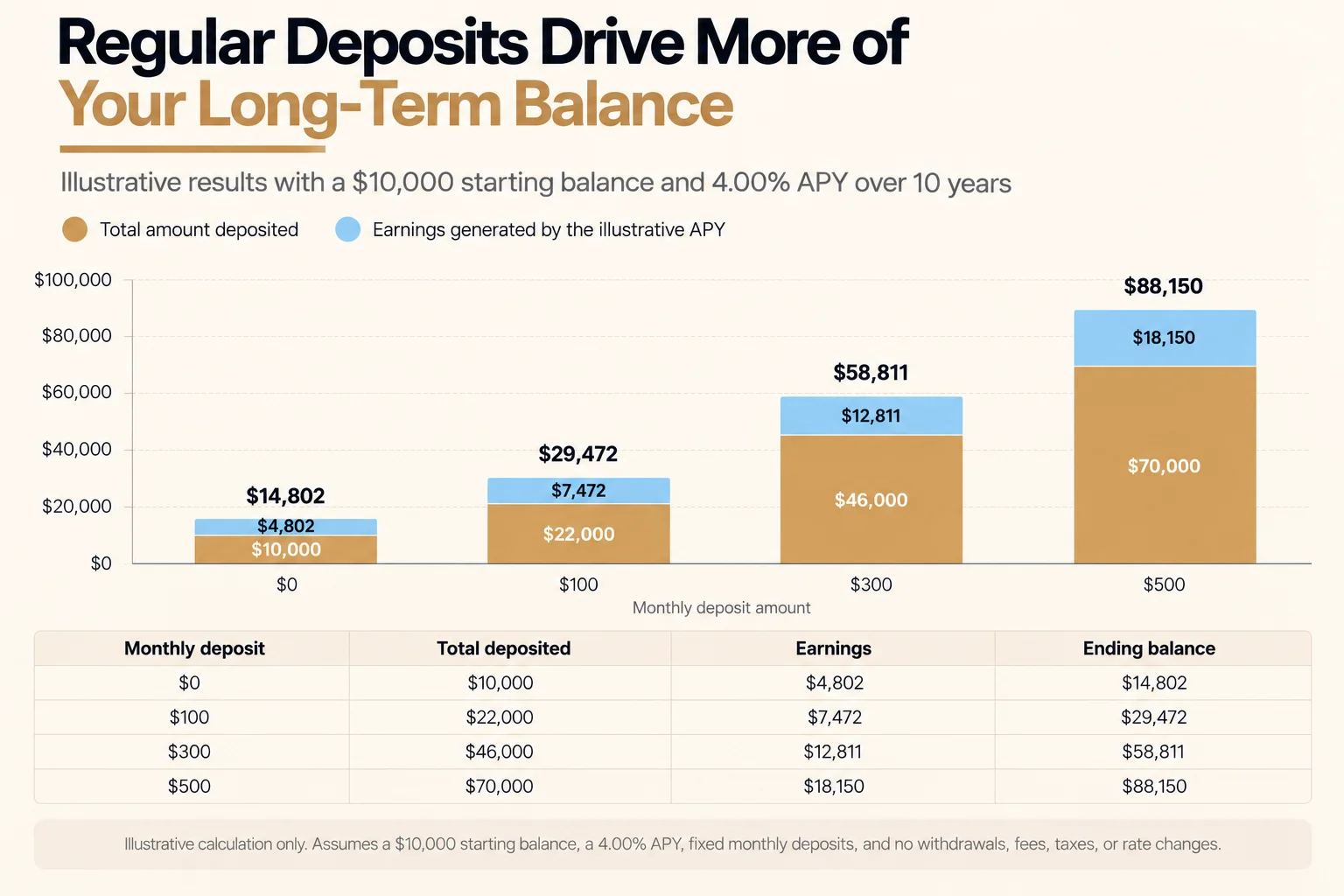
Compounding has the greatest effect when money stays in the account and additional deposits are made consistently. However, regular contributions often affect the ending balance more than a small APY difference.
The examples in how much a high-yield savings account can earn show how balance, time, and APY work together.
When a Savings Account Works Well for the Long Term
A savings account can be appropriate for a goal that extends over several years when the target amount cannot be exposed to a meaningful loss. Examples include a home deposit, tuition due on a fixed date, a business tax reserve, or funds set aside for a planned relocation. In these cases, certainty and access may carry more value than additional growth potential.
It can also hold the stable portion of a larger plan. An account holder may invest part of the money for growth while retaining cash for emergencies and near-term obligations. As the target date approaches, a larger share can be transferred into savings. This reduces the risk of having to sell a volatile asset after a market decline.
The account still needs periodic review. A once-competitive APY may fall behind, or a provider may introduce new fees or balance rules. The benefits of a high-yield savings account are strongest when the account combines competitive yield with straightforward terms and reliable access.
When a Savings Account May Not Be Enough
Cash products generally offer lower expected growth than assets that expose the holder to market risk. For a goal that is decades away, relying only on savings may require larger monthly contributions and leave the balance vulnerable when inflation exceeds the account’s APY.
That does not make investing automatically better. Investments can lose value, and the loss may occur when the funds are needed. Time horizon matters because a longer period may allow more time to recover from market declines. Risk tolerance also matters because a strategy that causes the account holder to sell during volatility may fail even if its long-run assumptions were reasonable.
A high-yield investment platform should therefore be assessed differently from an insured savings account. Expected return, asset ownership, liquidity, fees, custody, and loss risk all need separate review. A higher projected figure is not equivalent to a guaranteed bank yield.
A Better Framework Than Savings Versus Investing
The more useful question is how much of the goal should remain in savings at each stage. Define the target amount and date, separate emergency funds, estimate future costs, and decide how much short-term loss the plan could absorb without missing the deadline.
Compare providers using net yield, transfer access, protection, and account restrictions. A high-yield savings app can automate contributions, but automation does not replace periodic review. Check the APY, terms, security controls, and linked account details during the year.
An online savings app may also help separate balances by purpose, making it easier to track progress without combining every goal in one pool. If several account structures are being considered, what types of savings accounts should I have compares the common options and their typical uses.
Put your dollars into something real
With PureFi, your projected earnings come from shares of real homes with tenants. Choose your properties from your phone, review the documents, and see every fee before you confirm.
Learn more about how PureFi can help you own real estate shares or download the app to get started today.
Up to 6% APY is projected, variable, and not guaranteed. Property shares can lose value. PureFi is not a bank, and its balances and real estate shares are not covered by FDIC insurance or another government deposit scheme.


