
Alternatives to High-Yield Savings Accounts
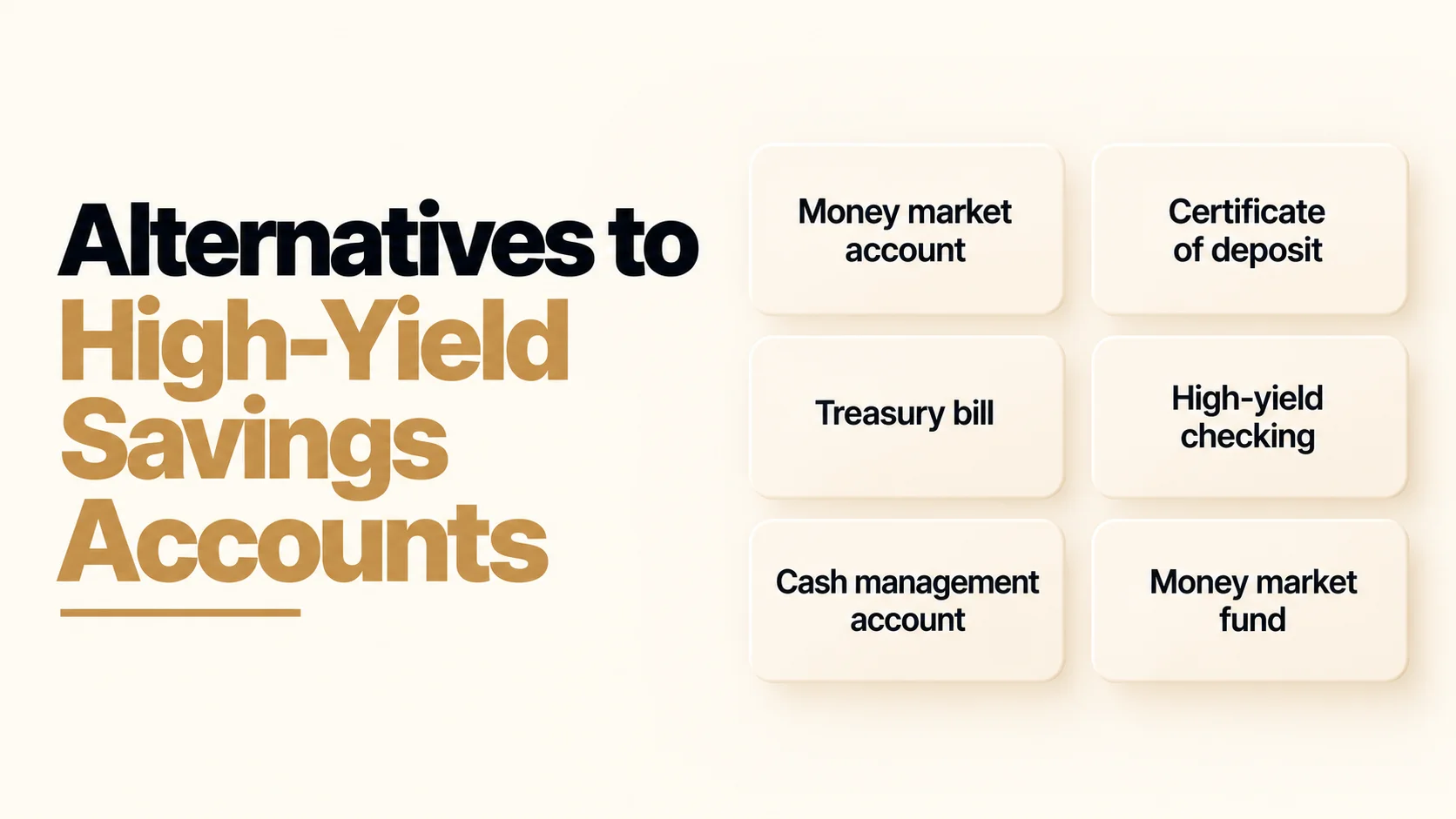
A high-yield savings account is useful when you want your money to earn without giving up easy access. It is not the only option, though. Money market accounts may provide more ways to withdraw. Certificates of deposit can lock in an APY. Treasury bills offer short-term U.S. government debt, while cash management and high-yield checking accounts combine earnings with everyday account features.
The right alternative depends on when you need the money, how often you plan to use it, and whether you need federal deposit protection.
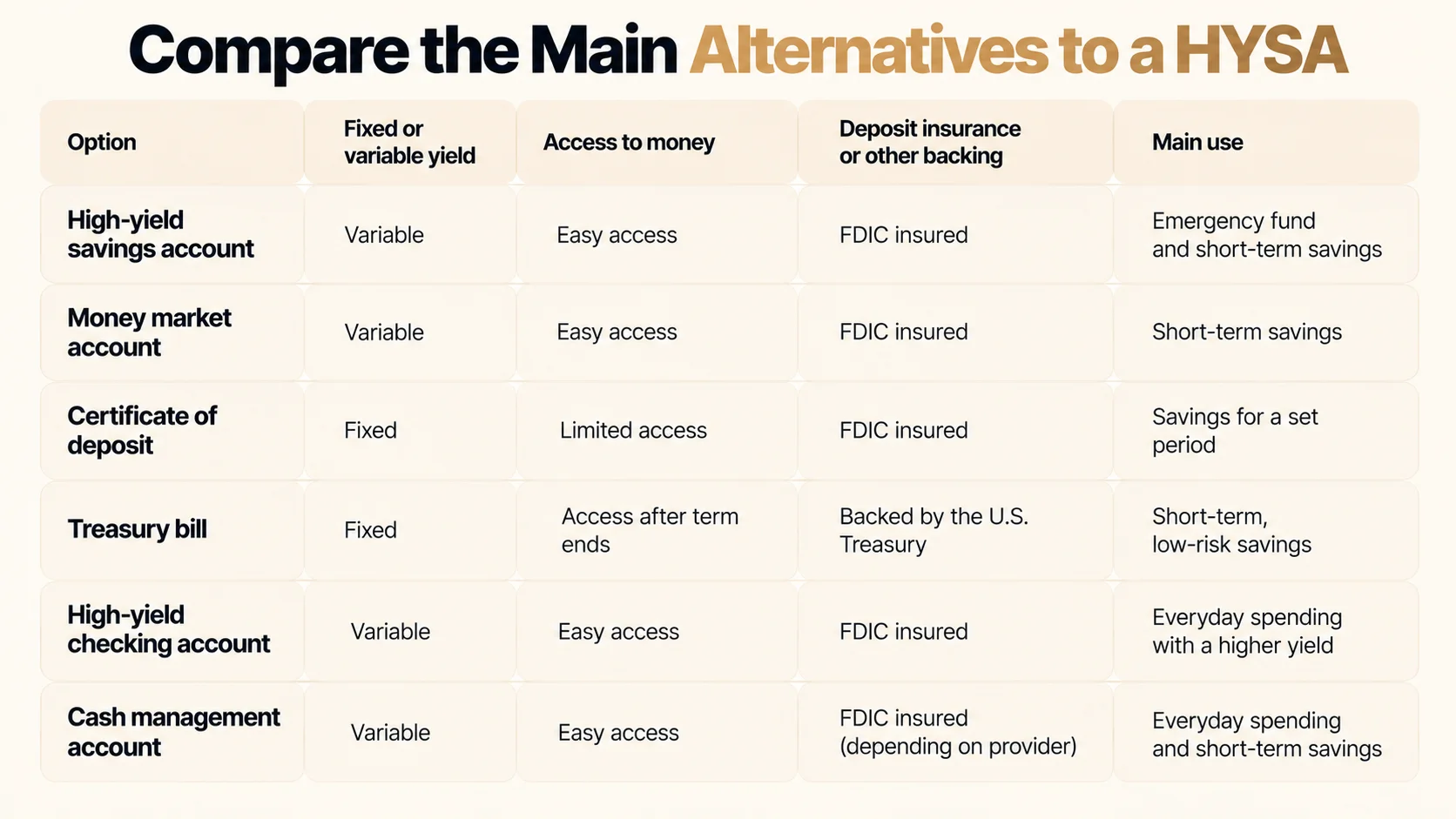
High-Yield Savings Account Alternatives at a Glance
| Option | Yield structure | Access | Main protection or risk | May suit |
|---|---|---|---|---|
| Money market account | Usually variable | Transfers and sometimes checks or an ATM card | Eligible deposits may have FDIC or NCUA protection | Savings that may need occasional transaction access |
| Certificate of deposit | Usually fixed | Normally held until maturity | Eligible deposits may be insured; early withdrawal penalties may apply | Money not needed before a known date |
| Treasury bill | Fixed when purchased and held to maturity | Hold until maturity or sell earlier | Backed by the U.S. government; price can change if sold early | Short-term money with a defined time frame |
| High-yield checking | Usually variable and conditional | Debit card, ATM, bill pay, and transfers | Eligible deposits may have FDIC or NCUA protection | Money used for regular transactions |
| Cash management account | Depends on the provider | Usually strong payment and transfer access | Protection depends on where the cash is held | People combining cash and investment tools |
| Money market fund | Variable investment yield | Shares can normally be sold when cash is needed | Not FDIC insured; value can fall | Brokerage customers who accept investment risk |
These products may look similar on an app screen, but their protections and access rules are not the same.
1. Money Market Accounts
Overview: A money market account is a deposit account offered by a bank or credit union. It works much like a savings account but may provide additional ways to use the money.
Access: Some money market accounts include checks or an ATM card. Others require electronic transfers, similar to an online savings app. The APY is normally variable, which means the provider can change it after the account is opened.
Eligibility and requirements: Most adults who meet the institution’s identity-verification requirements can apply. However, some accounts require a minimum opening deposit or a specific balance to earn the advertised APY or avoid a monthly fee.
Protection: Eligible deposits at an FDIC-insured bank or federally insured credit union may receive protection within the applicable limits. The standard limit is generally $250,000 per depositor, per institution, for each ownership category.
Who it may suit: A money market account may suit someone who wants to earn while keeping more ways to access the balance. It may be less suitable if the account has a high balance requirement or restrictive withdrawal terms.
Do not confuse a money market account with a money market mutual fund. One is a deposit account. The other is an investment.
Our money market account vs high-yield savings account guide examines the differences in more detail.
2. Certificates of Deposit
Overview: A certificate of deposit holds money for a fixed term. Terms can range from a few months to several years. Traditional CDs usually provide a fixed APY, so the APY does not fall during the term.
Access: You generally agree to leave the money in the CD until its maturity date. Withdrawing it early may trigger a penalty. The size of the penalty depends on the institution, the term, and the account agreement.
Eligibility and requirements: CDs are available through banks and credit unions. The provider may require a minimum opening deposit. Some institutions offer higher APYs for larger deposits, although this is not true for every CD.
Available types: A no-penalty CD may allow an early withdrawal after an initial waiting period. A CD ladder divides money among several CDs with different maturity dates, allowing parts of the balance to become available at regular intervals.
Protection: Eligible CDs at insured banks and credit unions may receive FDIC or NCUA protection within the applicable limits.
Who it may suit: A CD may suit money reserved for a known future expense. It is less suitable for an emergency fund or money that may be needed without warning.
Read our no-penalty CD vs savings account comparison before choosing between access and a fixed term.
3. Treasury Bills
Overview: Treasury bills are short-term securities issued by the U.S. Department of the Treasury. Available maturities range from four to 52 weeks.
T-bills are generally bought at a discount or at face value. At maturity, the holder receives the bill’s face value. The difference between the purchase amount and the maturity amount represents the earnings.
Eligibility and purchase requirements: Individual investors can buy Treasury bills through TreasuryDirect or an eligible bank, broker, or dealer. TreasuryDirect requires a valid taxpayer identification number, a U.S. address of record, and an account at a U.S. financial institution that accepts ACH transactions.
Access: You can hold a T-bill until maturity or sell it earlier through a bank or broker. TreasuryDirect does not provide a direct secondary-market selling service. Securities held there generally need to be transferred to a bank or broker before an early sale.
Selling before maturity creates price risk. The sale price may be higher or lower than the amount originally paid.
Protection and taxes: Treasury bills are backed by the full faith and credit of the U.S. government. They are not bank deposits, so FDIC insurance does not apply. Their earnings are subject to federal tax but are generally exempt from state and local income taxes.
Who they may suit: T-bills may suit money with a clear short-term time frame. They are less convenient for everyday payments or money that may be needed immediately.
The official TreasuryDirect Treasury Bills page provides current maturity and auction information.
4. High-Yield Checking Accounts
Overview: A high-yield checking account lets the customer earn while using the account for regular transactions. It may include a debit card, ATM access, check writing, electronic transfers, and bill payments.
Eligibility and requirements: The basic application requirements are generally similar to those for other checking accounts. However, earning the advertised APY may require additional monthly activity.
A provider may require qualifying direct deposits, a set number of debit-card purchases, electronic statements, or regular online banking activity. The highest APY may also apply only up to a balance limit.
Access: These accounts are designed for regular spending. Customers can usually reach the money through debit-card purchases, ATM withdrawals, checks, transfers, and bill payments.
Protection: Eligible balances at an FDIC-insured bank or federally insured credit union may receive protection within the applicable limits.
Who it may suit: A high-yield checking account may suit someone who can meet the monthly requirements through normal activity. It may be less attractive if earning the APY requires unnecessary purchases or constant account monitoring.
Our guide to high-yield checking accounts explains the most common qualification rules.
5. Cash Management Accounts
Overview: A cash management account is normally offered by a brokerage or financial technology company. It may combine cash storage, transfers, debit-card access, bill payments, and investment tools in one place.
Eligibility and requirements: Applicants generally need to meet the provider’s age, identity, residency, and tax-information requirements. Some products are available only alongside a brokerage account.
Access: Cash management accounts often provide debit cards, electronic transfers, direct deposits, bill payments, and ATM access. The exact tools and processing times depend on the provider.
Protection: The company may move uninvested cash into one or more partner banks through a sweep program. Eligible cash placed with those banks may receive pass-through FDIC insurance if the arrangement and account records meet the required conditions.
Money held in securities or money market funds does not receive FDIC protection. Customers should check where their cash is placed rather than assuming the entire account has the same coverage.
Who it may suit: A cash management account may suit someone who wants spending, saving, and investment tools within one platform. It may not suit someone who wants a straightforward bank savings account with one clearly identified deposit institution.
Read HYSA vs cash management account for a direct comparison.
6. Money Market Funds
Overview: A money market fund is a mutual fund that invests in short-term debt securities. Depending on the fund, it may hold government securities, bank obligations, or high-quality corporate debt.
Eligibility and requirements: Money market funds are normally purchased through a brokerage or investment account. The brokerage may require a minimum initial investment, although many funds have low or no stated minimums.
Access: Shares normally need to be sold before the money can be withdrawn or spent. Settlement and transfer timing depend on the fund and brokerage. Some brokerage accounts provide payment features connected to eligible fund balances.
Protection and risk: Money market funds are investments, not deposit accounts. They are not covered by FDIC insurance and can lose value, even though they generally aim to maintain a stable share price.
Brokerage protection does not protect investors from a decline in the fund’s value.
Who they may suit: A money market fund may suit someone who already holds cash in a brokerage account and understands the difference between an investment and an insured bank deposit.
The SEC’s Investor.gov money market fund guide provides more information about how these funds work.
How Should You Compare These Alternatives?
Start with the purpose of the money. An account for emergency expenses has different requirements from money set aside for a purchase next year.
When will you need the money?
If the timing is uncertain, a HYSA or money market account may provide the flexibility you need. If the money will not be used until a known date, a CD or Treasury bill may be more suitable.
High-yield checking is designed for regular transactions. A cash management account may work for customers who want spending and investment tools in one digital savings platform.
Is the yield fixed or variable?
Savings accounts, money market accounts, high-yield checking accounts, and many cash management products normally have variable yields. Traditional CDs generally fix their APY for the term. A Treasury bill provides a defined return when it is bought and held to maturity.
A fixed yield can provide certainty. A variable APY provides more flexibility but may rise or fall.
How is the money protected?
Eligible deposits at an insured bank or credit union may receive FDIC or NCUA protection. Treasury bills carry the backing of the U.S. government but are not deposit accounts.
Money market funds and other market investments are not covered by deposit insurance. Their value can change. Check the institution and account structure instead of relying on product names such as “cash,” “savings,” or “high yield.”
What happens if you need the money early?
Access can come with a cost. A savings or money market transfer may take several business days. A CD may charge an early withdrawal penalty. A Treasury bill may have to be sold at the current market price. A money market fund must be sold before the cash can be withdrawn.
The account offering the highest advertised yield may not be the best option if early access is difficult or expensive.
Put your dollars into something real
With PureFi, your projected earnings come from shares of real homes with tenants. Choose your properties from your phone, review the documents, and see every fee before you confirm.
Learn more about how PureFi can help you own real estate shares or download the app to get started today.
Up to 6% APY is projected, variable, and not guaranteed. Property shares can lose value. PureFi is not a bank, and its balances and real estate shares are not covered by FDIC insurance or another government deposit scheme.


