Types of High-Yield Savings Accounts and How They Compare
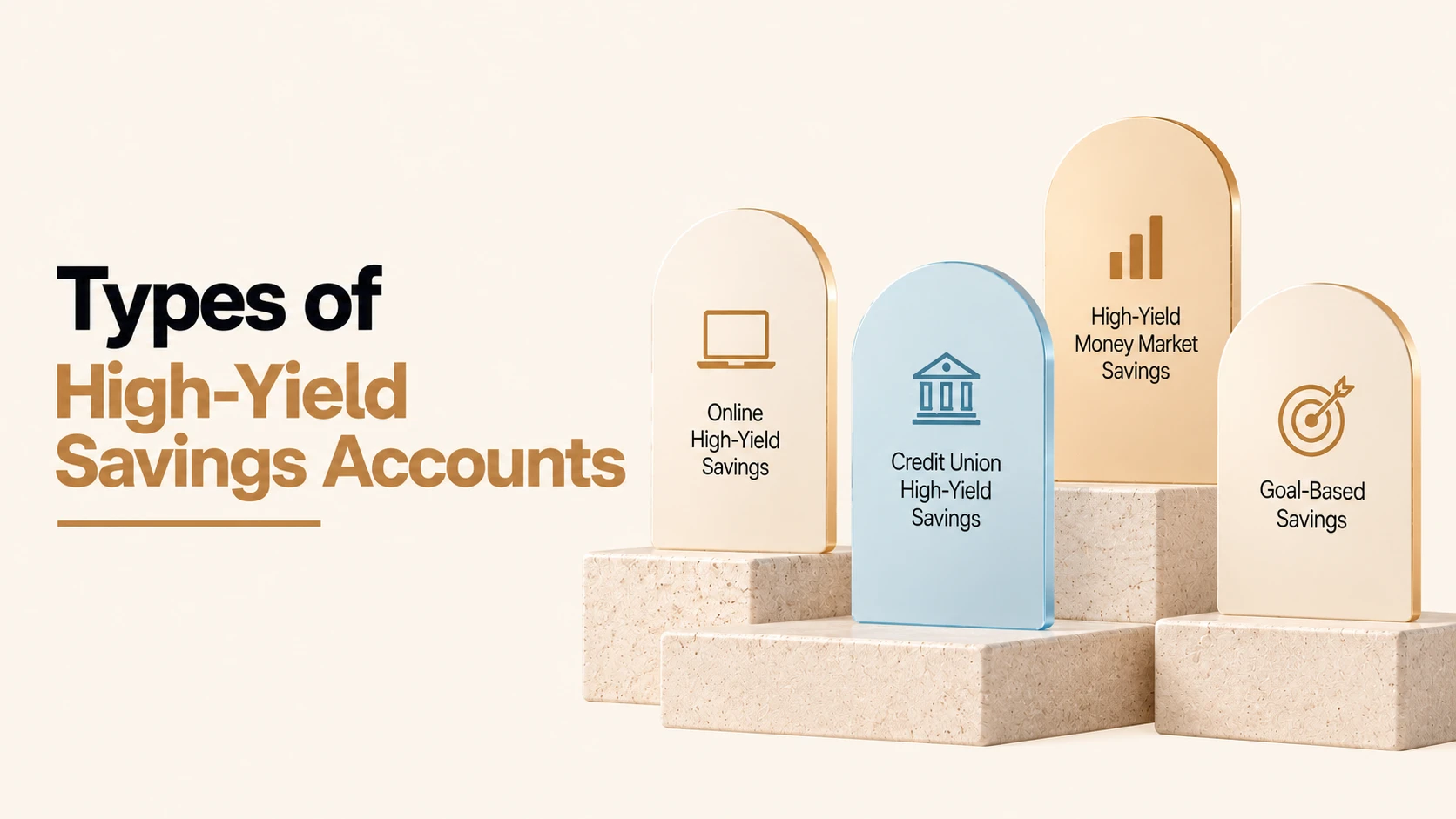
High-yield savings accounts come in several forms. Some are managed online, while others are offered by traditional banks or credit unions. The APY may apply to the entire balance, depend on a balance tier, or require certain monthly activities. Fees, access methods, and eligibility rules also vary. Understanding these differences can help you choose an account that matches your balance and the way you plan to use the money.
Here are seven common types of high-yield savings accounts and the main features of each.
1. Online High-Yield Savings Accounts
Online high-yield savings accounts are managed through a website or mobile app. Because many online providers have limited branch networks, they may offer competitive variable APYs and fewer monthly fees. Deposits and withdrawals are usually completed through electronic bank transfers. Cash deposits may be difficult, and external transfers can take several business days.
A good high-yield digital savings account should clearly display its current APY, transfer status, available balance, and fees. Before opening one, check its transfer limits, customer-support options, and whether ATM access is available.
2. Traditional Bank High-Yield Savings Accounts
Traditional banks may offer high-yield savings alongside checking accounts, cards, and branch services. Customers can often deposit cash, receive in-person support, and transfer money quickly between accounts at the same bank. However, the highest APY may only be available through an online-only product.
The bank may also require a minimum balance or a linked checking account. Check whether the advertised APY is available in your state and whether branch-opened accounts receive the same rate. Our high-yield versus regular savings account comparison explains the broader differences.
3. Credit-Union High-Yield Share Accounts
Credit unions commonly call savings balances “shares” because customers are members of the institution. Opening an account may require membership based on location, employment, association membership, or another qualifying connection. A small deposit may also be needed to establish membership.
Credit unions can offer competitive APYs, although their branches and ATM networks may be more limited. Accounts at federally insured credit unions receive NCUA share insurance within the applicable limits. Our guide to credit-union high-yield savings explains the eligibility and coverage rules.
4. No-Fee and No-Minimum High-Yield Savings Accounts
These accounts have no recurring monthly maintenance fee and may not require customers to maintain a specific balance. They can work well for people starting with a smaller deposit or building their balance gradually.
However, “no monthly fee” does not mean every service is free. Charges may still apply to wire transfers, expedited withdrawals, returned deposits, or paper statements. Some accounts also require a minimum opening deposit or pay the advertised APY only above a certain balance.
Review the full fee schedule before opening an account. See our guide to no-monthly-fee high-yield savings accounts.
5. Tiered-Rate High-Yield Savings Accounts
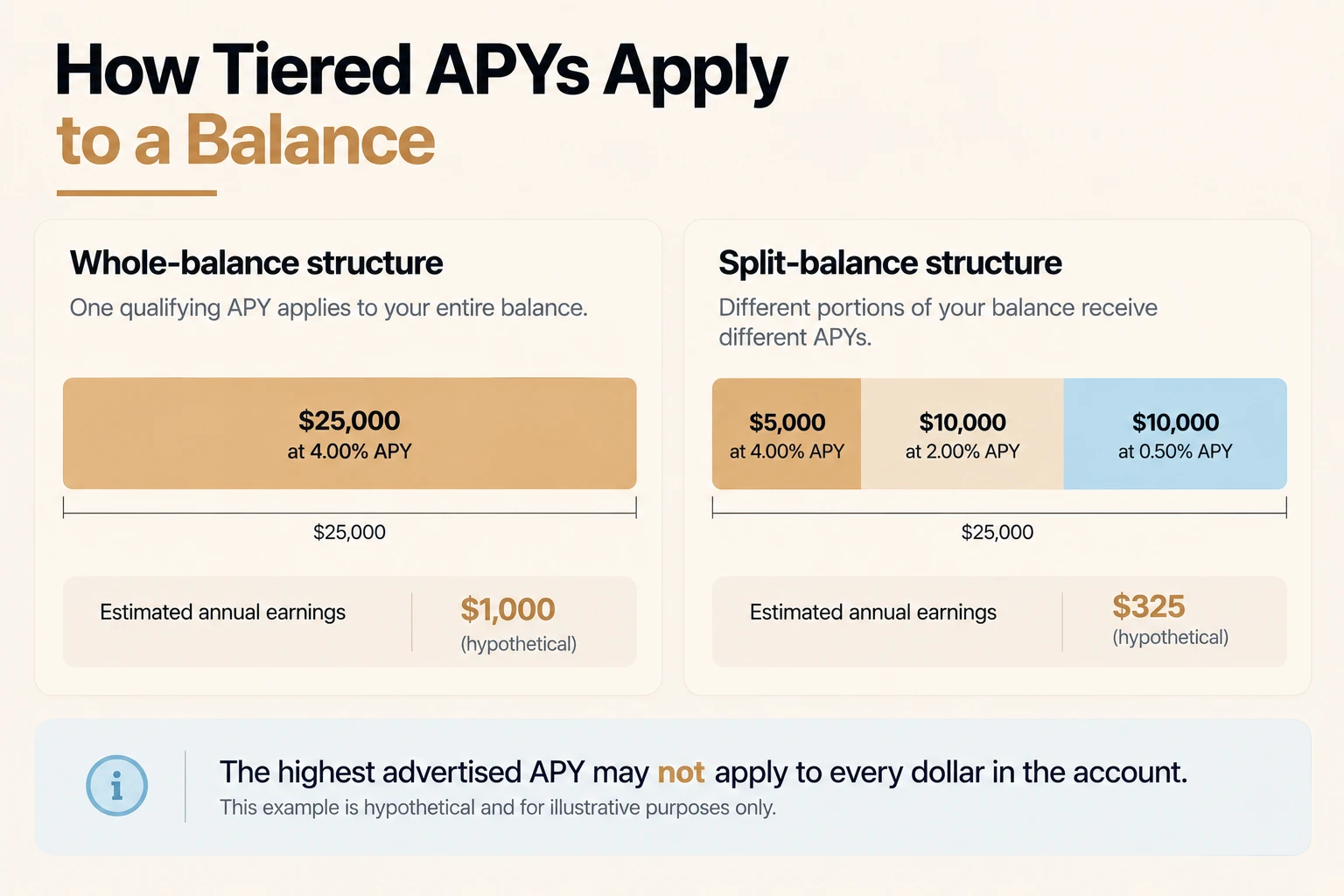
Tiered-rate accounts pay different APYs at specified balance levels. Under a whole-balance structure, the qualifying APY applies to the entire balance. Under a split-balance structure, each portion receives the rate assigned to its tier. Some providers offer their strongest APY only within a narrow balance range and reduce it after the customer passes a cap.
Federal advertising rules require tiered accounts to disclose the APY and corresponding minimum balance for each tier. A trustworthy digital savings platform should show every tier clearly instead of promoting only the highest possible APY.
6. Relationship or Activity-Based High-Yield Savings Accounts
Relationship accounts offer a higher APY when customers complete certain activities or use additional products. Requirements may include receiving direct deposits, maintaining a linked checking account, making recurring deposits, or paying for a membership plan. These accounts can work when the requirements already match your financial routine. They become less useful if you must complete unnecessary transactions or pay a fee solely to qualify.
Compare the qualifying APY with the standard APY paid when the conditions are missed. If a paid plan is required, calculate whether the additional earnings are greater than its monthly cost.
7. Promotional High-Yield Savings Accounts
Promotional accounts provide a temporary APY increase, cash bonus, or other reward. The offer may be limited to new customers, new deposits, or accounts opened before a deadline. Customers may need to deposit a minimum amount and keep it in the account for a set period. Once the promotion ends, the account normally returns to its standard variable APY.
Compare the total expected earnings over the full period you plan to keep the account. A short-term offer may not provide much value if the ongoing APY is low or the withdrawal requirements are too restrictive.
Products That Are Not High-Yield Savings Accounts
Some financial products share features with high-yield savings accounts but have different structures.
Money Market Deposit Accounts
A money market deposit account may offer a competitive APY with checks, an ATM card, or debit-card access. It is still a separate deposit product and may have higher minimum balance requirements.
Certificates of Deposit
A certificate of deposit holds money for a fixed term. Withdrawing before maturity may result in a penalty. A no-penalty CD permits earlier access under specific conditions, but it does not usually provide the same deposit flexibility as savings. Our no-penalty CD versus savings account guide explains the difference.
Cash Management Accounts
Cash management accounts are generally offered by brokerages and financial technology companies. They may combine transfers, card access, bill payments, and brokerage services. Any deposit protection depends on where the provider holds or sweeps the customer’s cash.
Investment Accounts
Investment accounts hold assets that can rise or fall in value. They are not savings accounts, even when a platform shows a projected APY. The FDIC covers eligible deposits at insured banks but does not protect non-deposit investments.
How Account Features Affect Your Choice
The account category is only one part of the decision. You should also review how the APY is calculated, which fees apply, and how quickly you can access your money.
An online account may offer a competitive APY but limited cash access. A traditional bank may provide branches and faster internal transfers but require a minimum balance. A credit union may offer strong terms but restrict membership.
An effective online savings app should show pending transfers, account requirements, and changes to the APY. A high yield savings app should also provide transaction alerts and clear security controls.
Remember that savings APYs are generally variable. The rate available when you open the account can rise or fall later. Compare the account’s complete structure instead of choosing it based only on the current number.
Which Type of High-Yield Savings Account Should You Choose?
Choose an online account if you want digital access and do not need regular branch services. A traditional bank may be more suitable if you deposit cash or prefer in-person assistance. A credit-union account can be useful when you meet its membership requirements and the APY is competitive.
A no-fee account may be better for a smaller balance. Tiered accounts work when your expected balance qualifies for the strongest APY. Relationship accounts make sense when you can meet their conditions without changing your normal financial activity. Promotional accounts may provide short-term value, but the ongoing APY matters once the offer ends.
The right account should match the amount you plan to deposit, the access you need, and the requirements you can meet consistently.
Put your dollars into something real
With PureFi, your projected earnings come from shares of real homes with tenants. Choose your properties from your phone, review the documents, and see every fee before you confirm.
Learn more about how PureFi can help you own real estate shares or download the app to get started today.
Up to 6% APY is projected, variable, and not guaranteed. Property shares can lose value. PureFi is not a bank, and its balances and real estate shares are not covered by FDIC insurance or another government deposit scheme.