PureFi Vs Ether.fi
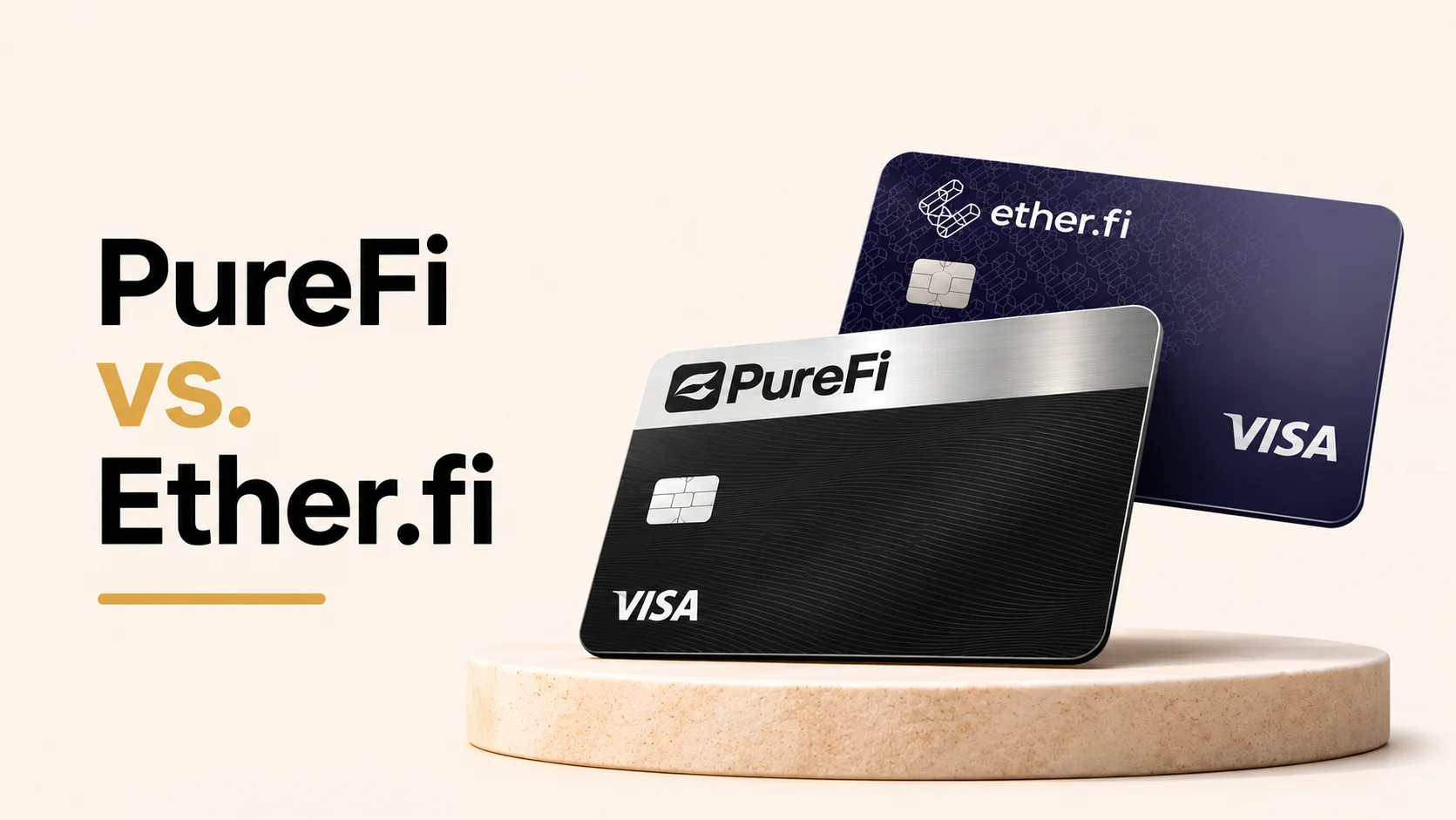
PureFi and Ether.fi both connect digital balances with Visa spending, but the cards handle purchases differently. PureFi will provide Visa debit cards that spend directly from the available PureFi balance. Ether.fi Cash can use eligible assets directly or let a cardholder borrow against crypto held in a non-custodial vault.
Both offer four levels and mobile-wallet support. The key differences are cashback bands, qualifications, foreign-exchange charges and borrowing risk. PureFi keeps spending separate from Earn. Ether.fi Borrow Mode preserves crypto holdings but adds variable debt and liquidation risk.
PureFi vs Ether.fi at a Glance
| Feature | PureFi | Ether.fi Cash |
|---|---|---|
| Card type | Visa debit | Visa Signature credit card |
| Levels | Basic, Gold, Obsidian, invite-only | Core, Luxe, Pinnacle, VIP |
| Spending method | Available PureFi balance | Direct Pay or crypto-backed Borrow Mode |
| Cashback | 0.25% to 2%; 3% Obsidian travel offer | Tiered rates up to 3%; VIP starts at 4% |
| Mobile wallets | Apple Pay and Google Pay | Apple Pay and Google Pay |
| Virtual card | Available after approval | Available, with regional fees possible |
| Foreign-exchange markup | 1% on Basic/Gold; 0% on Obsidian/invite-only | 0.5% Core; 0.25% Luxe; 0% Pinnacle/VIP outside USD/EUR |
| Custody | Self-custodial PureFi balance | Non-custodial Ether.fi vault |
How PureFi Cards Will Work
PureFi will offer Basic, Gold, Obsidian and an invite-only Visa debit card. Each card will spend directly from the available PureFi balance without separate preloading or a credit balance.
A virtual card will be available after approval, with a physical card on request. Customers will manage it in the app, add it to Apple Pay or Google Pay, freeze it and replace a compromised number.
PureFi will pay cashback automatically in USDC each month on eligible purchases of at least $10. The app will show transactions, holds, refunds and statements. Customers can also block alcohol, gambling and adult merchants.
PureFi Earn remains separate. It holds fractional shares of rented homes, and the card will not automatically sell those shares to fund a purchase.
How Ether.fi Cash Works
Ether.fi Cash is a Visa Signature card connected to a non-custodial Ether.fi vault. It provides two spending methods.
Direct Pay Mode
Direct Pay deducts an eligible asset from the vault at purchase. Supported spending assets include USDC, USDT, EURC, liquidUSD, liquidEUR and other eligible liquid assets. The customer can choose which asset is used first.
There is no borrowing balance in Direct Pay. The selected asset is converted at purchase.
Borrow Mode
Borrow Mode uses crypto in the vault as collateral. The customer can spend without selling the asset, but the purchase creates debt. The variable borrowing rate begins immediately, with no grace period or billing cycle.
If collateral falls far enough, liquidation can occur. Refunds go to the vault and do not automatically reduce the loan.
This distinction is central: PureFi is a stablecoin debit card, while Ether.fi Cash can function as a collateralized crypto credit card.
PureFi Card Tiers and Qualifications
| PureFi tier | Qualification or price | Cashback |
|---|---|---|
| Basic | Identity verification; free | 0.25% domestic |
| Gold | $10,000 balance, $2,500 monthly card spend for three months, or $15 monthly | 0.5% domestic |
| Obsidian | $100,000 balance | 1%; 3% on eligible travel up to $1,000 monthly |
| Invite-only | Financial criteria and approval; $5,000 charitable joining contribution and $2,500 yearly | 2% with no published cap |
Gold adds two lounge visits, two family cards and a 0.25% Earn yield boost. Obsidian adds unlimited lounges with one guest, five family cards, a relationship manager and a 0.5% Earn boost.
Ether.fi Membership Levels
Everyone begins at Core. Luxe and Pinnacle can be earned through activity points, unlocked through qualifying assets or purchased annually.
| Ether.fi level | One qualification route | Annual purchase option |
|---|---|---|
| Core | Entry level | Free |
| Luxe | 5,000 monthly points or $15,000 in eligible Liquid holdings | $199 |
| Pinnacle | 25,000 points or $100,000 in eligible Liquid holdings | $999 |
| VIP | $500,000 in eligible Liquid holdings or other VIP route | Not generally listed for purchase |
The membership rules also provide ETHFI staking routes. Check terms before buying a year.
PureFi vs Ether.fi: Cashback
PureFi uses relatively simple rates. Basic earns 0.25% domestically, Gold earns 0.5% domestically, Obsidian earns 1% at home and abroad, and invite-only earns 2%. Obsidian also earns 3% on eligible travel, limited to $1,000 in travel spending each month.
Ether.fi uses spending bands. For standard-currency purchases, Core earns 3% on the first $2,000 each month, 1% from $2,001 to $3,000 and 0.5% above $3,000. Luxe keeps the 3% band through $10,000, while Pinnacle keeps it through $50,000. VIP starts at 4% on its first $50,000 each month.
EUR and CHF use lower thresholds and can fall to 0.1% at higher spending. Cashback is paid in ETHFI.
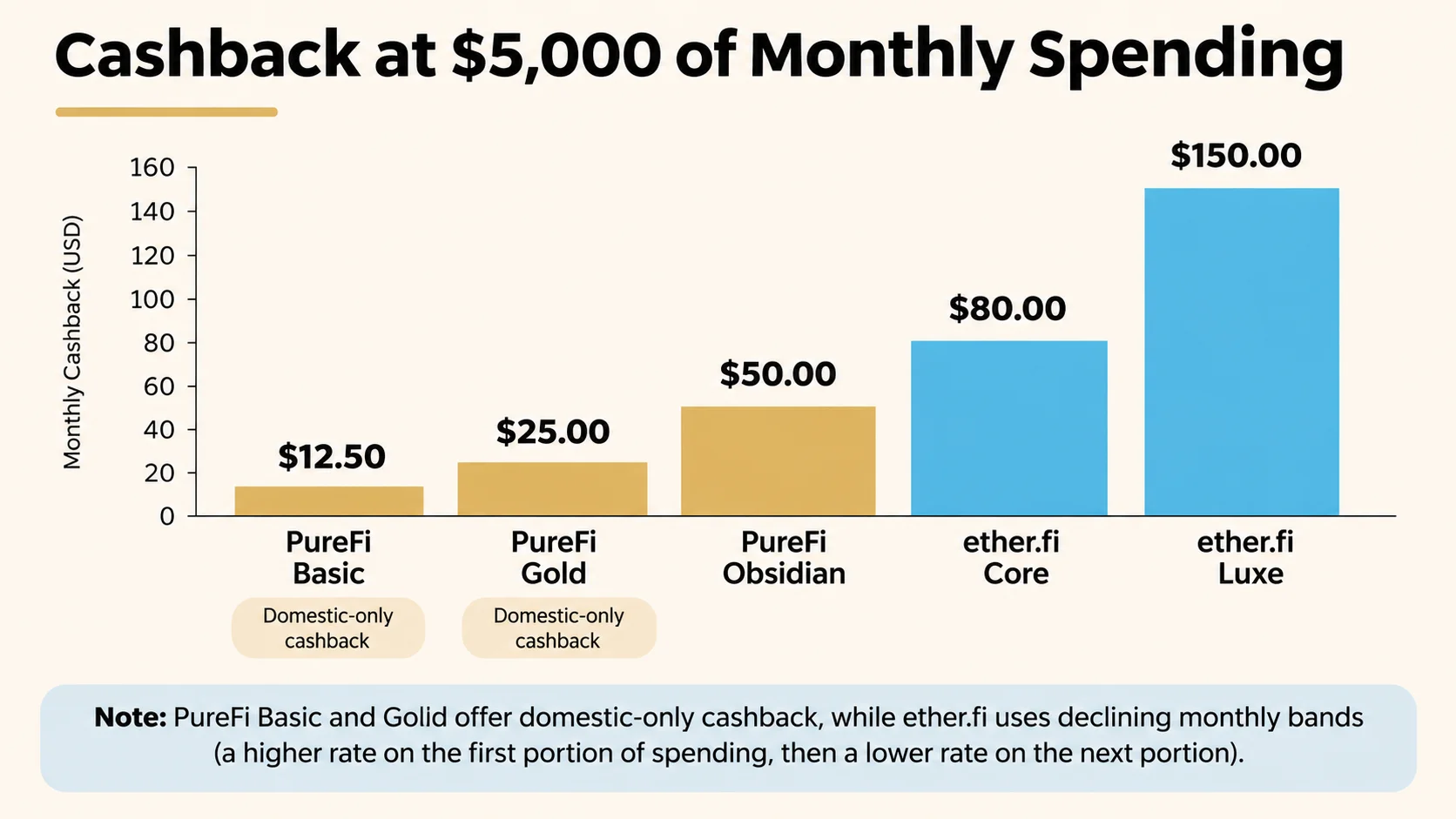
At $5,000 of standard-currency monthly spending, Core earns about $80. Luxe earns $150 because the entire amount remains in its 3% band.
At the same monthly spend, PureFi produces $12.50 on Basic, $25 on Gold or $50 on Obsidian before its travel offer. PureFi pays in USDC and connects premium tiers with Earn benefits.
PureFi vs Ether.fi: Fees and Foreign Spending
PureFi Basic is free. Gold is free when the customer meets a qualifying balance or spending route, or $15 a month otherwise. Obsidian is free with its required balance. The invite-only tier has its charitable joining contribution and annual fee.
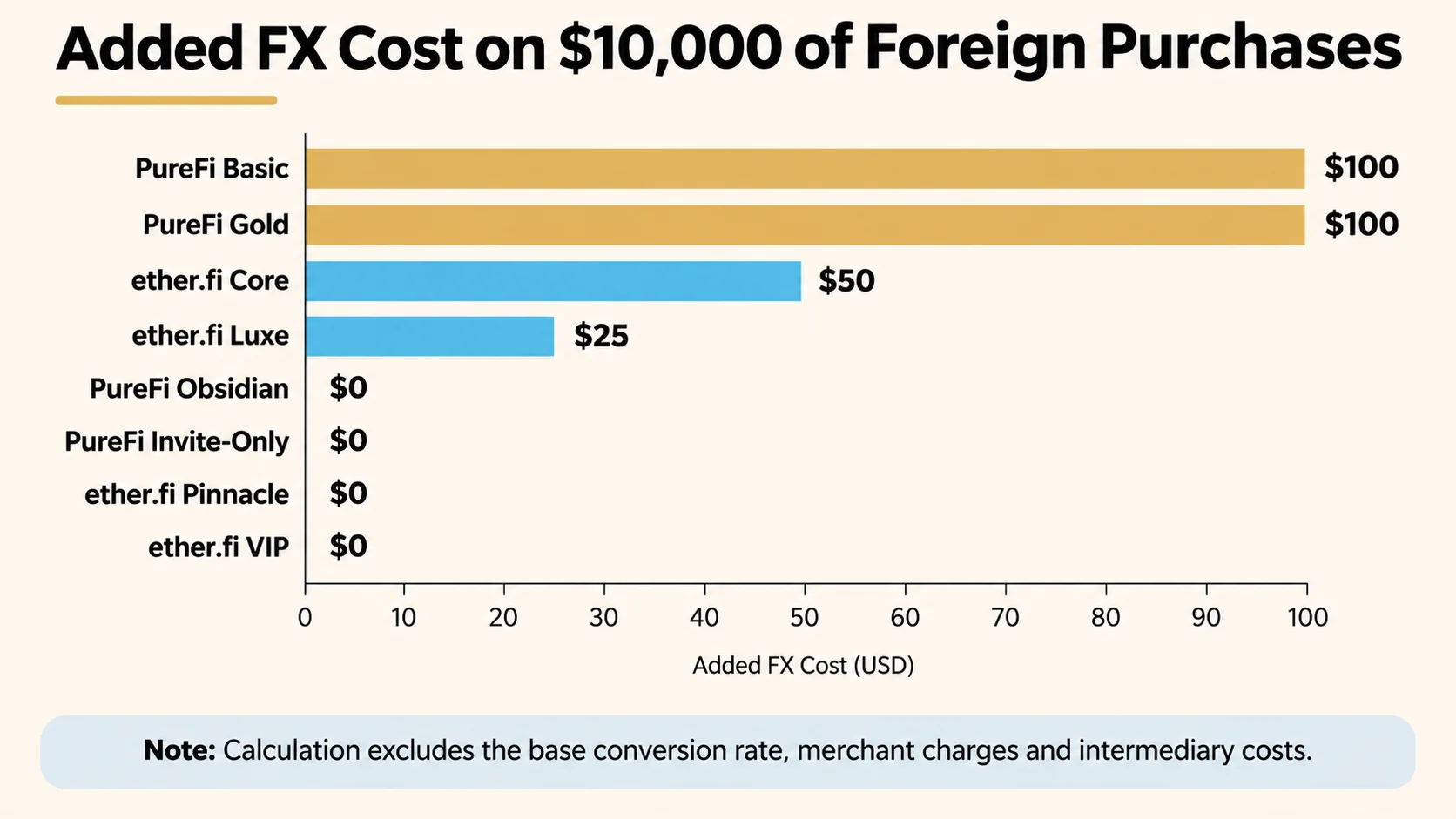
PureFi adds 1% above the underlying conversion cost on Basic and Gold. Obsidian and invite-only add no PureFi FX fee.
Ether.fi Core adds 0.5% and Luxe adds 0.25% when a purchase requires conversion outside USD or EUR. Pinnacle and VIP add no Ether.fi FX margin. Merchant and intermediary charges can still apply.
On $10,000 of foreign purchases, the added charge is $100 for PureFi Basic or Gold, $50 for Ether.fi Core, $25 for Luxe, and $0 for both programs’ top tiers. Base rates and third-party costs remain separate.
Read What Is a Foreign Transaction Fee? before comparing travel cards.
Cards, Limits and Everyday Controls
Both platforms support virtual and physical cards, Apple Pay, Google Pay and app-based card management.
PureFi adds merchant blocks, automatic USDC cashback, instant replacement numbers and family cards. Tiers are reviewed quarterly, with 90 days’ grace before a downgrade.
Ether.fi lets customers set card and vault limits. Defaults are $50,000 per card daily, $100,000 per vault daily and $1 million per vault monthly. ATM limits reach $5,000 per withdrawal and $25,000 daily.
Core usually includes one virtual card, with a $10 charge in certain markets. A Core physical card costs $50. Luxe includes one physical card and Pinnacle includes two.
Who Might Each Card Suit?
PureFi may suit someone who:
- Wants debit spending without collateralized borrowing
- Prefers cashback paid automatically in USDC
- Values family cards, merchant blocks and integrated Earn benefits
- Can qualify for Gold or Obsidian through their balance
Ether.fi may suit someone who:
- Wants to choose between direct crypto spending and secured borrowing
- Can keep spending inside a high cashback band
- Uses Ether.fi Liquid or staked ETHFI to qualify for a tier
- Needs high configurable card and ATM limits
PureFi provides the simpler spending structure. Ether.fi offers more flexibility and stronger headline cashback, but Borrow Mode adds debt and liquidation risk that does not exist with PureFi’s debit model.
Be first in line for a PureFi card
PureFi stablecoin Visa debit cards are coming soon. Download the PureFi app now and you will automatically be added to the list, with no separate form. When cards arrive, you will be able to order through the app and spend from your available PureFi balance wherever Visa debit is accepted.
The Prepaid Debit Visa Card is issued by Lead Bank under licence from Visa U.S.A. Inc. Bridge Ventures LLC is the program manager, and PureFi is the platform provider. Applicants must be 18 or older. Fees, eligibility and availability may vary. PureFi is not a bank, and PureFi balances are not FDIC insured or guaranteed by PureFi.