PureFi Vs TD Bank
PureFi and TD Bank can both give idle dollars a job, but they do it in very different ways. TD offers bank savings accounts. PureFi provides fractional shares of real homes with tenants. One holds deposits and pays a variable APY. The other is an investment whose projected earnings come from rent and changes in property value.
That difference affects everything from protection to access. This comparison looks at current yields, monthly fees, minimum balance rules and digital features. TD rates vary by location, so check the rate shown for your ZIP code before opening an account.
PureFi vs TD Bank Breakdown
| Feature | PureFi | TD Bank |
|---|---|---|
| Main product | Fractional shares of rented homes | Savings accounts |
| Advertised earnings | Up to 6% projected APY | Variable APY based on account, balance and relationship status |
| Monthly fee | $0 | $5 for Simple Savings; $15 for Signature Savings unless waived |
| Opening deposit | Depends on the selected property offering | $0 |
| Protection | Not FDIC insured | Eligible deposits are FDIC insured within applicable limits |
| Access | Sell shares at the current available market price | Transfers, TD ATMs and branch access |
| Main risk | Property shares and rental earnings can lose value | APY can fall; fees can reduce earnings |
The advertised percentages are not equivalent. TD pays a bank-set yield on a deposit. PureFi’s projected APY comes from an investment and is not guaranteed.
What Does PureFi Offer?
PureFi is a digital savings platform backed by real assets. Through PureFi Earn, customers choose fractional shares of real homes that already have tenants. Projected earnings come from rent and changes in the value of those homes.
PureFi projects up to 6% APY. Earnings appear in the app each morning, but the projection is variable and not guaranteed. A home may collect less rent than expected. Its market value can also rise or fall.
There is no monthly account fee. Any fee connected with buying a property share appears before confirmation. The app also provides the property documents and information needed to review an offering.
PureFi is not a bank or a high yield digital savings account. Balances and property shares are not FDIC insured. Anyone considering PureFi should treat it as an investment rather than a replacement for insured emergency savings.
What Savings Accounts Does TD Bank Offer?
TD’s two main consumer savings products are TD Simple Savings and TD Signature Savings. Both have a $0 minimum opening deposit, but their fees and rate structures differ.
TD Simple Savings
TD Simple Savings has a $5 monthly maintenance fee. TD waives it when the customer maintains at least $300 as the minimum daily balance or links an eligible TD checking account.
During the first year, customers may also avoid the fee by making a recurring transfer of at least $25 per statement cycle from an eligible linked TD checking account. The fee is automatically waived for qualifying primary account holders aged 18 or younger or 62 or older.
The account includes TD ATM access, automatic transfers and optional savings overdraft protection for linked TD checking.
TD Signature Savings
TD Signature Savings is built for larger balances. Its $15 monthly fee can be waived by maintaining a $10,000 minimum daily balance or linking an eligible TD Beyond Checking or TD Complete Checking account.
The account uses balance tiers. Customers may also qualify for a relationship rate bump by linking an eligible TD mortgage, home-equity product, credit card or active checking account that meets TD’s activity conditions.
The highest advertised tier requires at least $250,000. Signature Savings also includes waived TD fees at non-TD ATMs, while ATM-owner surcharges are reimbursed when the account maintains at least $2,500.
PureFi vs TD Bank: How Earnings Compare
The cleanest calculation starts with the balance and APY:
Estimated annual earnings = Balance × APY
At PureFi’s projected 6% APY, a $10,000 investment would produce about $600 over one year if the projection were achieved. That figure is before applicable purchase fees and taxes. It is not a promise of profit.
TD’s result depends on the account, balance, location and whether the customer qualifies for a relationship bump. Use the APY displayed on TD’s website for the relevant ZIP code on the day of comparison. For example, a 0.10% APY would produce about $10 on $10,000 before any fee. A 2.50% APY would produce about $250.
This is not a simple contest between the largest numbers. TD’s eligible deposit is protected by FDIC insurance within the applicable limits. PureFi’s $10,000 buys property shares whose value can change.
For more context on this distinction, see Savings vs Investing.
PureFi vs TD Bank: Fees and Balance Rules
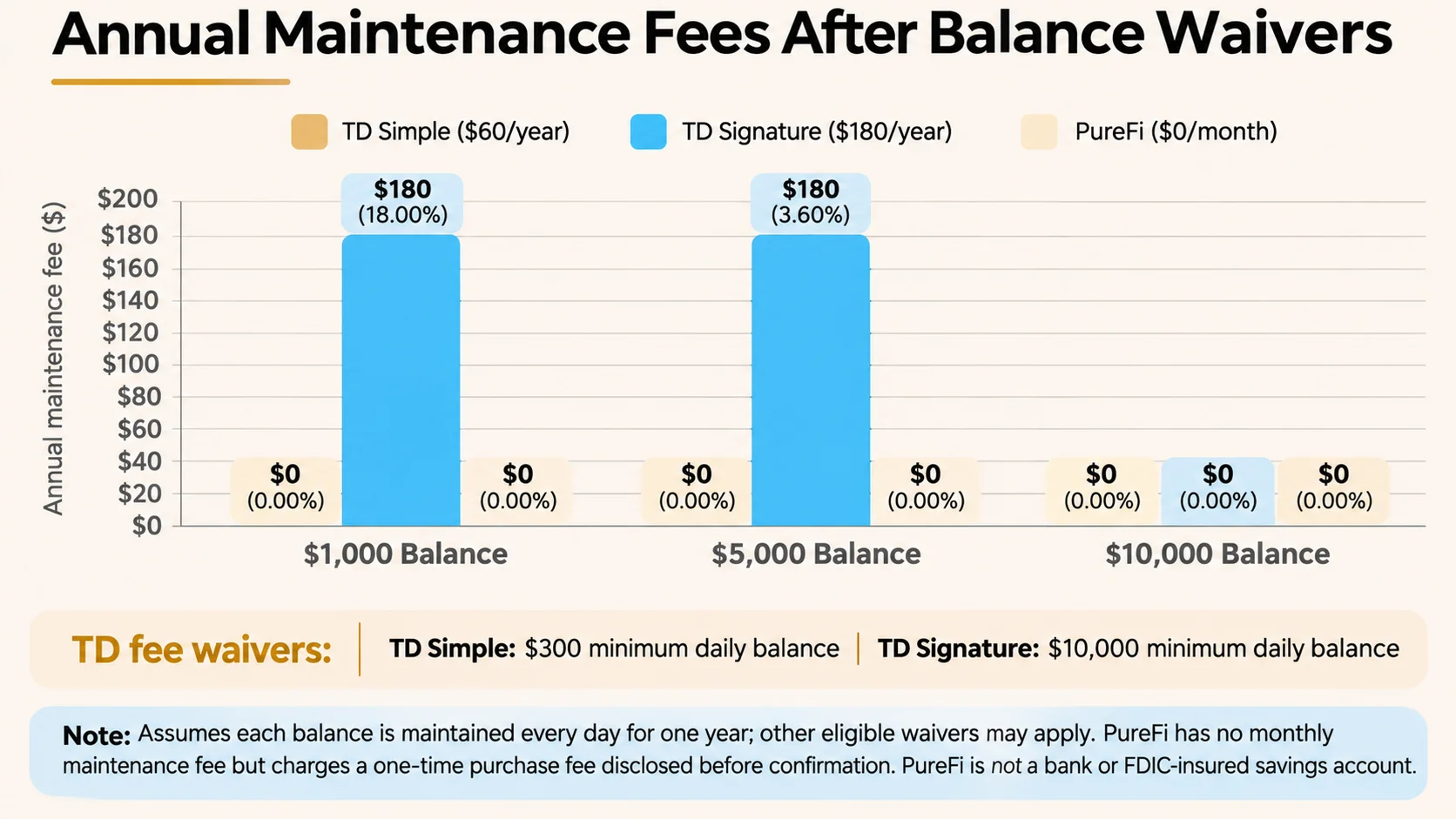
TD’s monthly fee can matter more than a small difference in APY.
A $5 monthly fee costs $60 a year. On a $1,000 balance, that equals 6% of the account. A $15 monthly fee costs $180 a year. On a $10,000 balance, that equals 1.8%.
Customers who consistently meet TD’s waiver conditions may pay neither charge. The problem arises when a balance drops below the threshold or a linked-account condition is no longer met. A withdrawal near the end of the statement period could turn an otherwise modest account into a fee-paying one.
PureFi has no monthly maintenance fee and no bank-style waiver requirement. It may charge a disclosed fee when a customer buys a property share. That cost should be included when estimating the investment’s likely result.
Our guide to high-yield savings accounts with no monthly fees explains why “no monthly fee” does not necessarily mean every service is free.
PureFi vs TD Bank: Access and Features
TD has the broader conventional banking network. Customers can use branches, TD ATMs, online banking, mobile check deposit and linked checking. Telephone support is available around the clock. That can matter to someone who deposits cash, wants face-to-face service or needs a traditional bank relationship.
PureFi is app-first. Customers can choose homes, review documents, see projected earnings and manage their holdings from their phone. It is closer to a high yield investment platform than an online savings app.
Access also works differently. Moving money out of TD savings generally means making a transfer or withdrawal. Accessing money invested through PureFi may require selling property shares at the current market price. The sale price may be higher or lower than the original purchase price.

Who Might Each Option Suit?
PureFi may suit someone who:
- Wants exposure to income-producing residential property
- Can accept changes in share value and rental earnings
- Does not need the investment to function as an emergency deposit
- Prefers app-based property selection and clear documents
TD Bank may suit someone who:
- Prioritizes FDIC-insured cash
- Wants branch and ATM access
- Already uses TD and can meet a fee-waiver condition
- Needs straightforward access for short-term savings
The better choice depends less on the headline yield and more on the job assigned to the money. TD is designed to hold deposits. PureFi is designed to provide ownership in rented homes.
Put your dollars into something real
With PureFi, your projected earnings come from shares of real homes with tenants. Choose your properties from your phone, review the documents, and see every fee before you confirm.
Learn more about how PureFi can help you own real estate shares or download the app to get started today.
Up to 6% APY is projected, variable, and not guaranteed. Property shares can lose value. PureFi is not a bank, and its balances and real estate shares are not covered by FDIC insurance or another government deposit scheme.