SGOV vs. High-Yield Savings Account

SGOV is an exchange-traded fund that holds short-term Treasury bills. A high-yield savings account is a bank or credit-union deposit with a variable APY. One trades through a brokerage account. The other sits inside a banking app.
The better option depends on what the money is for. Taxes may point you toward SGOV. Deposit insurance and a stable balance may favor a savings account. Access also works differently. Here is what to compare before moving your cash.
SGOV vs. HYSA at a Glance
| Feature | SGOV | High-yield savings account | |---||---||---| | Product type | Short-term Treasury ETF | Bank or credit-union deposit | | Return figure | SEC yield and monthly distributions | APY | | Current figure | 3.83% 30-day SEC yield as of November 4, 2026 | Depends on the provider | | Fees | 0.09% expense ratio | Varies; many have no monthly fee | | Balance protection | Not FDIC insured | Eligible deposits may be federally insured | | Value changes | Share price can move | Deposited balance does not move with markets | | Access | Sell through a brokerage | Transfer or withdraw through the provider | | Tax treatment | Treasury-derived income is generally exempt from state and local tax | Earnings are generally taxable federally and at state level where applicable |
Do not compare SGOV’s SEC yield with a savings APY as though they were the same measurement. APY reflects compounding over a year. The 30-day SEC yield is a standardized estimate based on a fund’s recent income and expenses.
What Is SGOV?
SGOV is the ticker for theiShares 0–3 Month Treasury Bond ETF. It invests in U.S. Treasury bills with no more than three months left until maturity.
The fund is designed to keep rate sensitivity low while producing income from very short-term government debt. It trades on the New York Stock Exchange, so you need a brokerage account to buy it.
As of November 4, 2026, SGOV reported:
- A 3.83% 30-day SEC yield
- A 3.63% 12-month trailing yield
- A 0.09% expense ratio
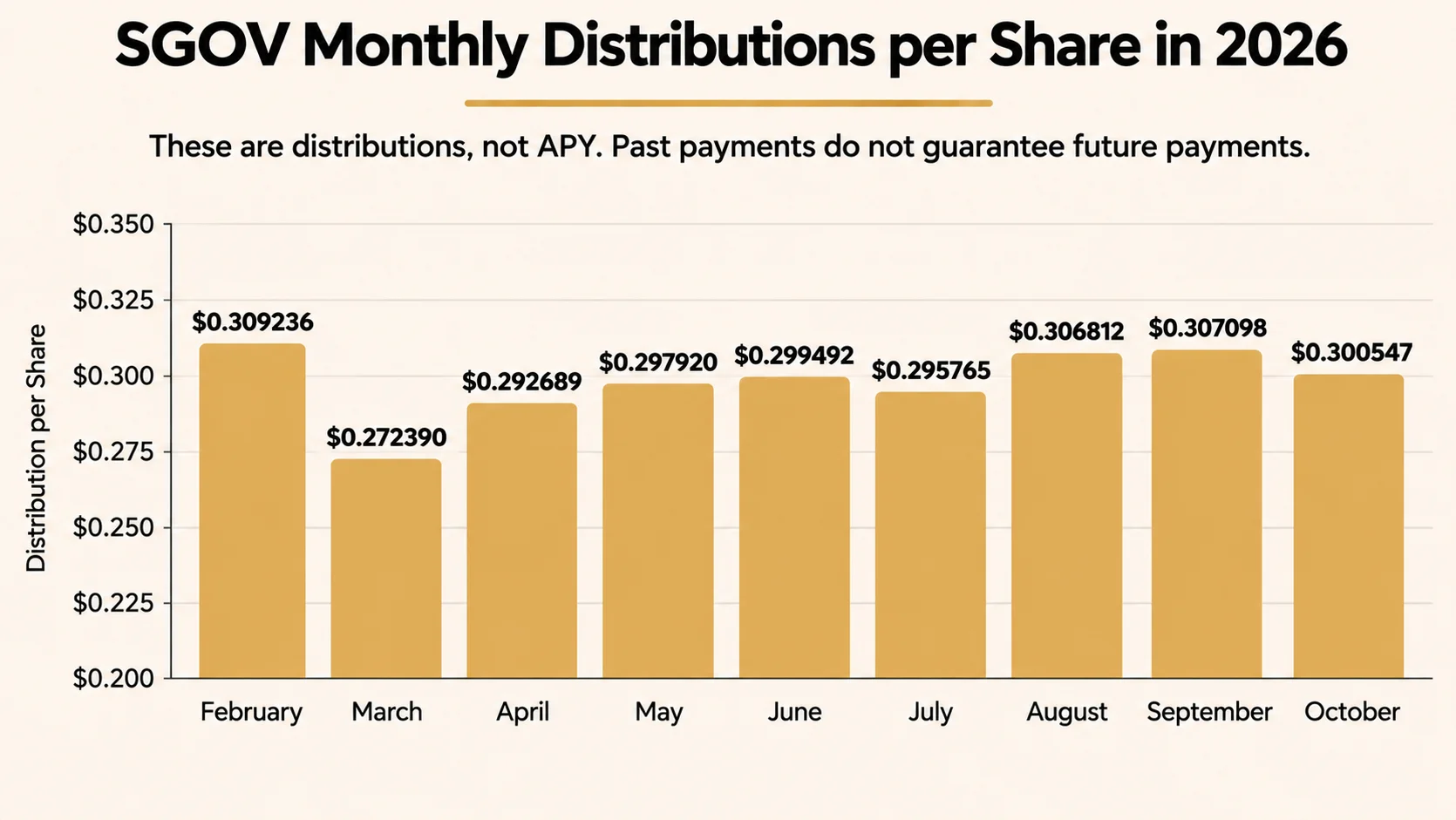
- Monthly distributions
These numbers change. SGOV does not lock in its published yield for a year.
The share price usually rises gradually as income builds. It then adjusts when a distribution is paid. That pattern can make the chart look uneven even when the fund is behaving normally.
SGOV is an investment, not a deposit. Our guide tosavings vs. investing explains why that distinction matters.
What Is a High-Yield Savings Account?
A high-yield savings account, or HYSA, is a savings deposit that offers a higher APY than many standard savings accounts. Online banks often pay more because they operate with fewer physical branches.
The APY is variable. The bank can raise or lower it after you open the account. Your deposited balance does not fall because market prices move, although fees or withdrawals can reduce it.
Eligible deposits at an FDIC-insured bank are generally insured up to $250,000 per depositor, per bank and per ownership category. Credit unions may offer equivalent NCUA coverage. Coverage depends on the institution, ownership structure and total deposits held there.
Most accounts are managed through anonline savings app. Access may include ACH transfers, internal transfers and, less commonly, an ATM card.
Which Option May Earn More?
There is no permanent winner. SGOV follows the short-term Treasury market. HYSA rates are set by individual providers and often move after changes in broader market rates.
Reading SGOV’s yield
The 30-day SEC yield helps investors compare bond funds using a standard method. The trailing yield shows what the fund distributed over the previous 12 months. Neither promises what you will receive next.
SGOV also charges a 0.09% expense ratio. Do not automatically subtract it again when looking at a published SEC yield, since that standardized figure already accounts for fund expenses.
Reading a HYSA’s APY
APY estimates one year of growth after compounding. A 4% APY does not mean the account will keep that APY for the next year. The provider may change it at any time, subject to its terms and disclosure requirements.
Compare both figures on the same date. A SGOV yield from this month and a bank APY from six months ago will not tell you much. If you want to model a bank balance, seehow much a high-yield savings account can earn.
Liquidity and Withdrawal Flexibility
Both options are liquid, but not in the same way.
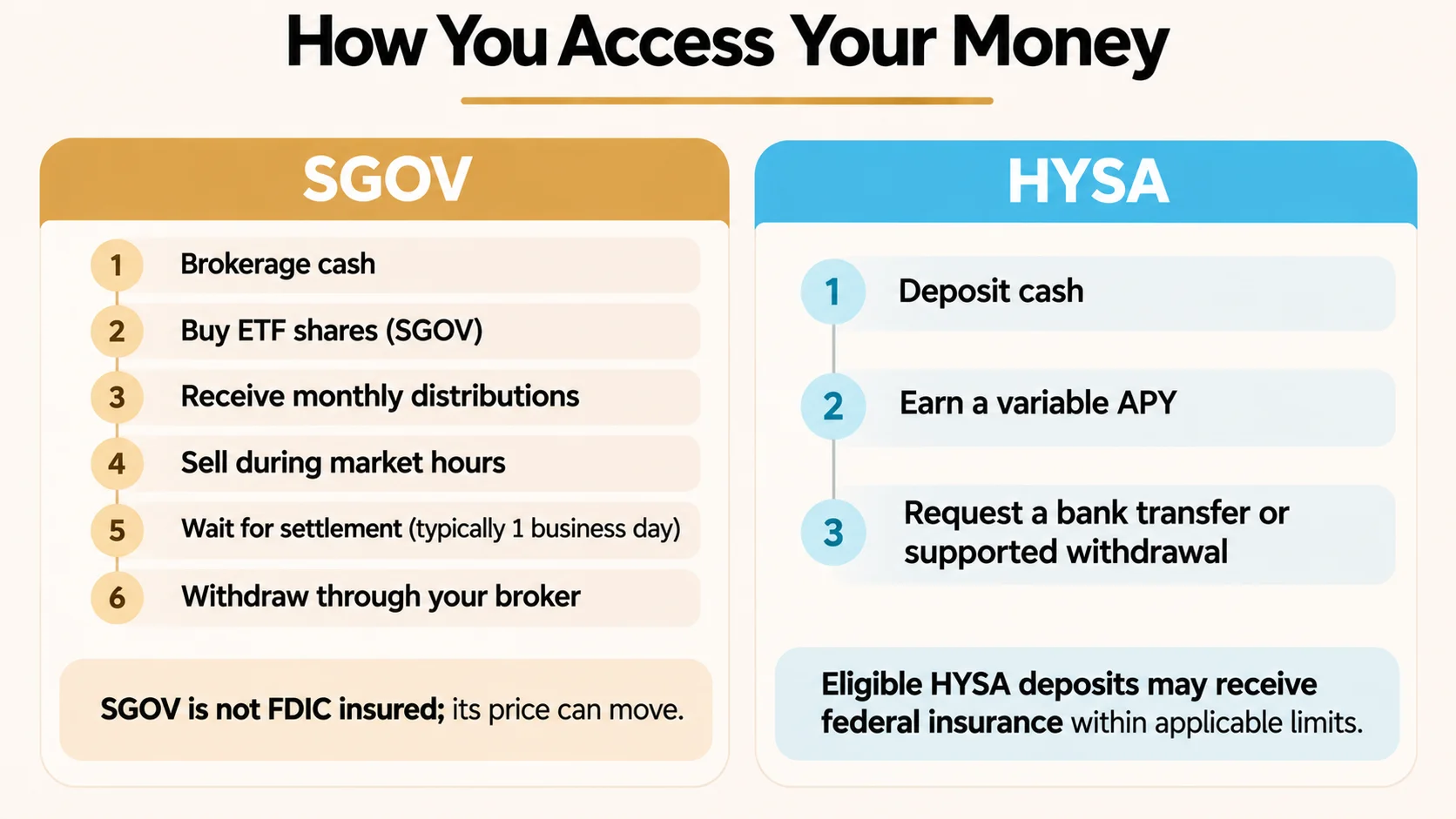
SGOV shares can normally be sold while U.S. markets are open. Most U.S. securities now use next-business-day settlement. Once the trade settles, the time needed to move cash out depends on the broker and withdrawal method. You cannot place a normal market trade while the exchange is closed.
A HYSA balance does not have to be sold. You request a transfer or make a supported withdrawal. An internal transfer may be quick. An external ACH transfer can take several business days. New deposits may also be held before they become available.
Neither option should be called instantly accessible without checking the provider’s rules. Our guide towithdrawing from a high-yield savings account covers common transfer methods and delays.
Risk and Protection
SGOV holds U.S. Treasury bills, which carry very low credit risk. Its short maturity also limits its exposure to changing market rates. Still, SGOV is an ETF. Its market price can move, and it may trade slightly above or below the value of its holdings.
SGOV is not FDIC insured. The government backing Treasury obligations does not turn an ETF share into an insured bank deposit.
A HYSA at an eligible insured institution offers a different kind of protection. Its displayed deposit balance does not fluctuate with Treasury prices. Federal insurance can protect eligible deposits if the institution fails, within the applicable limits.
That does not protect you from a falling APY or inflation. It only addresses eligible deposit losses caused by an insured institution’s failure. Read more abouthow HYSA protection works.
How Taxes Differ
SGOV may have a tax advantage for people who live in states with an income tax. Income attributable to U.S. Treasury obligations is generally exempt from state and local income tax. It remains subject to federal tax.
The exact exempt portion can vary by year and state. Investors should use the fund’s annual tax supplement rather than assuming every dollar distributed receives the exemption.
HYSA earnings are generally subject to federal tax and state or local tax where applicable. A provider normally reports taxable earnings on Form 1099-INT when reporting thresholds are met.
Taxes can change the result of a close yield comparison. They should not be the only factor. Account protection, access and price risk still matter.
Who Might Each Option Suit?
SGOV may suit you if:
- You already have a brokerage account.
- You accept small movements in the share price.
- You want exposure to short-term Treasury bills.
- The potential state and local tax treatment is useful to you.
- You do not need to withdraw through a bank at any hour.
A HYSA may suit you if:
- You want eligible federal deposit insurance.
- You prefer a balance that does not move with market prices.
- You want bank transfers instead of ETF trades.
- The money is part of an emergency fund or a near-term expense.
You do not have to choose only one. Some people keep immediate emergency cash in a HYSA and place a separate cash reserve in short-term Treasury products. The right split depends on when the money may be needed and how much complexity you want.
Put your dollars into something real
With PureFi, your projected earnings come from shares of real homes with tenants. Choose your properties from your phone, review the documents, and see every fee before you confirm.
Learn more about how PureFi can help youown real estate shares ordownload the app to get started today.
Up to 6% APY is projected, variable, and not guaranteed. Property shares can lose value. PureFi is not a bank, and its balances and real estate shares are not covered by FDIC insurance or another government deposit scheme.