PureFi vs Wealthfront
PureFi and Wealthfront both let customers manage money digitally, but the products do different jobs.
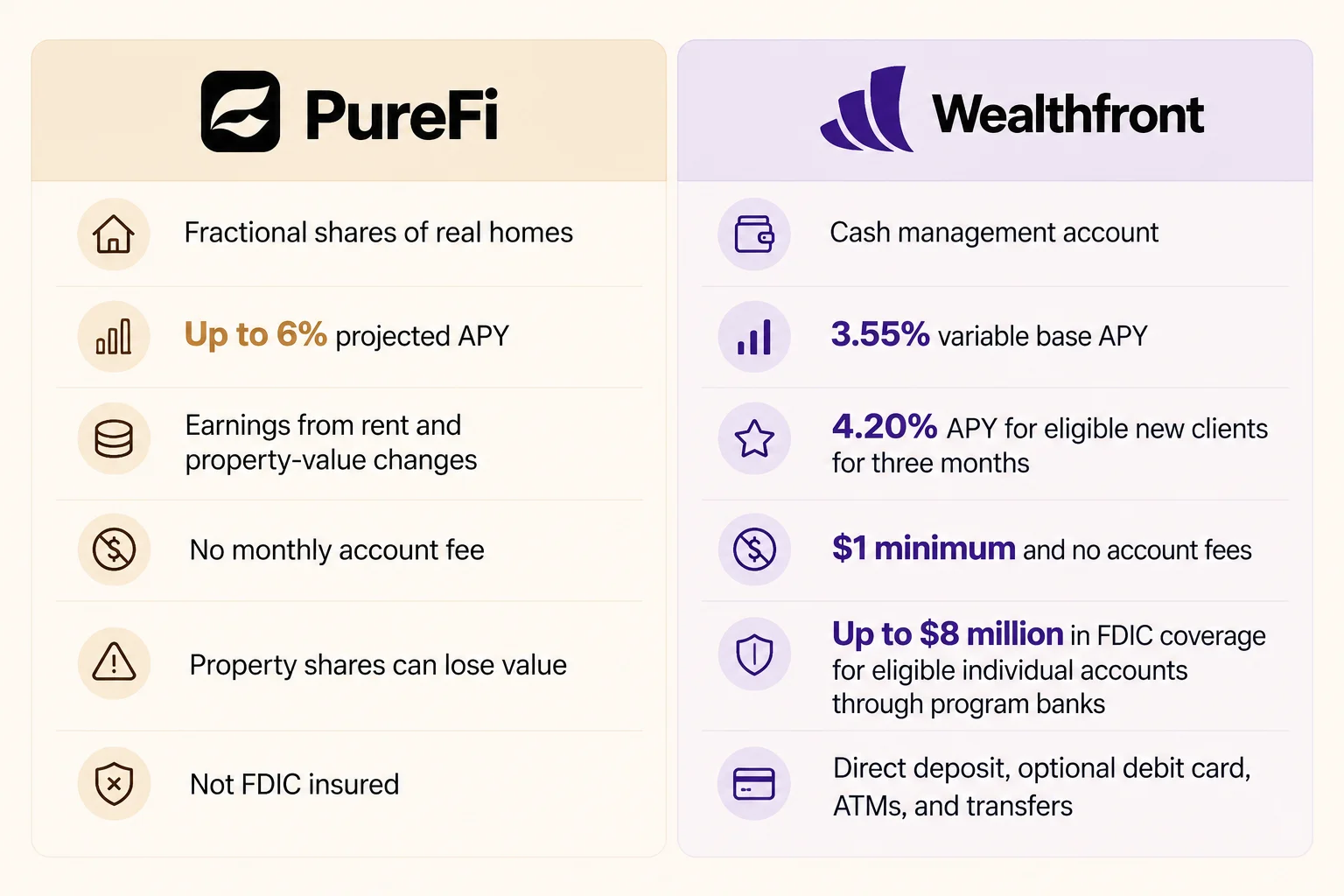
PureFi provides access to shares of real homes with tenants. Projected earnings come from rent and changes in property value. Wealthfront’s Cash Account holds cash through a network of program banks. It combines a variable APY with transfers, direct deposit, an optional debit card, and other cash-management tools.
This difference affects everything from protection to withdrawals. PureFi carries property-market risk. Wealthfront provides pass-through FDIC insurance for eligible deposits held at program banks.
PureFi vs Wealthfront at a Glance
| Feature | PureFi | Wealthfront Cash Account |
|---|---|---|
| Product | Fractional real-estate investment platform | Cash management account |
| Advertised return | Up to 6% projected APY | 3.55% base APY; new clients can receive 4.20% for three months |
| Source of earnings | Rent and changes in property value | Yield paid by program banks |
| Monthly account fee | None | None |
| Minimum | Amount shown through the app | $1 |
| Main transaction cost | One-time property purchase fee | No account, overdraft, or minimum-balance fees |
| Protection | Not FDIC insured | Up to $8 million in FDIC insurance for individual accounts through program banks |
| Access | Sell property shares at their current market value | Transfers, direct deposit, optional debit card, ATMs, and eligible instant withdrawals |
| Availability | More than 100 countries, subject to jurisdiction | Available to eligible U.S. residents |
| Main use | Digital access to rental-property shares | Holding and managing accessible cash |
Wealthfront’s rates are current as of October 30, 2026 and can change. Our projected APY is also variable and not guaranteed.
What Is PureFi?
PureFi provides fractional access to real homes with tenants. Users choose individual properties through the app, review the available documents, see the purchase fee, and decide whether to buy shares.
This is an investment rather than a savings or cash management account. The value of the shares is tied to the selected homes.
Projected earnings: We project up to 6% APY as of August 25, 2026. Those projected earnings come from rental income and changes in home value.
The projection is not guaranteed. Rent can vary, property expenses can change, and a home may fall in value. A user could earn less than projected or lose part of the amount invested.
Fees: We do not charge a monthly account fee. A one-time property purchase fee is displayed before the transaction is confirmed.
Access: There is no fixed lock-up period. Users can request to sell their shares, but the sale takes place at the current market value. The amount received may be higher or lower than the original purchase amount.
Protection: We are not a bank. Our balances and real-estate shares are not covered by FDIC insurance or another government deposit scheme.
The distinction between holding cash and buying an asset is covered in more detail in our guide to savings vs investing.
What Is the Wealthfront Cash Account?
Wealthfront describes its Cash Account as neither a checking nor a savings account. It is offered by Wealthfront Brokerage LLC. Customer cash is moved to participating program banks, where it earns a variable APY and may qualify for FDIC insurance.
This structure lets Wealthfront spread deposits across several banks instead of holding the entire balance at one institution.
Current APY: The base rate is 3.55% APY as of October 2026. New Wealthfront clients can currently receive 4.20% APY for their first three months. After that, the account returns to the variable base rate available at the time.
Wealthfront also advertises a continuing 0.25 percentage-point APY increase for customers who receive at least $1,000 a month in direct deposits and open and fund an eligible Wealthfront investing account. The offer has separate requirements.
Fees and minimums: The Cash Account has a $1 minimum. Wealthfront states that it charges no account, overdraft, or minimum-balance fees.
Access: Customers can transfer money to linked accounts, receive direct deposits, request an optional debit card, and use more than 19,000 fee-free ATMs.
Eligible external accounts connected to the RTP or FedNow network can receive free instant withdrawals, including on weekends and holidays. Other withdrawals usually arrive within one business day, although recently deposited money can take longer.
Protection: Eligible individual Cash Accounts can receive up to $8 million in FDIC insurance through program banks. Joint accounts can receive up to $16 million, subject to the program’s conditions and the customer’s deposits at participating banks.
The official Wealthfront Cash Account page contains the current APY and feature details.
PureFi vs Wealthfront: How Do Their Returns Differ?
The percentages shown by PureFi and Wealthfront describe different kinds of earnings.
Our projected APY comes from real estate. Rent can generate income while changes in home value affect what the shares are worth. Neither part is fixed.
Wealthfront’s Cash Account earns through participating banks. Earnings accrue daily based on the cash balance and are generally credited near the beginning of each month. The base APY is variable.
The current 4.20% APY for new clients lasts three months. It should not be treated as the account’s permanent rate. Once the promotional period ends, the account moves to the base APY available at that point.
PureFi’s up to 6% projected APY has no promotional three-month end date, but it is not a guaranteed deposit yield. Property performance determines the result, and shares can lose value.
Someone comparing the two should not simply choose the larger percentage. Wealthfront offers a cash return with applicable deposit protection. PureFi provides property exposure with investment risk.
PureFi vs Wealthfront: Fees and Minimum Deposits
Neither platform charges a monthly account fee.
With us, the main stated transaction cost is the one-time property purchase fee shown before confirmation. Users can review the amount before deciding whether to proceed.
Wealthfront requires only $1 to open and fund a Cash Account. It does not charge account, overdraft, or minimum-balance fees.
There may be separate costs if a customer uses other Wealthfront products. Investment portfolios, lending products, and the Cash Account do not all follow the same fee structure. The Cash Account’s lack of account fees should not be applied automatically to every Wealthfront service.
PureFi users should make the same distinction. The absence of a monthly fee does not remove property risk or the transaction fee attached to buying shares.
PureFi vs Wealthfront: Cash Management Features
Wealthfront has the stronger set of tools for managing everyday cash.
The Cash Account supports direct deposit, an optional debit card, fee-free ATM access, transfers, and routing and account numbers. Paychecks may also arrive up to two days early, depending on the payer and payment network.
Customers can usually move money from the Cash Account into a Wealthfront investment portfolio within minutes. This makes the account useful for someone who wants accessible cash and automated investing on the same platform.
PureFi is built around property shares rather than everyday payments. Users choose homes, review investment documents, and track their holdings through the app. We do not currently offer the same debit-card and cash-transfer tools as Wealthfront. PureFi cards are coming soon, but they should not be treated as an available feature yet.
For more on how these products differ from bank savings, read What Is a Cash Management Account?.
PureFi vs Wealthfront: Access to Money

Wealthfront provides more direct access. Free instant withdrawals are available when the receiving account participates in RTP or FedNow and the request meets Wealthfront’s conditions. Other transfers usually arrive within one business day. Recent deposits may take several extra days to clear.
The optional debit card and ATM access provide additional ways to use the balance without transferring it to another bank first.
With PureFi, reaching the money requires selling property shares. There is no fixed lock-up, but the sale happens at the current market value. That is different from withdrawing a cash balance.
Money needed for an emergency or an upcoming bill should not rely on a property sale. Our guide to HYSA liquidity looks at why transfer timing and withdrawal methods matter.
PureFi vs Wealthfront: Eligibility and Availability
We are available in more than 100 countries, subject to local laws and platform eligibility. This gives PureFi a broader international reach than many U.S.-only financial products.
Wealthfront account holders generally need to be at least 18, have a U.S. Social Security number, maintain a permanent U.S. residential address, and currently live in the United States.
The Cash Account is therefore built mainly for eligible U.S. customers. Its direct deposit, ATM, routing-number, and FDIC program features also centre on the U.S. financial system.
Both platforms are managed digitally. Wealthfront operates as an online cash and investment service. PureFi focuses on mobile access to fractional property shares.
Our guide to the advantages of online-only savings accounts covers the wider benefits and limitations of managing money without a branch.
Who Might Each Option Suit?
Choose PureFi if:
- You want fractional exposure to real homes with tenants
- You understand that projected earnings are not guaranteed
- You can accept changes in property-share value
- You do not need the money to behave like insured cash
- You want to choose individual properties through an app
- You live outside the United States and meet PureFi’s local eligibility rules
Choose Wealthfront if:
- You want accessible cash with a variable APY
- You want pass-through FDIC insurance through program banks
- You need direct deposit, a debit card, or ATM access
- You want a low $1 minimum and no account fee
- You already use or plan to use Wealthfront’s investment portfolios
- You meet its U.S. residency and identification requirements
These points describe the products generally. They are not personal financial recommendations.
Put your dollars into something real
With PureFi, your projected earnings come from shares of real homes with tenants. Choose your properties from your phone, review the documents, and see every fee before you confirm.
Learn more about how PureFi can help you own real estate shares or download the app to get started today.
Up to 6% APY is projected, variable, and not guaranteed. Property shares can lose value. PureFi is not a bank, and its balances and real estate shares are not covered by FDIC insurance or another government deposit scheme.