PureFi vs Valley Direct: APY, Fees and Access Compared
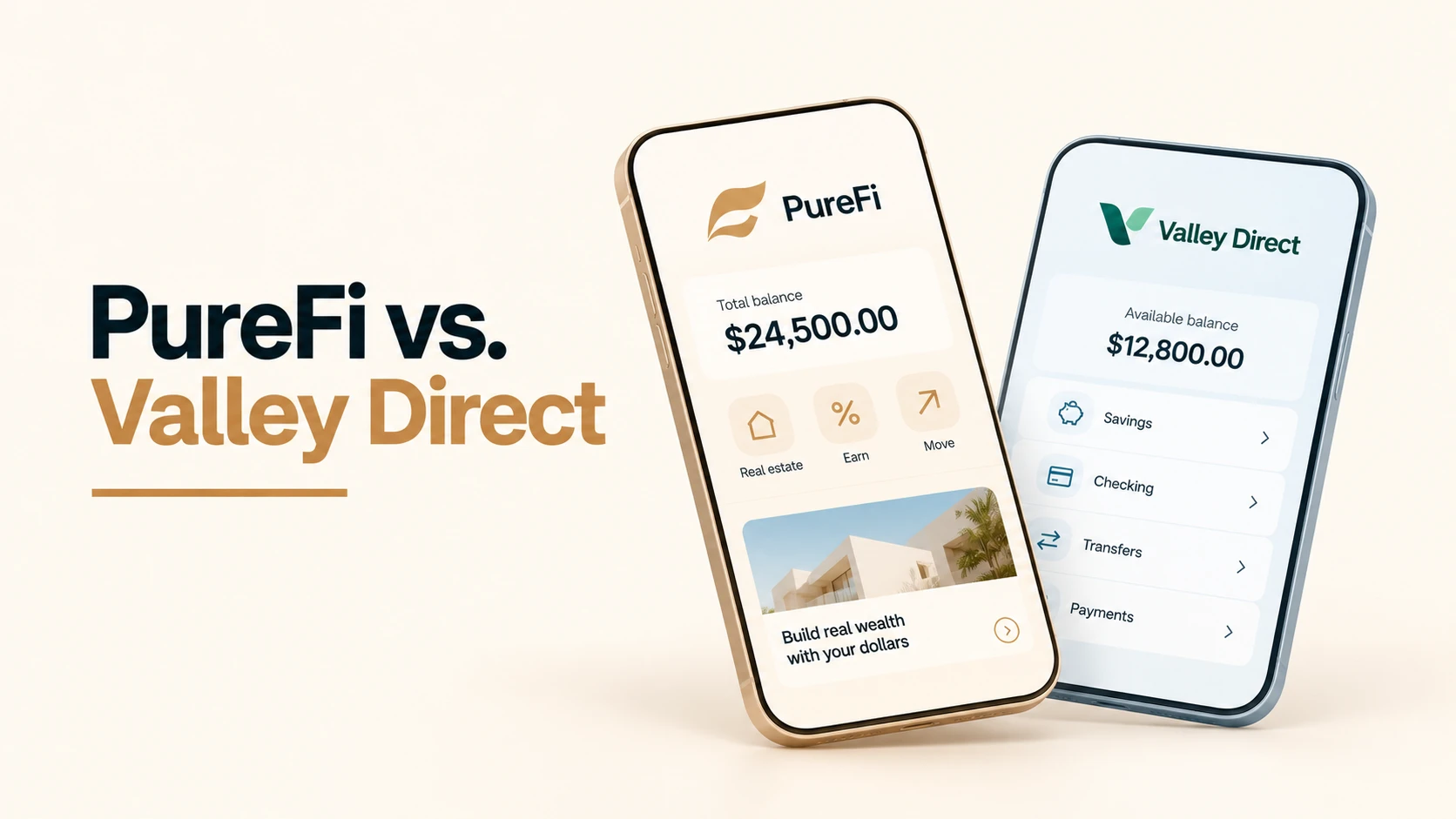
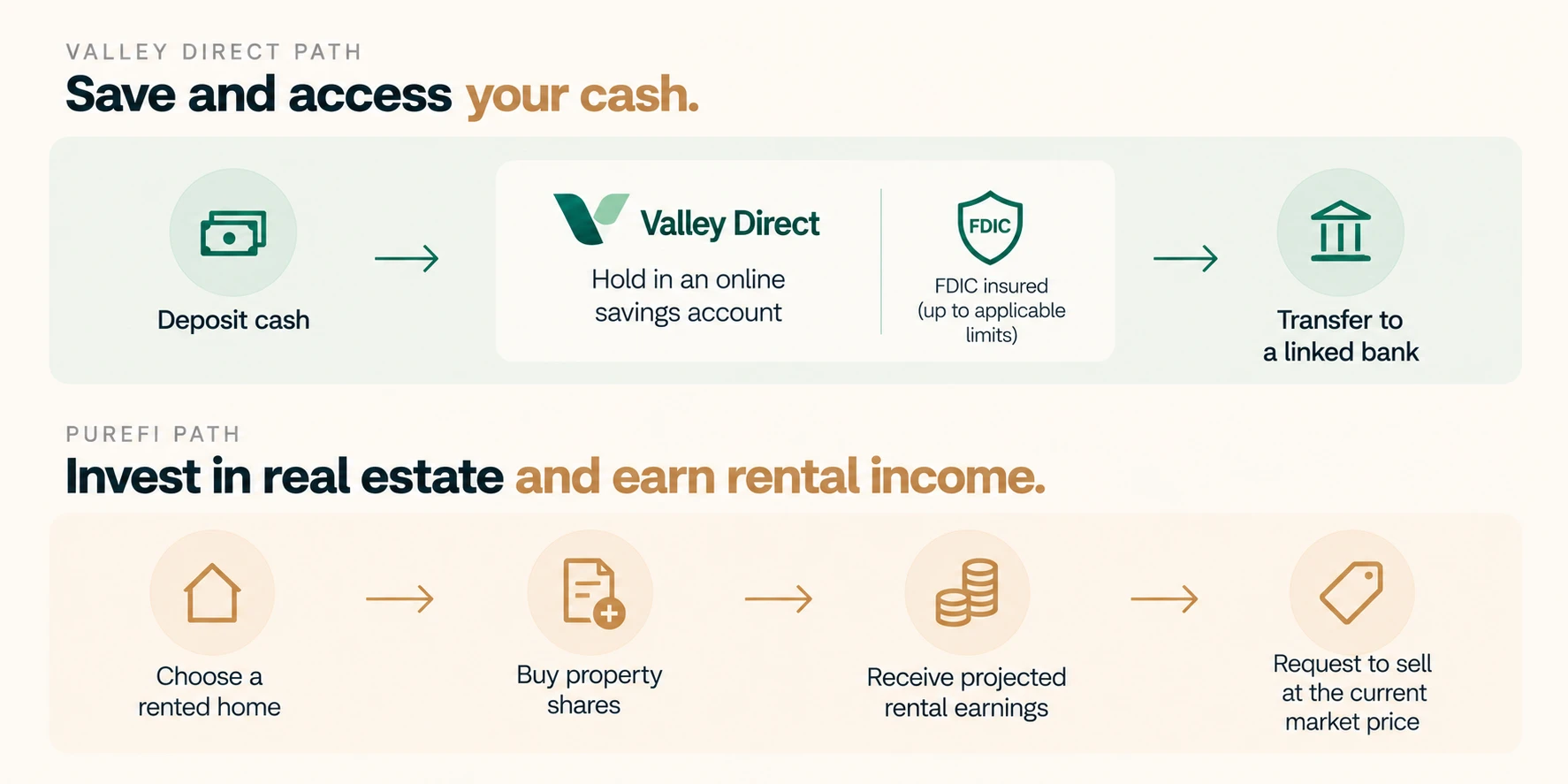
PureFi and Valley Direct both provide digital ways to earn from money, but they are not the same type of product. Valley Direct offers an FDIC-insured high-yield savings account and certificates of deposit. We provide fractional shares of rented homes. With Valley Direct, your money remains a bank deposit. With PureFi, it becomes an investment tied to selected properties.
This comparison covers APYs, fees, requirements, access, protection, and risk.
PureFi vs Valley Direct at a Glance
| Feature | PureFi | Valley Direct |
|---|---|---|
| Product type | Fractional shares of individual rented homes | High-yield savings account and CDs |
| Earnings | Rent and changes in property value | Bank deposit yield |
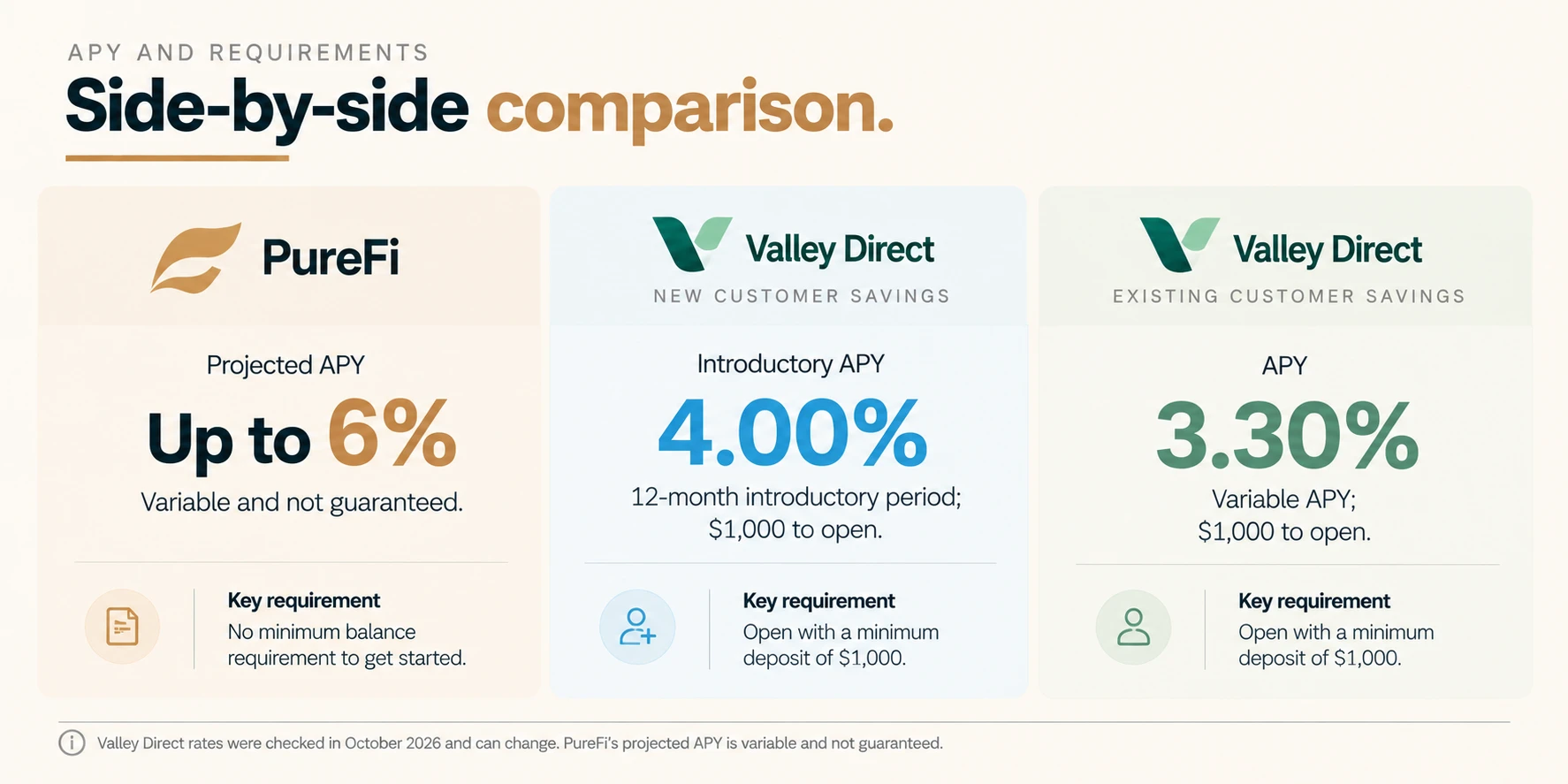
| APY | Up to 6% projected, variable and not guaranteed | 4.00% introductory savings APY for eligible new customers; 3.30% for existing customers |
| Monthly fee | None | None for the high-yield savings account |
| Opening requirement | Shown in the app before purchase | $1,000 for savings; $500 for CDs |
| Access | Request to sell shares at the current market price | Transfers, direct deposit, Zelle, and mobile check deposit for savings; CDs restrict early access |
| Protection | Not FDIC or SIPC insured | Eligible deposits are FDIC insured within legal limits |
| Main risk | Rental earnings and share value can fall | Savings APY can change; CDs may carry an early-withdrawal penalty |
Valley Direct’s current rates were checked in October 2026. Its introductory APY can change, and eligibility conditions apply.
What Is PureFi?
We make it possible to buy shares of individual rental homes without managing an entire property. Each home is bought outright and professionally managed. You can select properties or review a suggested mix through the app.
Projected earnings come from rent and changes in property value. You can review available documents such as the title deed, lease agreement, and inspection report before confirming. The applicable fee is also shown.
We project up to 6% APY. The projection is variable and not guaranteed. Rent can change, expenses can rise, and property shares can lose value. PureFi is a high yield investment platform, not a bank or a high yield digital savings account.
Our guide to savings vs investing explains why liquidity, protection, and time frame matter when comparing these options.
What Does Valley Direct Offer?
Valley Direct is the online banking division of Valley National Bank. It offers a high-yield savings account and fixed-term CDs. Accounts are opened and managed online.
High-Yield Savings Account
Valley Direct currently advertises a 4.00% introductory APY for eligible new customers. The introductory APY applies for 12 months. Existing Valley Direct and Valley National Bank customers earn 3.30% APY.
New customers need at least $1,000 to open the account. After opening, a minimum daily balance of $0.01 is required to earn the advertised APY. There is no monthly maintenance fee.
The savings APY is variable and can change after opening. Because the promotion is restricted to eligible new customers, applicants should confirm which APY applies.
Certificates of Deposit
Valley Direct also offers CDs with different terms. The APY is fixed for the selected term.
A minimum deposit of $500 is required to open a CD. Valley Direct allows customers to fund up to $500,000 per account, although FDIC coverage has separate legal limits. Removing money before maturity may result in a penalty.
How Do the APYs Compare?
APY reflects a stated yield and compounding over one year. It does not measure risk or access.
Valley Direct’s 4.00% introductory APY applies to a bank savings account. It is available only to eligible new customers and lasts for 12 months. Existing customers currently receive 3.30% APY. Both figures are variable and may change.
PureFi’s projected APY comes from rental property rather than a bank deposit. We project up to 6%, based on rent and property performance. That percentage is not promised. The amount earned can be lower, and the property shares themselves can lose value.
The higher projection is not an automatic reason to choose PureFi. Valley Direct offers deposit protection for eligible balances. We offer rental-property exposure with different risk and liquidity.
For more context on bank savings yields, read what a high-yield savings account is.
Fees and Opening Requirements
With PureFi, the one-time purchase fee is displayed before you buy property shares. You can review the property, documents, and cost before confirming. There is no recurring subscription fee.
Valley Direct requires $1,000 to open its high-yield savings account. That requirement may be a barrier for someone who is starting with a smaller balance. Once the account is open, only $0.01 must remain to qualify for the advertised APY. CDs require at least $500 to open.
Applicants need a valid US bank account with online access. An opening deposit can be as high as $500,000.
Account Access and Withdrawals
Valley Direct customers can use linked-bank transfers, direct deposit, Zelle, and mobile check deposit. The account has no ATM card, and Valley Direct operates online rather than through its own branch network.
That works well for someone with a checking account elsewhere. It is less convenient for people who deposit cash or want ATM access.
CD access is more limited. Money is committed for the chosen term, and an early withdrawal may reduce earnings through a penalty.
PureFi property shares do not have a fixed lock-up period. You can request to sell shares at the current market price. However, this is not the same as moving cash from an online savings app. The value may have risen or fallen, and a property-share sale should not be treated as instant access to a fixed cash balance.
Valley Direct’s savings account is generally more suitable for an emergency fund or near-term bill. PureFi is designed for money allocated to real estate investment.
Deposit Protection and Investment Risk
Valley Direct deposits are held through Valley National Bank, a member of the FDIC. Eligible deposits are generally protected up to at least $250,000 per depositor, per insured bank, for each ownership category. The FDIC deposit insurance guide explains how the limits work.
FDIC insurance protects covered deposits if an insured bank fails. It does not fix the savings APY or remove CD withdrawal rules.
PureFi is not a bank. Balances and property shares held through PureFi are not protected by FDIC insurance, SIPC coverage, or another government deposit scheme. Rental income can fall because of vacancy, missed payments, repairs, management expenses, or other property costs. Home values can also move down.
You can review the available property documents before buying. Shares are held in an account in your name rather than combined into a general savings pool. Capital remains at risk.
Our guide on whether high-yield savings accounts are safe explains the protection attached to bank and credit union deposits.
Digital Features and Accessibility
Valley Direct’s online and mobile tools let customers monitor balances, transfer funds, deposit checks, and manage savings or CDs. Applicants must meet US account and identity requirements.
With PureFi, you can browse rental homes, review documents, choose property shares, see fees, and track your holdings from a phone. Security measures include encryption, two-factor authentication, identity checks, and fraud monitoring. PureFi availability depends on jurisdiction.
People searching for a digital savings platform or high yield savings app may come across both products. Valley Direct is the bank savings option. PureFi is the real estate investment option. Similar digital access does not make the underlying products interchangeable.
Who Is Valley Direct Best For?
Valley Direct may suit people who:
- Can meet the $1,000 savings-account opening requirement
- Qualify for the 12-month introductory APY
- Want eligible deposits covered by FDIC insurance
- Already have a US bank account for funding and transfers
- Prefer online account management and mobile check deposit
- Want access to both flexible savings and fixed-term CDs
It can suit an emergency fund, a planned purchase, or money that must remain in cash. Watch the new-customer rules, introductory period, and lack of ATM access.
Who Is PureFi Best For?
We may suit people who:
- Want fractional exposure to individual rented homes
- Prefer to review the assets behind their projected earnings
- Are comfortable with variable, non-guaranteed returns
- Can accept changes in the value of their property shares
- Do not need the invested money for immediate expenses
PureFi should not replace protected emergency savings. It may fit the portion of your money intended for longer-term real estate exposure. Our guide on how to invest in real estate explains how the model works.
Put your dollars into something real
With PureFi, your projected earnings come from shares of real homes with tenants. Choose your properties from your phone, review the documents, and see every fee before you confirm.
Learn more about how PureFi can help you own real estate shares or download the app to get started today.
Up to 6% APY is projected, variable, and not guaranteed. Property shares can lose value. PureFi is not a bank, and its balances and real estate shares are not covered by FDIC insurance or another government deposit scheme.