PureFi vs Synchrony Bank
PureFi and Synchrony both provide digital ways to earn, but the products are fundamentally different.
With PureFi, users purchase shares of rented residential properties. Synchrony offers a conventional high-yield savings account issued by an FDIC-insured bank.
That distinction affects the return, risk, access, and protection each option provides. PureFi currently projects a higher APY, but property shares can lose value. Synchrony pays a variable bank-set yield on deposits and provides FDIC insurance within applicable limits.
Here is what to compare before choosing between them.
PureFi vs Synchrony at a Glance
| Feature | PureFi | Synchrony High Yield Savings |
|---|---|---|
| Product type | Shares of rented residential properties | Bank savings account |
| Displayed return | Up to 6% projected APY | 3.55% APY as of October 2026 |
| Source of earnings | Rent and changes in property value | Bank-set deposit yield |
| Monthly fee | None | None |
| Minimum opening deposit | No advertised minimum balance | None |
| Value risk | Property shares can lose value | Deposit value does not move with property prices |
| Government protection | No FDIC or government deposit insurance | FDIC-insured within applicable limits |
| ATM access | Cards coming soon | Optional ATM card |
| Check writing | No | Not available with Synchrony HYSA |
| Fixed term | No fixed lock-up advertised | None |
| Geographic availability | More than 100 supported countries, subject to local rules | Primarily eligible U.S. applicants |
Rates are accurate as of October 2026 and can change. PureFi’s up-to-6% APY is projected and not guaranteed. Synchrony’s APY is variable and can change after the account is opened.
How Does PureFi Work?
PureFi lets users choose shares of individual homes that already have tenants. Each property page provides information about the home, expected rental performance, documents, and applicable purchase fee.
Potential earnings come from rent and changes in property value.
When a tenant pays rent, the owner receives a proportional share based on the property shares held. If the home rises in value, the shares may also become more valuable. The reverse is possible. A decline in the property market can reduce the value received when shares are sold.
We currently project up to 6% APY. The figure is based on current rents and home values. It is variable and not guaranteed.
There is no monthly account fee or advertised minimum balance. A one-time fee applies when property shares are purchased, and the amount appears before the user confirms the order.
Users hold their balance in a self-custodial wallet. The property shares are held in the user’s name rather than placed into a conventional bank savings account.
This makes PureFi a high-yield investment platform rather than a bank. Our guide to savings versus investing explains why the product structure matters.
How Does Synchrony High Yield Savings Work?
Synchrony High Yield Savings is an online bank account. Customers deposit money, and Synchrony applies its current APY to the balance.
Current October 2026 rate listings show a 3.55% APY with no minimum opening deposit. Synchrony’s official page confirms that the rate is variable and can change after the account is opened.
Earnings compound daily. The account does not have a fixed term, so customers can add or withdraw money without waiting for a maturity date.
Synchrony does not charge a monthly service fee. It also does not require a minimum opening deposit or ongoing minimum balance.
The account is managed online or through the Synchrony Bank app. Customers can use electronic transfers, mobile check deposits, direct deposits, mailed checks, and incoming wires to fund it.
Synchrony does not operate a conventional branch network for everyday account management. Customers need to be comfortable using online banking, the mobile app, an ATM, or telephone support.
PureFi vs Synchrony: APY and Earnings
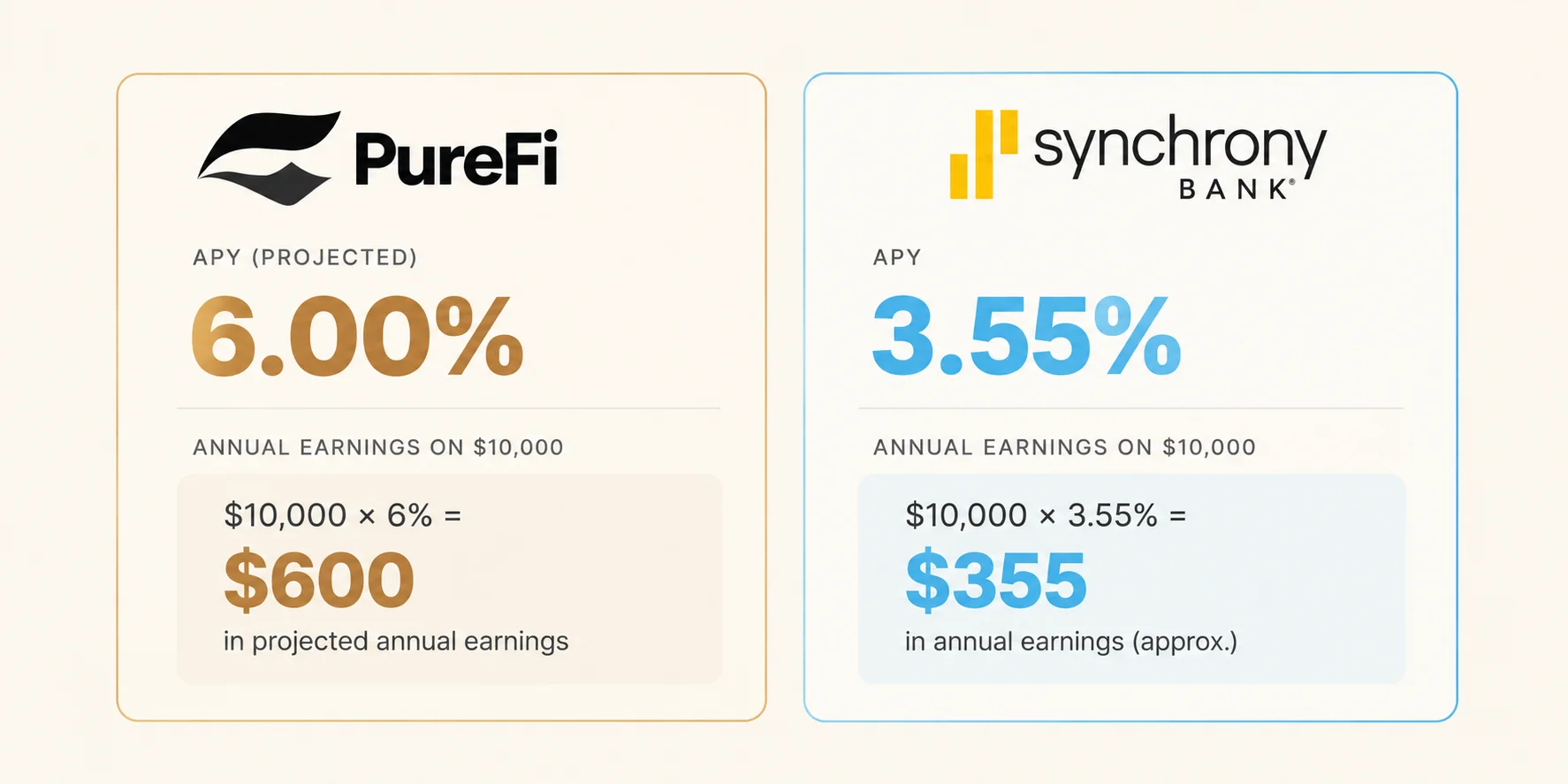
PureFi displays the higher percentage, but comparing 6% with 3.55% does not tell the whole story.
PureFi’s Projected APY
Our up-to-6% APY is tied to real estate performance. Rental payments and changes in property value both affect the result.
If rent falls because of a vacancy or another property issue, the amount earned may be lower. If the property loses value, the shares may be worth less when sold.
The projected APY helps users estimate potential performance. It should not be read as a fixed promise.
Synchrony’s Savings APY
Synchrony’s 3.55% APY applies to a deposit balance. The bank calculates earnings daily and adds them according to its crediting schedule.
The APY is variable. Synchrony can raise or lower it after the account has been opened. The original deposit does not gain or lose value because of movements in the housing market.
Our guide to why high-yield savings rates change explains what can influence a bank’s APY.
The practical difference is risk. PureFi offers a higher projected figure with property-market exposure. Synchrony offers a lower variable rate with a more stable deposit structure.
PureFi vs Synchrony: Fees and Minimum Balances
Neither option charges a standard monthly account fee or requires an advertised minimum balance.
PureFi Fees
We charge a one-time fee when a user purchases property shares. The amount is shown on the order before confirmation.
Transfer, conversion, network, or licensed-partner charges may also apply depending on how money enters or leaves the platform. Users should review the full transaction cost before purchasing shares.
There is no ongoing monthly fee simply for holding an account.
Synchrony Fees
Synchrony charges no monthly service fee and requires no minimum opening deposit. Standard electronic transfers to and from Synchrony High Yield Savings do not carry a Synchrony transfer fee.
The bank currently charges $25 for an outgoing wire. An external bank or another service provider may apply its own charge.
An ATM owner can also impose a fee. Synchrony refunds up to $5 in domestic ATM fees per statement cycle. Customers with Diamond status in the Synchrony Perks program receive unlimited domestic ATM-fee refunds under the current terms.
Foreign conversion and overseas transaction charges are not included in that reimbursement.
Our guide to high-yield savings accounts with no monthly fees explains why customers should still review service charges.
PureFi vs Synchrony: Account Access
Both options are digital, but customers access their money in different ways.
Accessing Money Through PureFi
Users manage their wallet and property shares through the PureFi app. They can view property information, monitor rental activity, and track the current value of their holdings.
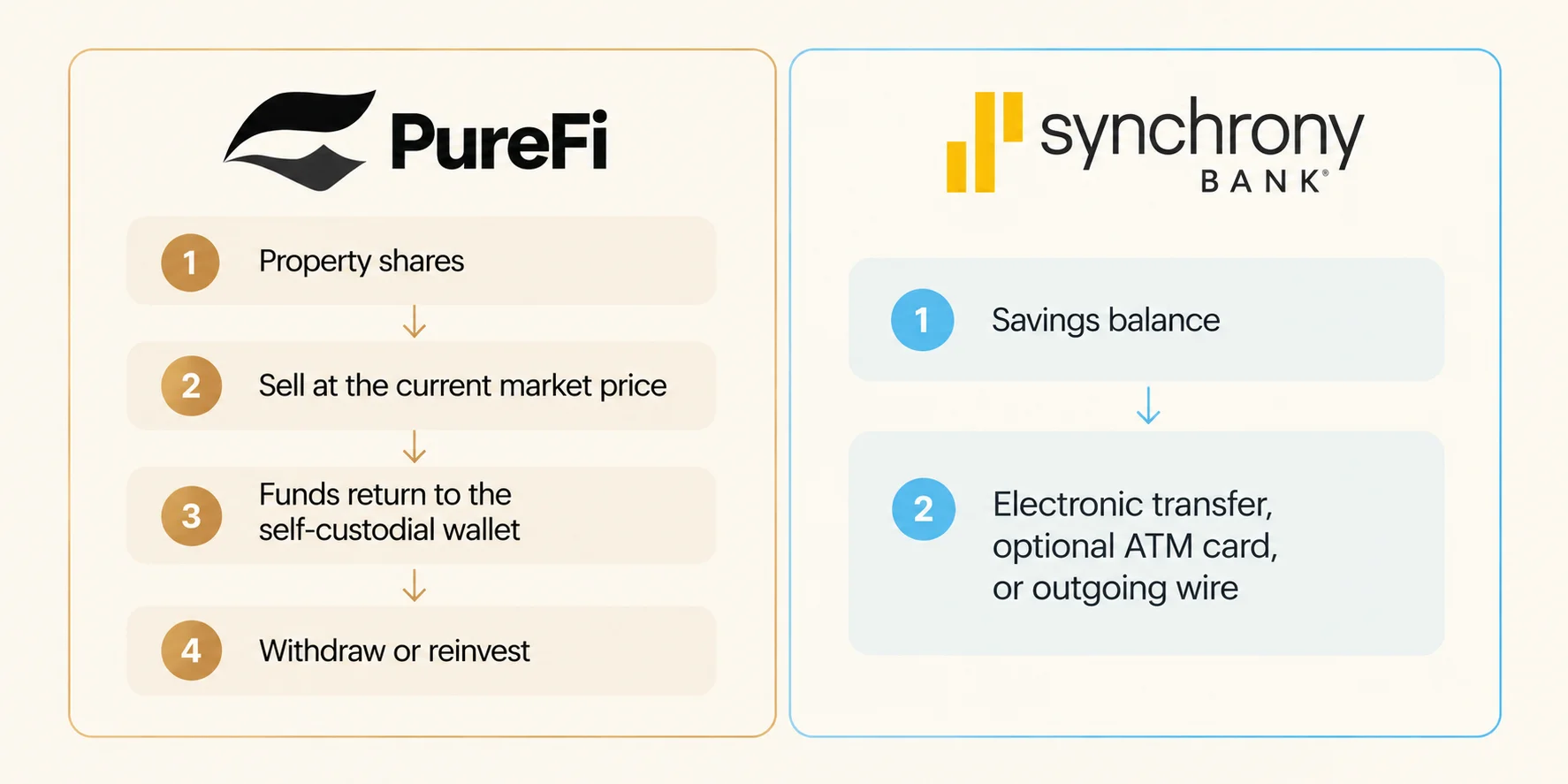
There is no advertised fixed lock-up. A user can sell property shares at the current market price when they want to exit.
That market price may be higher or lower than the amount originally paid. Selling property shares is not the same as transferring a stable savings balance.
PureFi cards are coming soon. Card availability, supported countries, fees, and transaction limits will be shared when the service becomes available.
Accessing Synchrony Savings
Synchrony offers more direct cash-access options than many online savings accounts.
Customers can request an optional ATM card. The card works at machines displaying the Plus or Accel logos in the United States and overseas. It supports cash withdrawals and basic ATM transactions.
Synchrony does not describe it as a full purchase-enabled debit card. Customers should not assume it will work for shopping or recurring card payments.
Electronic transfers are also available through online banking, the app, and Synchrony’s automated telephone service. Standard transfers to linked accounts do not carry a Synchrony fee.
Customers can request an outgoing wire by telephone. Checks cannot be written from the High Yield Savings Account. Synchrony only offers check writing with its Money Market Account.
Our guide to whether high-yield savings accounts have debit cards explains the difference between debit and ATM access.
PureFi vs Synchrony: Account Features
PureFi focuses on direct access to residential property shares. Synchrony focuses on digital saving and cash access.
| Feature | PureFi | Synchrony |
|---|---|---|
| Choose individual properties | Yes | No |
| Track rental performance | Yes | No |
| Mobile account management | Yes | Yes |
| Electronic transfers | Yes | Yes |
| Mobile check deposit | No | Yes, subject to limits |
| ATM card | Coming soon | Optional |
| Check writing | No | No for HYSA |
| Savings rewards program | No | Synchrony Perks |
| Physical branches | No | No conventional branch network |
Synchrony currently allows mobile check deposits through its app. Its official account page lists a daily mobile deposit limit of $2,000 per account, although the bank can change limits and eligibility.
Customers can also fund the account through direct deposit, electronic transfers, incoming wires, and mailed personal or cashier’s checks.
Synchrony Perks rewards customers based on balance or the length of their banking relationship. Benefits can include enhanced ATM-fee reimbursement. The value depends on the customer’s status and use of the account.
PureFi vs Synchrony: Protection and Risk
The two options carry different types of risk.
PureFi
We are not a bank. Users own shares tied to rented homes, and those shares can increase or decrease in value.
Projected earnings are not guaranteed. Rental performance, property expenses, vacancies, and market conditions can affect the result.
Balances and property shares do not receive FDIC insurance or protection from another government deposit scheme.
A self-custodial wallet gives the user direct control. It also makes the user responsible for protecting account access, recovery details, and connected devices.
Synchrony
Synchrony Bank is an FDIC member. Eligible deposits are protected up to $250,000 per depositor, per insured bank, for each ownership category.
Coverage is calculated across qualifying deposits held in the same ownership category at Synchrony. Opening several accounts at the bank does not automatically provide separate $250,000 limits for each one.
FDIC coverage protects eligible deposits if the bank fails. It does not prevent Synchrony from changing its APY.
Our guide to whether high-yield savings accounts are safe covers deposit protection and other account risks.
PureFi vs Synchrony: Accessibility
PureFi is available in more than 100 countries, subject to local rules and identity checks. Funding support extends across more than 160 countries, although available methods and properties can vary by jurisdiction.
Users manage everything through the app. This may suit people who want exposure to U.S. residential property but do not want to buy or manage an entire home.
Synchrony High Yield Savings is intended for eligible U.S. applicants. It is a personal, non-IRA account and requires the customer to complete the bank’s identity and eligibility checks.
The optional ATM card can work at supported machines overseas. That does not mean non-U.S. residents can open the account. International ATM availability and account eligibility are separate matters.
Synchrony may suit customers who are comfortable with an online-only bank and do not need branch-based support.
Who Might Each Option Suit?
The right choice depends on whether the money needs the stability of a bank deposit or can take on property-market risk.
Choose PureFi If You:
- Want to choose shares of individual rented homes
- Want potential earnings linked to rental income
- Understand that the projected APY is not guaranteed
- Can accept changes in the value of property shares
- Want real estate exposure without managing an entire home
- Live in one of our supported jurisdictions
Choose Synchrony If You:
- Want a conventional high-yield savings account
- Prioritize FDIC protection for eligible deposits
- Want an optional ATM card for cash withdrawals
- Prefer no monthly service fee or minimum balance
- Want mobile check deposit and electronic transfers
- Meet Synchrony’s U.S. account requirements
A digital savings platform and a high yield savings app can both make account management convenient. The product behind the app still matters. Compare the source of the earnings, access methods, risk of loss, and available protection before deciding.
Put Your Dollars Into Something Real
With PureFi, your projected earnings come from shares of real homes with tenants. Choose your properties from your phone, review the documents, and see every fee before you confirm.
Learn more about how PureFi can help you own real estate shares or download the app to get started today.
Up to 6% APY is projected, variable, and not guaranteed. Property shares can lose value. PureFi is not a bank, and its balances and real estate shares are not covered by FDIC insurance or another government deposit scheme.