PureFi vs. Rain Stablecoin Card Comparison
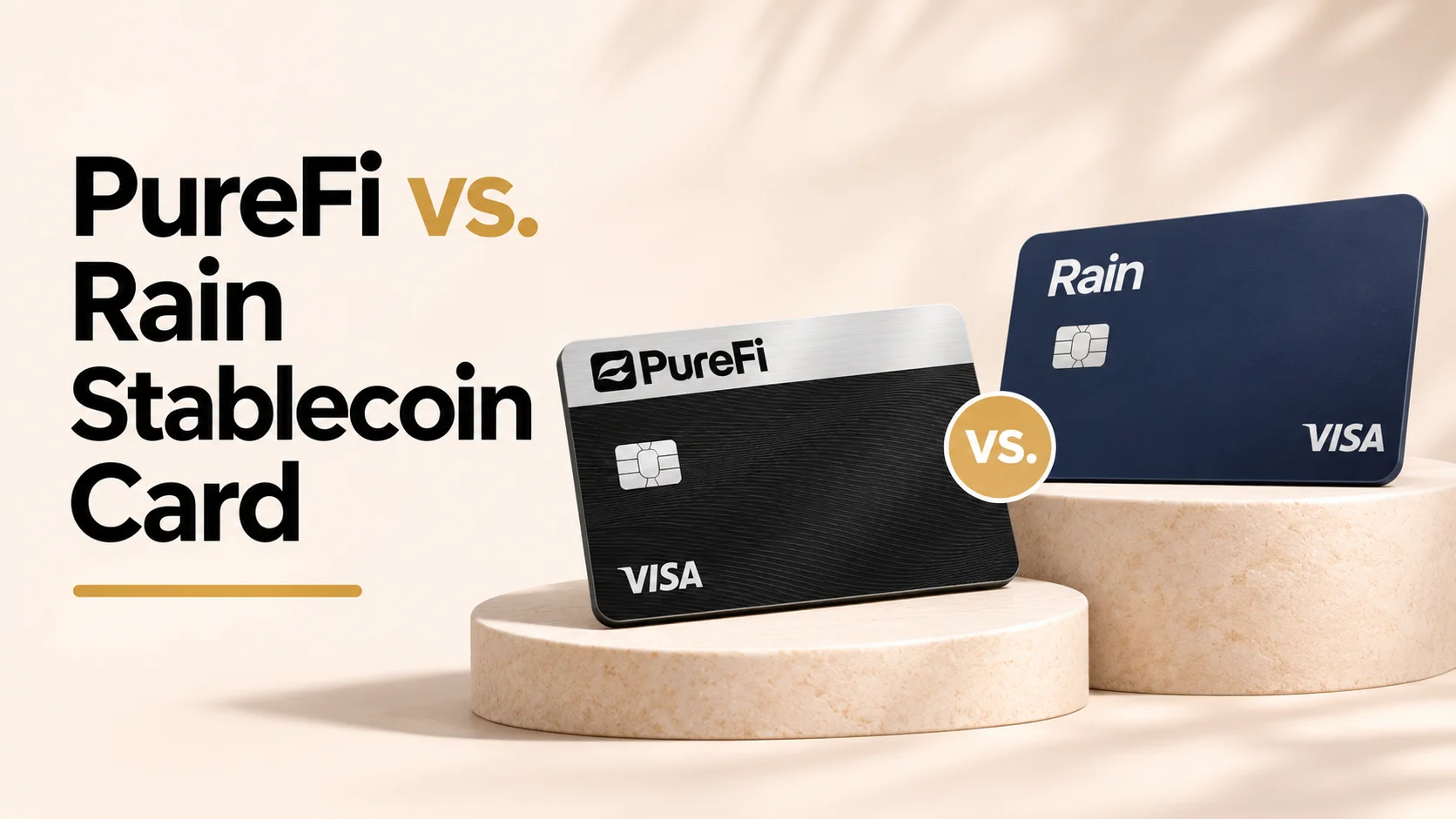
PureFi and Rain both use stablecoin infrastructure to support card payments. However, they offer different products. PureFi is developing stablecoin Visa debit cards for individual customers. Rain mainly provides the technology businesses need to launch their own branded card programmes.
That difference affects everything from fees to availability. PureFi customers will manage their cards through the PureFi app. Someone using Rain’s infrastructure will normally receive a card from one of Rain’s business partners.
This comparison explains how the two models work, what card features they support and what customers should check before choosing a card. If you are new to digital-dollar cards, start with our guide to getting a stablecoin-backed debit card.
PureFi vs. Rain at a Glance
| Feature | PureFi | Rain |
|---|---|---|
| Main product | Consumer stablecoin card | Enterprise card-issuing infrastructure |
| Current status | Coming soon | Active through partner programmes |
| Card options | Basic, Gold and Obsidian | Virtual and physical cards configured by partners |
| Card structure | Prepaid Visa debit | Credit and prepaid programmes |
| Card network | Visa | Visa or Mastercard, depending on the programme |
| Funding | Available PureFi balance | Depends on the partner’s wallet and card structure |
| Supported assets | Final card list will be confirmed at launch | Stablecoins and other approved assets selected by each partner |
| Card fees | Final pricing has not been announced | Set by the business launching the card |
| Mobile wallets | Support will be confirmed at launch | Apple Pay and Google Pay supported |
| Customer access | Directly through PureFi | Through a Rain business partner |
PureFi and Rain should not be treated as two identical consumer card brands. PureFi is preparing a direct card product. Rain provides the issuing technology behind cards offered by fintechs, remittance companies, crypto platforms and other businesses.
What Is the PureFi Stablecoin Card?
PureFi’s stablecoin cards will allow customers to spend from their available PureFi balance wherever Visa debit is accepted. The cards are designed for online and in-store purchases.
Customers will not need to move money into a separate prepaid card account before every transaction. The card will use the available balance shown in the PureFi app.
Three public tiers are planned:
- Basic: The entry card for verified PureFi customers
- Gold: A higher tier with enhanced rewards and selected travel benefits
- Obsidian: A premium tier with stronger rewards, travel features and account support
PureFi plans to offer virtual card details and physical cards. Customers will also be able to review card activity and manage card settings through the app. Full details for card freezing, replacement and disputes will be published before cards are shipped.
The PureFi card balance and PureFi Earn are separate. PureFi Earn offers fractional shares of real, rented homes with up to 6% projected APY. Property shares cannot be spent directly at checkout. Funds must be available in the customer’s PureFi balance before the card can use them.
PureFi is a digital savings platform and financial technology provider, not a bank. PureFi balances are self-custodial and are not protected by FDIC insurance.
What Is the Rain Stablecoin Card Platform?
Rain is an enterprise stablecoin payment platform. It helps other companies build and launch card products rather than offering one standard card directly to every consumer.
A fintech company, wallet provider or remittance service can use Rain to create a branded card programme. The partner decides how customers apply, which assets can fund the card, what fees apply and what rewards are available.
Rain’s card-issuing platform supports consumer and business cards. It can also support both prepaid and credit structures.
Businesses can use Rain to provide:
- Virtual and physical cards
- Branded card designs
- Apple Pay and Google Pay
- Configurable spending controls
- Consumer and corporate programmes
- Single-use virtual cards
- Card rewards
- Compliance and fraud monitoring
- Dispute management
Rain is a principal member of both Visa and Mastercard. Its card-issuing page says Rain-issued cards can be accepted at more than 175 million locations. However, the payment network used by an individual card depends on the partner programme.
Rain-powered cards can therefore look and work differently. A card from one partner may support USDC and Apple Pay. Another programme may use a different stablecoin, card network or reward system.
Our guide to white-label stablecoin debit cards explains why the company printed on a card is not always the same company providing the underlying issuing technology.
PureFi vs. Rain Card Fees
PureFi has not published its final card pricing. Fees for Basic, Gold and Obsidian will be announced before customers are asked to order.
This means PureFi’s card issuance, replacement, ATM and foreign-currency charges should not be estimated. Customers will need to review the final pricing when ordering opens.
Rain also does not publish one universal fee schedule for cardholders. Its business partners decide what they charge customers.
A Rain-powered card may have:
- An issuance or physical-card delivery fee
- A monthly membership fee
- A foreign-currency charge
- An ATM withdrawal fee
- A replacement-card fee
- A stablecoin conversion or funding charge
Some partner programmes may absorb part of these costs. Others may pass them to the cardholder. Two cards using Rain infrastructure can therefore have different prices.
The Stablecard by Western Union shows how a specific Rain programme can work. It uses USDPT as collateral for a Visa secured credit card. Western Union states that fees may apply for foreign transactions, physical-card delivery, ATM withdrawals and cash collection. Those fees belong to that programme and should not be applied automatically to every Rain-powered card.
When comparing the total cost, look beyond the amount charged to order the card. Conversion, withdrawal and foreign-currency fees may have a larger effect over time. Read our guide to foreign transaction fees before using a stablecoin card abroad.
Supported Stablecoins and Currencies
PureFi works with USDC, USDT and other U.S. dollar stablecoins across its platform. However, the final card-specific list has not yet been published.
PureFi will confirm which stablecoins and blockchain networks can fund card spending when the cards launch. Customers should check both the asset and network. The same stablecoin can exist on several networks, but a platform may support only selected versions.
PureFi’s card will spend from the available PureFi balance. It will not sell or spend fractional property shares held through PureFi Earn.
Rain’s infrastructure can support several stablecoins and other digital assets. Its wallet platform supports USDC, USDT and other approved assets across networks such as Ethereum, Solana, Base, Polygon, Arbitrum, Avalanche, Optimism and BNB Smart Chain.
That does not mean every Rain-powered card accepts every asset. The business launching the card chooses which currencies and networks are included.
For example, Western Union’s Rain-powered Stablecard uses USDPT, a dollar-backed token issued by Anchorage Digital Bank on Solana. A different Rain partner may use USDC or another supported asset.
This makes the partner’s own terms more important than Rain’s full technical capabilities. Before adding funds, customers should confirm:
- The exact stablecoin accepted
- The supported blockchain network
- Any minimum deposit
- Conversion charges
- What happens if funds are sent through the wrong network
Stablecoins do not carry the same protection as an insured bank balance. Their value, reserves and redemption process can also differ. Read Are Stablecoins Safe? before choosing an asset to fund a card.
Card Features and Payment Options

PureFi’s planned cards focus on a direct customer experience. The balance, card and PureFi Earn account will appear in the same app.
PureFi also plans to vary rewards and benefits by tier. Basic will provide the entry-level card experience. Gold and Obsidian will add higher rewards and other account or travel features.
Final cashback eligibility may depend on the card tier, purchase location, merchant category or monthly limit. These terms should be reviewed when the cards launch.
Rain provides a wider set of configurable features because it is building for different businesses. A partner can use Rain to launch virtual cards, physical cards or both. It can also set spending limits and decide whether the programme uses a prepaid or credit structure.
Rain supports Apple Pay and Google Pay. Businesses can also add branded rewards and card controls. Rain’s system handles areas such as card authorisation, compliance, fraud checks, disputes and reporting behind the scenes.
The cardholder experience still depends on the partner. Rain may technically support mobile wallets, ATM withdrawals or rewards, but an individual programme may not enable every option.
Merchants do not need to accept stablecoins directly. The card network processes the purchase through its normal payment flow. The stablecoin infrastructure sits behind the card and supports funding or settlement.
This is one reason stablecoin cards can feel similar to ordinary payment cards. Our article on how stablecoins reduce transaction costs explains where the underlying payment process may become more efficient and where additional costs can remain.
Availability and Eligibility
PureFi cards are coming soon. Customers cannot order one yet.
Anyone who downloads the PureFi app is automatically placed on the card list. There is no separate card registration form at this stage. PureFi will announce launch countries, eligibility rules, delivery times and ordering details before the cards become available.
Rain does not have one consumer availability list. Its infrastructure supports card programmes across several regions, including North America, Latin America, Asia-Pacific and CEMEA. That does not mean every person in those regions can apply for a Rain-powered card.
Availability depends on the company offering the card. A Rain partner must decide:
- Which countries it serves
- Whether it offers virtual or physical cards
- What identity documents it accepts
- Which customers qualify
- Which payment network it uses
- Whether physical delivery is available
A customer may therefore be eligible for one Rain-powered programme but not another.
Identity verification will normally be required for both PureFi and Rain-issued cards. Stablecoin infrastructure does not remove card-network, sanctions-screening or customer-verification requirements.
Is PureFi or Rain Easier for an Individual to Use?
PureFi is the more direct consumer product. Eligible customers will apply, order and manage their cards through the PureFi app after launch.
Rain is relevant to consumers when a service they already use has built its card programme on Rain. The customer normally interacts with that partner’s app and brand rather than opening a general Rain card account.
PureFi may suit someone who:
- Wants a Visa debit card connected to an available PureFi balance
- Prefers a clear choice between Basic, Gold and Obsidian
- Wants card activity and PureFi Earn visible within one app
- Is comfortable waiting for final launch details
A Rain-powered card may suit someone who:
- Already uses a participating Rain partner
- Wants a card linked to that partner’s wallet or payment service
- Needs mobile-wallet support
- Has checked that programme’s fees, assets and eligibility
- Understands that features differ between Rain partners
PureFi and Rain solve different parts of the card process. PureFi is creating the product a customer will use. Rain provides the infrastructure that another company can use to create its own card.
What Should Businesses Know About Rain?
Rain is more directly comparable with a card issuer or white-label infrastructure provider than with a standard consumer card.
A fintech, remittance company, marketplace or crypto platform can use Rain to launch a branded programme without building the full issuing system from the beginning. Rain can support card production, payment processing, compliance operations, dispute handling and stablecoin settlement.
Rain says stablecoin card programmes can launch faster than traditional fiat card programmes because fewer providers need to be connected. Its daily onchain settlement model is also designed to reduce the amount of reserve capital a business must keep tied up for several days.
These are benefits for the company launching the card. The individual cardholder still needs to review the partner’s fees, supported assets, rewards and availability.
Be first in line for a PureFi card
PureFi stablecoin Visa debit cards are coming soon. Download the PureFi app now and you will automatically be added to the list, with no separate form. When cards arrive, you will be able to order through the app and spend from your available PureFi balance wherever Visa debit is accepted.
The Prepaid Debit Visa Card is issued by Lead Bank under licence from Visa U.S.A. Inc. Bridge Ventures LLC is the program manager, and PureFi is the platform provider. Applicants must be 18 or older. Fees, eligibility and availability may vary. PureFi is not a bank, and PureFi balances are not FDIC insured or guaranteed by PureFi.