PureFi vs. Pibank
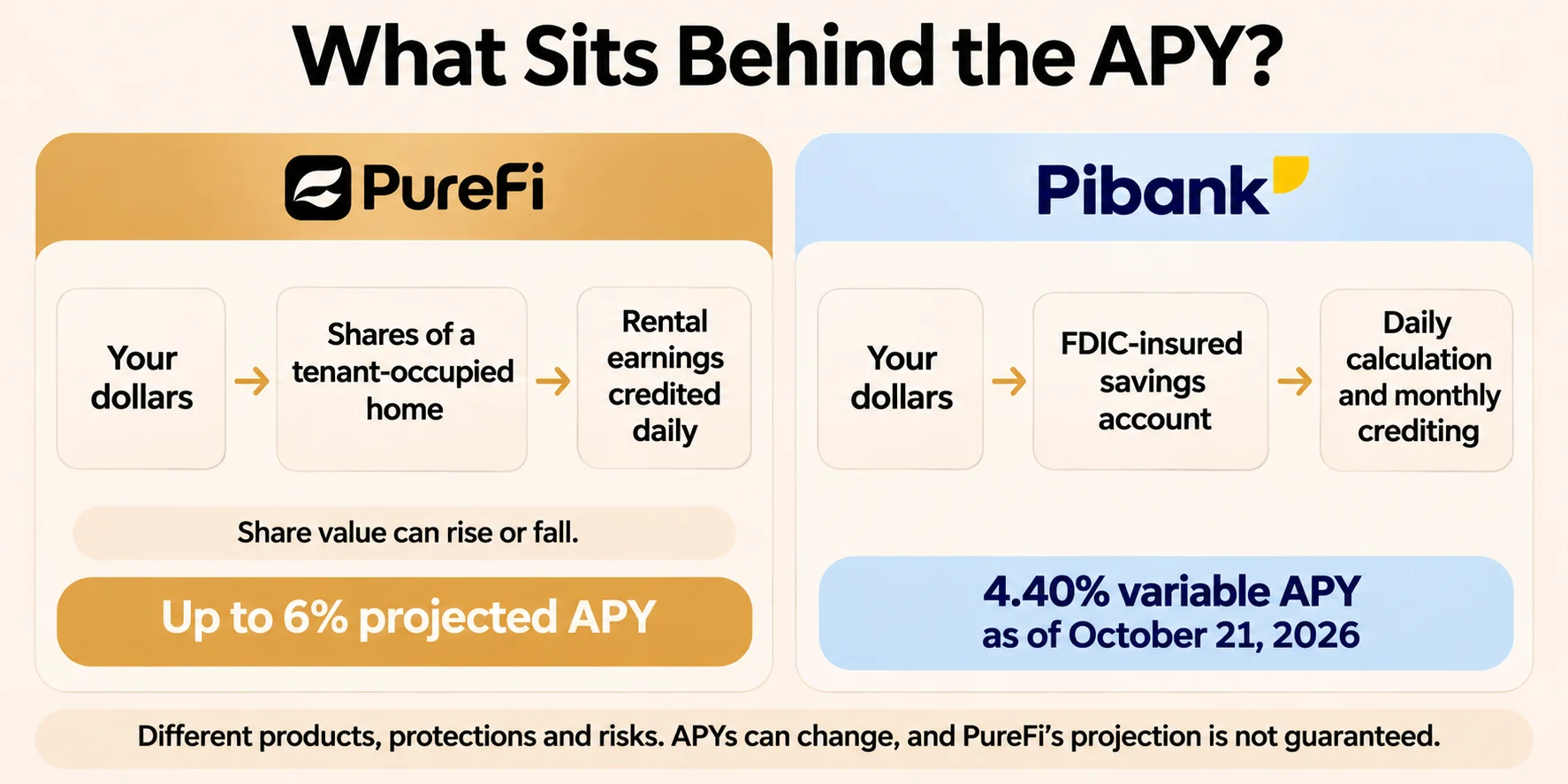
PureFi and Pibank both provide digital ways to earn, but the products differ. PureFi connects users with tenant-occupied homes. Pibank offers an online savings account issued by Intercredit Bank, N.A.
PureFi projects up to 6% APY from rent and changes in property value. Pibank Savings currently offers a 4.40% variable APY on bank deposits. It has no monthly fee or minimum balance, but its transfer options are more limited than those of many online savings accounts.
The main differences involve earnings, access, protection and eligibility.
PureFi vs. Pibank at a Glance
| Feature | PureFi | Pibank |
|---|---|---|
| Product | Shares of tenant-occupied homes | Online savings account |
| Published earnings | Up to 6% projected APY | 4.40% variable APY |
| Source of earnings | Rent and changes in property value | Yield paid on bank deposits |
| Monthly fee | None | None |
| Minimum balance | Purchase amount shown in the app | No minimum |
| Minimum to earn | Based on the share purchase | $0.01 |
| Access | Sell shares at the current market price | Wire transfers |
| ACH support | Funding options vary by country | Not supported |
| Debit card | Cards coming soon | Not available |
| Joint accounts | Property shares held in the user’s name | Available |
| Protection | Not FDIC insured | FDIC insured within applicable limits |
| Availability | More than 100 countries | U.S. residents only |
Pibank’s 4.40% APY was advertised as of October 21, 2026. It is variable and can change after the account has been opened.
What Is PureFi?
PureFi is a financial technology company, not a bank. Its digital savings platform provides shares of homes that already have tenants. Projected earnings come from rent and changes in home values. Rental earnings are credited daily. Users can review the properties, legal documents and one-time purchase fee before confirming.
PureFi provides a self-custodial wallet, so users control their balance keys. Property shares are held in the user’s name and can be sold at the current market price.
The up to 6% APY is projected rather than guaranteed. Rent can change, and property shares can rise or fall in value.
What Is Pibank?
Pibank is an online banking brand of Intercredit Bank, N.A., Member FDIC. Its main consumer product is Pibank Savings.
The account currently offers 4.40% APY with no monthly fee or opening minimum. At least $0.01 is needed to earn. Earnings are calculated daily and credited monthly, generally on the 15th or next business day.
Pibank Savings supports individual and joint ownership. Customers can open multiple accounts through the app, each with a stated $5 million maximum balance.
Pibank is much more limited than a full-service digital bank. It does not currently offer checking, cards, Bill Pay or direct payments from savings. Its focus is a high yield digital savings account rather than everyday banking.
The guide to high-yield deposit accounts explains how savings accounts differ from money market accounts and CDs.
PureFi vs. Pibank: APY and Earnings
The figures come from different sources.
How PureFi earnings work
PureFi projects up to 6% APY from rent and changes in the value of tenant-occupied homes. Nothing is lent out to generate the return.
Rental earnings can arrive daily, but the value is not fixed. Expenses, occupancy, rent and home prices can affect the result.
How Pibank earnings work
Pibank Savings currently offers 4.40% APY. It uses the daily balance method and credits earnings monthly.
There is no balance tier for the advertised APY. A balance of $0.01 or more can earn, but Pibank may change the APY at any time.
PureFi’s figure is a real-asset projection. Pibank’s figure is the variable APY on a bank deposit.
The comparison of savings rates covers the other factors that should be checked alongside a headline APY.
PureFi vs. Pibank: Fees and Minimum Balances
Neither option currently charges a monthly account fee. PureFi shows a one-time purchase fee before a user confirms a property-share order. The available purchase amount is displayed in the app. There is no monthly fee for holding the account.
Pibank Savings has no opening minimum, monthly maintenance fee or ongoing balance requirement. Its fee schedule also lists no charge for wires, dormancy, excess transactions or stop-payment requests.
Another institution can charge for sending or receiving a Pibank wire. This matters because wires are the main withdrawal method.
Pibank states that closing an account before monthly earnings are credited may forfeit the accrued amount.
The guide to high-yield savings accounts with no monthly fees explains why a no-fee label does not cover costs charged by another provider.
PureFi vs. Pibank: Access to Funds
Access is one of the largest differences between the two products.
Access through PureFi
PureFi users can sell shares at the current market price. Proceeds return to their balance, with no fixed maturity date or stated lock-up.
The market price may be higher or lower than the original purchase amount.
Access through Pibank
Pibank Savings is designed only for saving. It does not currently generate or accept standard ACH transfers, including microdeposits.
The account also does not provide:
- A debit or ATM card
- Bill Pay
- Zelle
- Check deposits
- Checks or direct payments
The first deposit can be made through Plaid or by wire. Outgoing transfers must use wires. Pibank does not charge, but the other bank may.
Customers can set daily and per-transaction limits in the app. Larger requests may need approval.
The guide to HYSA liquidity explains why transfer methods can matter as much as the published APY.
PureFi vs. Pibank: Available Banking Services

Neither option currently replaces a complete checking account.
Pibank has no debit card, checking account, ATM access, Bill Pay or Zelle. Customers need another account for spending, cash and bills.
PureFi focuses on real estate shares and a self-custodial balance. PureFi cards are coming soon, but the current service should not be treated as a direct substitute for everyday checking.
Someone wanting an online savings app separate from daily spending may appreciate Pibank. Someone comparing a high-yield savings app or high-yield investment platform tied to real assets may find PureFi more relevant.
The underlying products are still different. Pibank holds deposits. PureFi provides property shares.
PureFi vs. Pibank: Eligibility and Accessibility
PureFi is available in more than 100 countries and can be funded from more than 160 countries, subject to local availability and rules. Users manage the account through the PureFi mobile app.
Pibank is available only to eligible U.S. residents. Applicants must be at least 18, have a valid Social Security number and provide a driver’s licence, state-issued ID or qualifying U.S. passport.
The application includes identity verification, a Know Your Customer questionnaire, an OFAC check, a ChexSystems review and biometric facial verification. A credit freeze or fraud alert may affect the application process.
Customers can begin applying on the website, but they need the Pibank app to complete setup and manage the account.
PureFi has much wider geographic availability. Pibank is restricted to U.S. residents who can complete its identity and banking-history checks.
Who Might Each Option Suit?
Choose PureFi if:
- You want projected earnings connected to rent from real homes.
- You want to select the properties linked to your balance.
- You understand that property shares can rise or fall in value.
- You live outside the United States in a supported country.
- You accept that the projected APY is variable and not guaranteed.
Choose Pibank if:
- You want an FDIC-insured U.S. savings account.
- You want a competitive APY without balance tiers.
- You do not want a monthly fee or minimum balance.
- You are comfortable using wires instead of ACH.
- You do not need a debit card, Bill Pay, Zelle or checks.
- You want the option to open a joint savings account.
Final Comparison
The main difference between PureFi and Pibank is the product behind the APY.
PureFi provides shares of tenant-occupied homes. Its projected earnings come from rent and changes in property value. Pibank provides an FDIC-insured savings account with a variable APY.
Pibank may suit eligible U.S. residents who want a simple place for savings and can work with wire-based access. PureFi may suit users who want wider international availability and exposure to real homes, while accepting the risks that come with property ownership.
Put your dollars into something real
With PureFi, your projected earnings come from shares of real homes with tenants. Choose your properties from your phone, review the documents, and see every fee before you confirm.
Learn more about how PureFi can help you own real estate shares or download the app to get started today.
Up to 6% APY is projected, variable, and not guaranteed. Property shares can lose value. PureFi is not a bank, and its balances and real estate shares are not covered by FDIC insurance or another government deposit scheme.