PureFi vs Marcus by Goldman Sachs
PureFi and Marcus provide app-based ways to put idle money to work, but their products are not equivalent. Although both may appear in a search for a digital savings platform, Marcus offers an FDIC-insured online savings account through Goldman Sachs Bank USA.
PureFioffers fractional shares of rented homes and is not a bank. That difference affects earnings, protection, and access. This comparison covers APY, fees, minimum balances, accessibility, and risk using details available on October 3, 2026. The percentages matter, but the structure behind each one matters more.
PureFi vs Marcus at a Glance
| Feature | PureFi | Marcus by Goldman Sachs |
|---|---|---|
| Product | Fractional real estate investment platform | Online savings account |
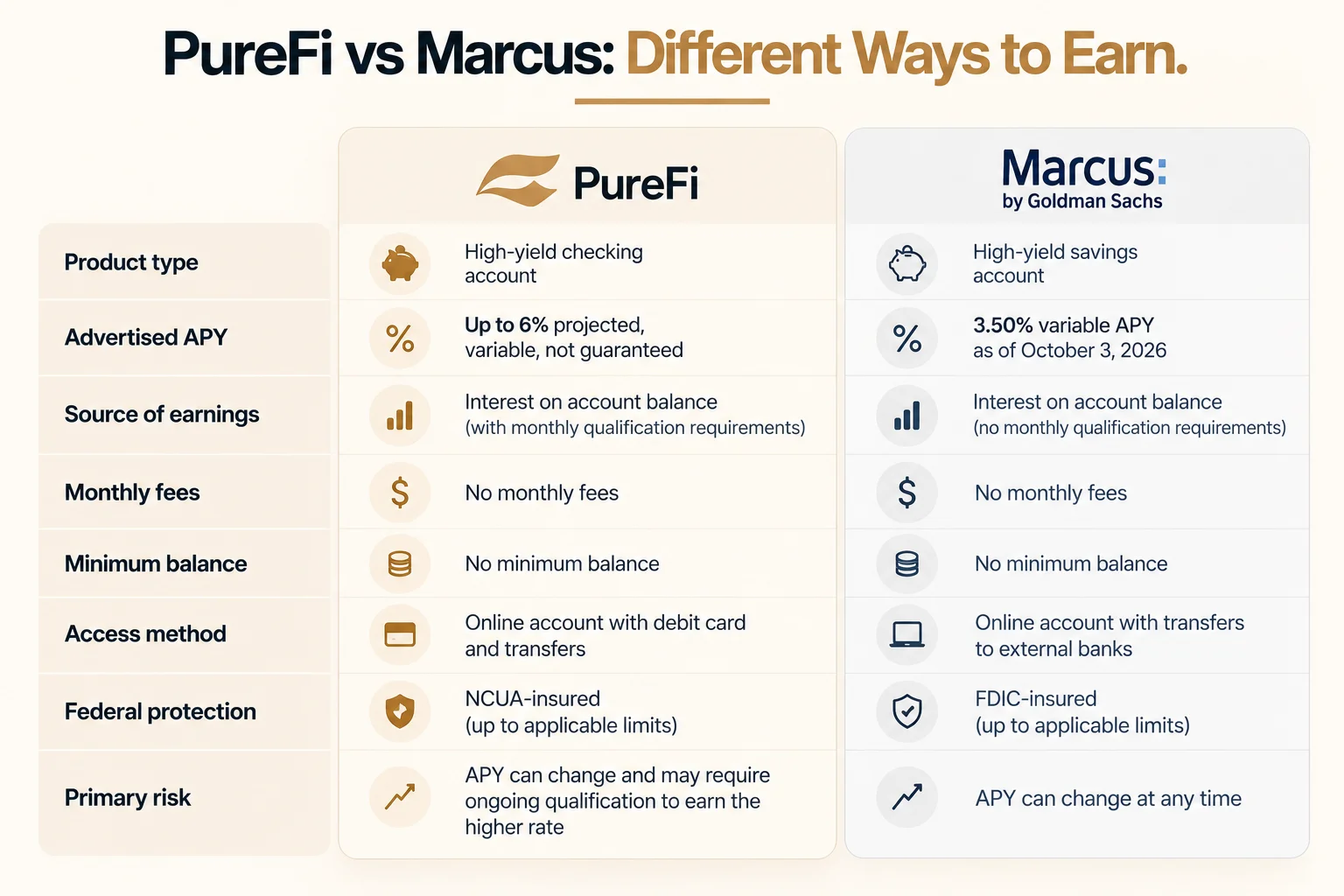
| Advertised APY | Up to 6% projected | 3.50% variable APY |
| Earnings source | Tenant rent and property-value changes | Earnings on a bank deposit |
| Guarantee | Not guaranteed; shares can lose value | APY can change; eligible deposits receive FDIC protection |
| Monthly fee | None | None |
| Other fees | One-time property purchase fee shown before confirmation | No Marcus account or transfer fee; an external institution may charge |
| Minimum | No minimum balance advertised on PureFi Earn | No minimum opening deposit |
| Access | App-based; shares sell at the current market price | App, website, phone, ACH, wire, or check |
| Geographic availability | More than 100 supported countries | Intended for eligible US customers |
Marcus listed a 3.50% standard APY on October 3, 2026. PureFi’s up-to-6% projection was dated August 25, 2026. Both figures can change, and PureFi’s projection carries property-market risk that does not apply to an insured Marcus deposit.
What Does PureFi Offer?
PureFi is a high-yield investment platform that allows users to buy fractional shares of rented homes. A user signs up through the app, completes identity verification, adds dollars, and chooses individual properties. Each property page includes documents that can be reviewed before buying.
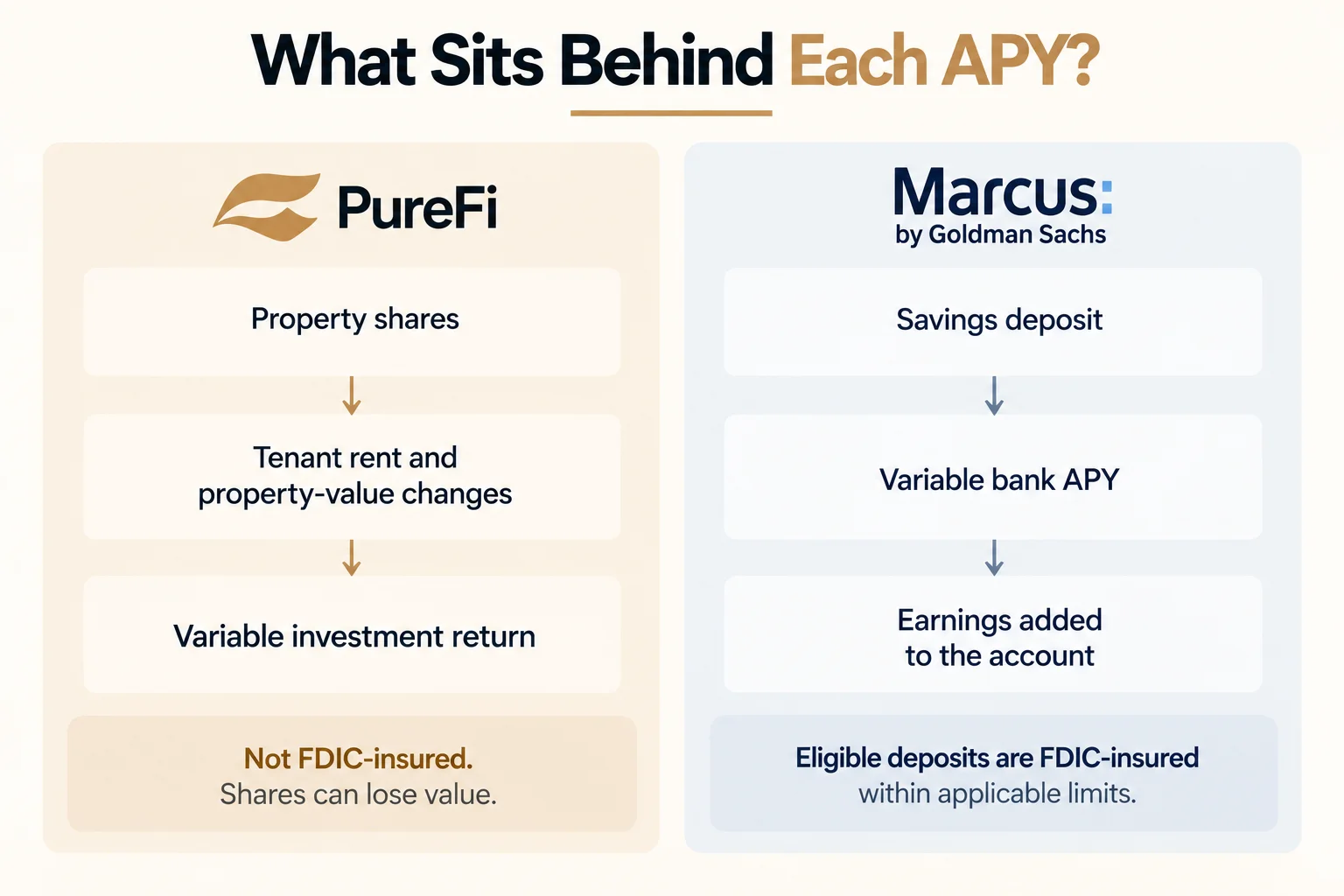
Potential returns come from two sources. When tenants pay rent, owners receive their proportional share. The value of the property shares can also rise or fall with the underlying home. PureFi projects up to 6% APY based on current rent and property values, but it does not promise that return. Rental performance can vary, and a decline in property value can reduce the amount received when shares are sold.
PureFi holds each user’s property shares in an account in their name rather than pooling them with other customers’ shares. The wallet is self-custodial, so the user controls the balance. Neither arrangement makes the balance or shares federally insured.
PureFi is available through its app in more than 100 countries, although availability depends on local jurisdiction. It may suit people who want direct exposure to residential real estate without buying and managing an entire home.
What Does Marcus by Goldman Sachs Offer?
Marcus provides an online savings account issued by Goldman Sachs Bank USA. As of October 3, 2026, the standard account APY was 3.50%. The APY is variable and can change before or after an account is opened. Earnings compound daily and are added monthly.
The account has no fees or minimum opening deposit. Marcus does not charge for transfers, although another bank may impose its own fee.
Customers can use the Marcus website or high-yield savings app to link external accounts, arrange transfers, view activity, and download documents. Telephone support is available around the clock.
The account has no debit or ATM card. Funds can be accessed through a bank transfer, domestic wire, or check, making it a place for savings rather than everyday spending.
Marcus also promotes a temporary referral boost, but the standard APY is the fairer comparison because the promotion has eligibility and time limits. Readers can review what a high-yield savings account is before comparing rates.
PureFi vs Marcus APY and Earnings
PureFi advertises the higher number, but its APY is a projection based on rent and home-value changes. Both can vary, and shares may be worth less when sold.
Marcus’s 3.50% APY applies to a bank deposit. The rate can change, but the balance does not fluctuate with property prices. Principal and credited earnings are eligible for FDIC protection within applicable limits.
The percentages therefore represent different trade-offs. PureFi carries rental and property-value risk. Marcus offers a variable savings return with federal deposit protection.
Comparing only 6% with 3.50% misses the uncertainty around PureFi’s earnings and share value. A bank APY can change, but the eligible deposit does not face real estate market movements. Our guide explains why high-yield savings account rates change.
PureFi vs Marcus Fees and Minimum Balances
Neither product advertises a monthly account fee. Both also promote access without a minimum balance or opening deposit, although their other costs and limits differ.
PureFi charges a one-time property-share purchase fee shown before confirmation. Applicable transfer costs should also appear before approval. Both affect the investment’s net return.
Marcus charges no account or transfer fee, although an external bank may charge. Each Online Savings Account has a $1 million principal limit, and each owner has a $3 million limit across Marcus deposit accounts. Credited earnings are excluded from these deposit-limit calculations under Marcus’s terms.
A maximum permitted balance should not be confused with the FDIC limit. Someone can hold more at Marcus than the amount covered in a single ownership category. Deposit protection must be calculated separately.
How Do PureFi and Marcus Compare for Access?
Marcus supports ACH withdrawals, domestic wires, and mailed checks. Transfers of $100,000 or less requested through Marcus by noon Eastern Time on a business day are generally processed by 5 p.m. The receiving bank controls final availability, and delays can occur.
Marcus currently imposes no monthly withdrawal-count limit, but it does not provide ATM or debit-card access. Customers generally transfer money to checking before spending it.
PureFi users manage their wallet and shares through the app. Rental payments can be reinvested or taken out, while shares can be sold at the current market price without a fixed lock-up.
Selling shares is not the same as transferring savings. The price may be higher or lower than the purchase price, so the sale feature does not protect the original amount.
Marcus is an online savings app for eligible US customers. PureFi is available in many supported countries. Broader access does not remove investment risk.
Account Protection and Risk
Marcus deposits are issued by Goldman Sachs Bank USA, an FDIC member. Coverage is generally up to $250,000 per depositor, per insured bank, for each ownership category. Applicable Goldman Sachs Bank USA deposits in the same category are combined.
PureFi is not a bank and does not hold customer deposits. Its wallet balances and real estate shares are not covered by the FDIC, NCUA, or another government deposit scheme. The value of the shares depends on the properties, rental performance, and market conditions.
PureFi uses encryption, monitoring, and verification for sensitive actions. These controls protect access and data, not the market value of an investment.
Marcus provides deposit protection for eligible savings. PureFi provides real estate ownership with possible gains or losses. The decision begins with whether the money must remain protected or can face investment risk.
Who May Prefer Marcus or PureFi?
Marcus may suit someone who wants an FDIC-insured high yield digital savings account with no monthly fee or opening minimum. It separates savings from checking while maintaining bank-transfer access. The lack of a card may discourage unplanned spending but limits immediate cash access.
PureFi may suit someone comfortable with variable real estate returns. Users select homes, review documents, receive a share of rent, and participate in property-value changes. It is available across more countries than Marcus.
Marcus is designed for saving. PureFi is designed for investing. An emergency reserve favors protection and bank access, while someone with protected cash already set aside may consider property shares for a longer goal. Our article asks whether savings accounts are good for the long term.
Readers comparing other online bank products can also review PureFi vs American Express and PureFi vs EverBank.
Put your dollars into something real
With PureFi, your projected earnings come from shares of real homes with tenants. Choose your properties from your phone, review the documents, and see every fee before you confirm.
Learn more about how PureFi can help you own real estate shares or download the app to get started today.
Up to 6% APY is projected, variable, and not guaranteed. Property shares can lose value. PureFi is not a bank, and its balances and real estate shares are not covered by FDIC insurance or another government deposit scheme.