PureFi vs Goldsand
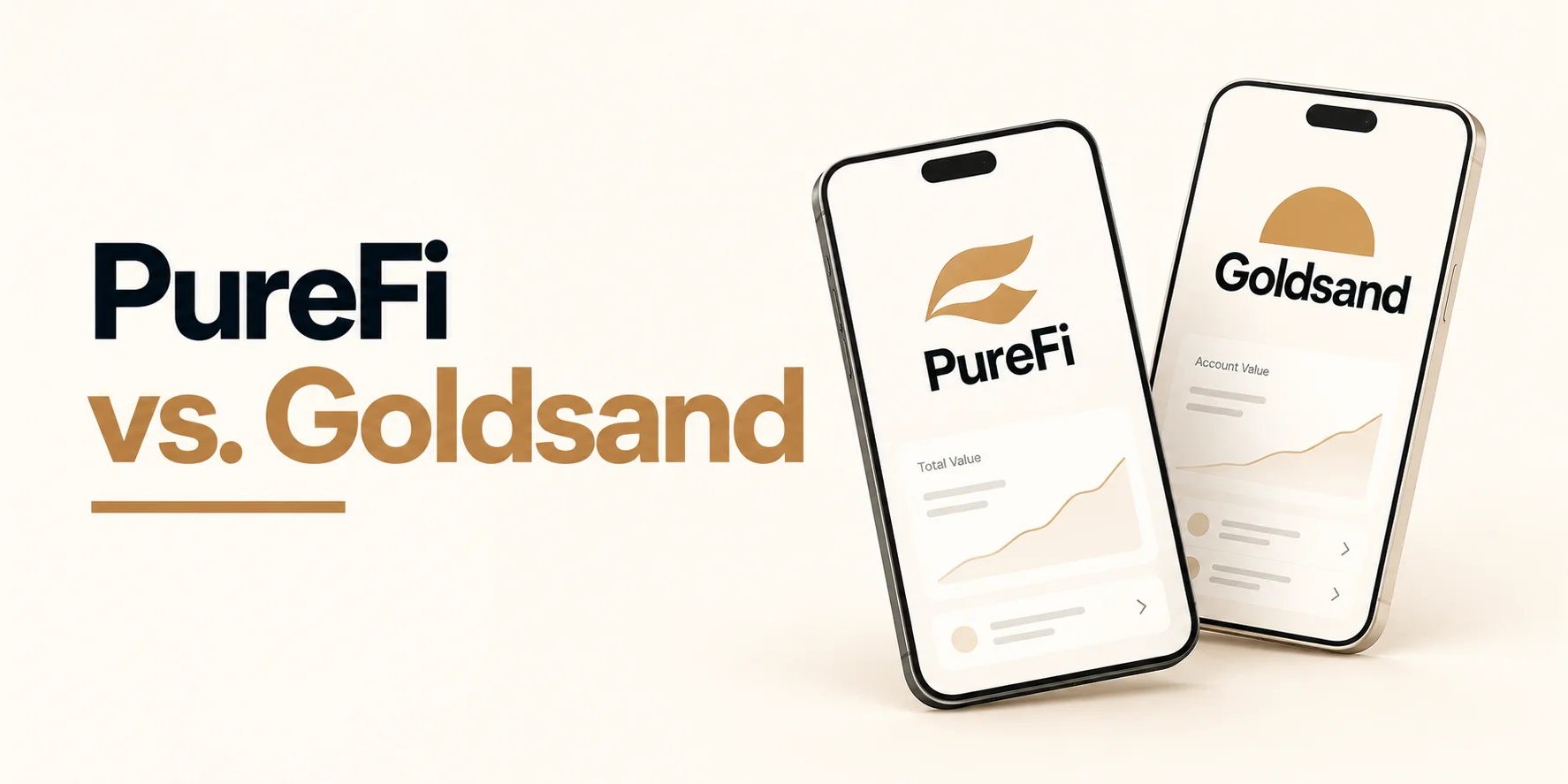
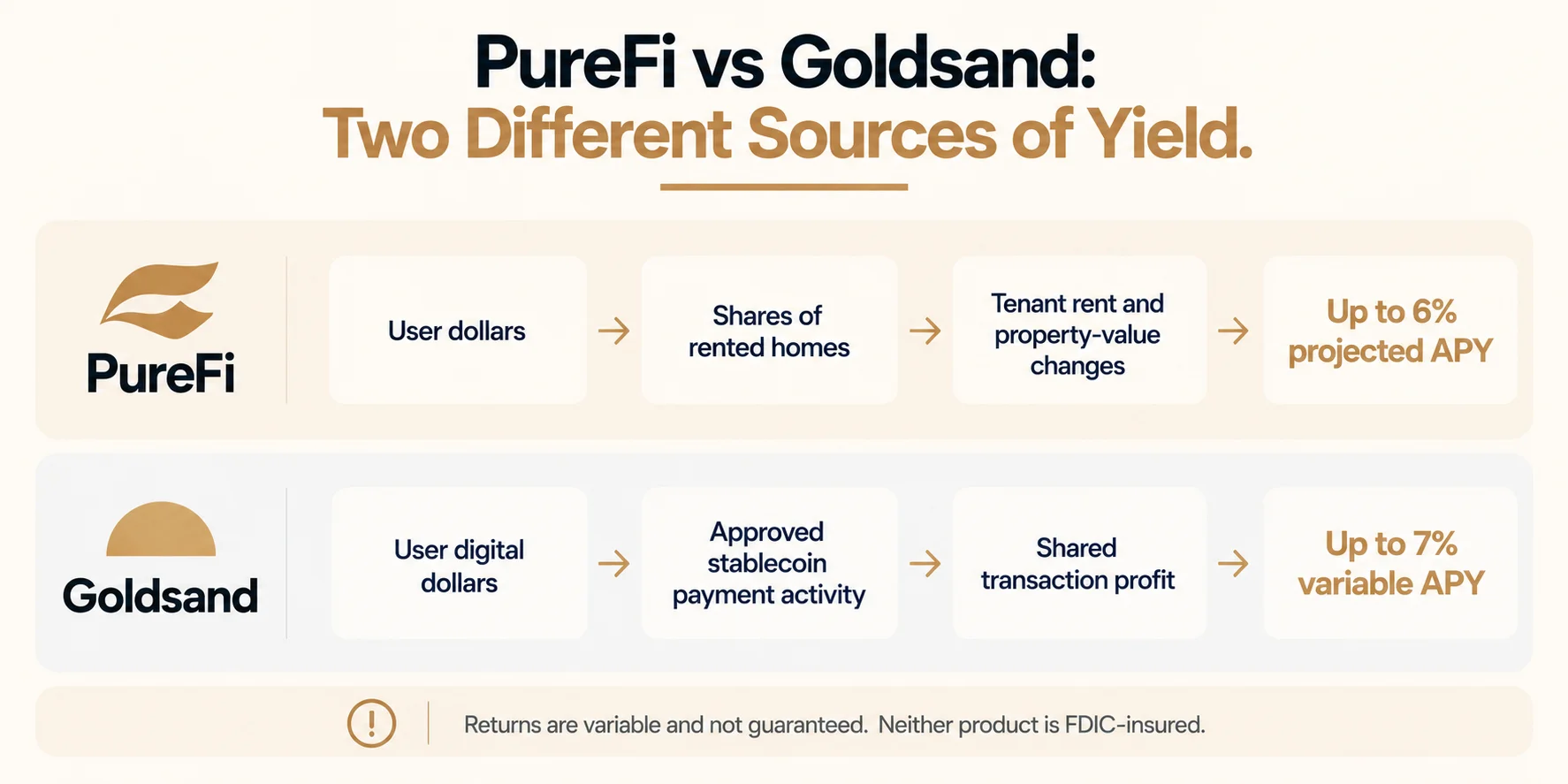
PureFi and Goldsand both give users a digital way to earn yield on dollars, but the money goes to different places. PureFi puts it into shares of rented homes. Goldsand provides access to stablecoin payment activity and shares the resulting profit.
Neither company is a bank, and neither product is an FDIC-insured savings account. That makes the source of earnings, ownership structure, risks, fees, and withdrawal process more important than the advertised APY alone.
This comparison uses product information available on October 4, 2026 to explain those differences.
PureFi vs Goldsand at a Glance
| Feature | PureFi | Goldsand |
|---|---|---|
| Product | Fractional shares of rented homes | Non-custodial access to stablecoin payment activity |
| Advertised APY | Up to 6% projected | Up to 7% variable |
| Earnings source | Tenant rent and changes in property value | Profit from approved stablecoin payment processing |
| Bank status | Not a bank | Not a bank |
| Government protection | Not FDIC-insured | Not FDIC- or SIPC-insured |
| Monthly fee | None | Current fee schedule should be checked in the app |
| Other costs | One-time fee shown before a property purchase | Possible platform and blockchain network fees |
| Minimum deposit | No minimum balance advertised | No public minimum clearly stated |
| Access | Mobile app and self-custodial wallet | Mobile app and non-custodial wallet |
| Availability | More than 100 supported countries | US early access; geographic restrictions apply |
The percentages are not directly equivalent. PureFi’s projection depends on rents and home values, while Goldsand’s return depends on transaction activity and third-party protocols. Neither guarantees the advertised figure.
What Does PureFi Offer?
PureFiis a high-yield investment platform for buying fractional shares of tenant-occupied homes. Users verify their identity, add dollars, and review individual properties and legal documents before approving a purchase.
Earnings can come from two parts of the investment. When a tenant pays rent, owners receive their proportional share. The market value of the property shares can also increase or decrease as the underlying home changes in value. PureFi projects up to 6% APY using current rents and property values, but the projection is variable and not guaranteed.
Property shares are held in an account in the user’s name. The wallet is self-custodial, and shares can be sold at the current market price without a fixed lock-up. A sale may return more or less than the original purchase amount.
PureFi is available in more than 100 supported countries. This broad coverage may make it more accessible to people who want exposure to US residential property without buying, financing, and managing a complete home. More detail is available in the guide to how PureFi real estate works.
What Does Goldsand Offer?
Goldsand presents itself as a halal high-yield savings app, but it is not a bank or a traditional high-yield digital savings account. Operated by Camelcorn Inc., it provides a non-custodial interface for accessing third-party decentralized finance protocols and providers.
Goldsand uses stablecoins such as USDC and USDT, which are designed to remain close to one US dollar. User capital supports approved payment activity, and Goldsand shares part of the transaction profit. Lending and prohibited activity are filtered out under its Shariah-focused structure.
The platform advertises up to 7% APY. The underlying protocol determines returns, while lower transaction volumes or fees can reduce profit or leave it at zero for a period.
Goldsand is also non-custodial. Users retain control and responsibility for their wallet credentials and digital assets. That control does not remove the risks associated with stablecoins, smart contracts, third-party protocols, or account security.
PureFi vs Goldsand APY and Earnings
Goldsand displays up to 7% APY, compared with PureFi’s projection of up to 6%. The one-point difference does not show which is more suitable because the platforms generate earnings differently.
How PureFi Generates Earnings
PureFi puts dollars into shares of rented homes. Rent produces earnings for shareholders, while changes in a home’s value affect its share price. Results can depend on occupancy, property expenses, local housing conditions, and the eventual selling price.
How Goldsand Generates Earnings
Goldsand connects user capital with approved stablecoin payment processing. Operators earn fees for helping complete transactions, and Goldsand shares the resulting profit with users. Transaction volume, available fees, and protocol performance affect the return.
Why the Percentage Is Only One Part of the Comparison
PureFi’s APY is based on real estate performance. Goldsand’s APY is estimated from protocol data and transaction activity. Neither is guaranteed. Users should consider what could reduce earnings, affect the original amount, or delay an exit.
Readers who want to understand percentage-based growth can use the guide to how much a high-yield savings account earns. The calculation may be useful for illustrations, but it cannot guarantee the outcome of either platform.
Fees and Minimum Deposits
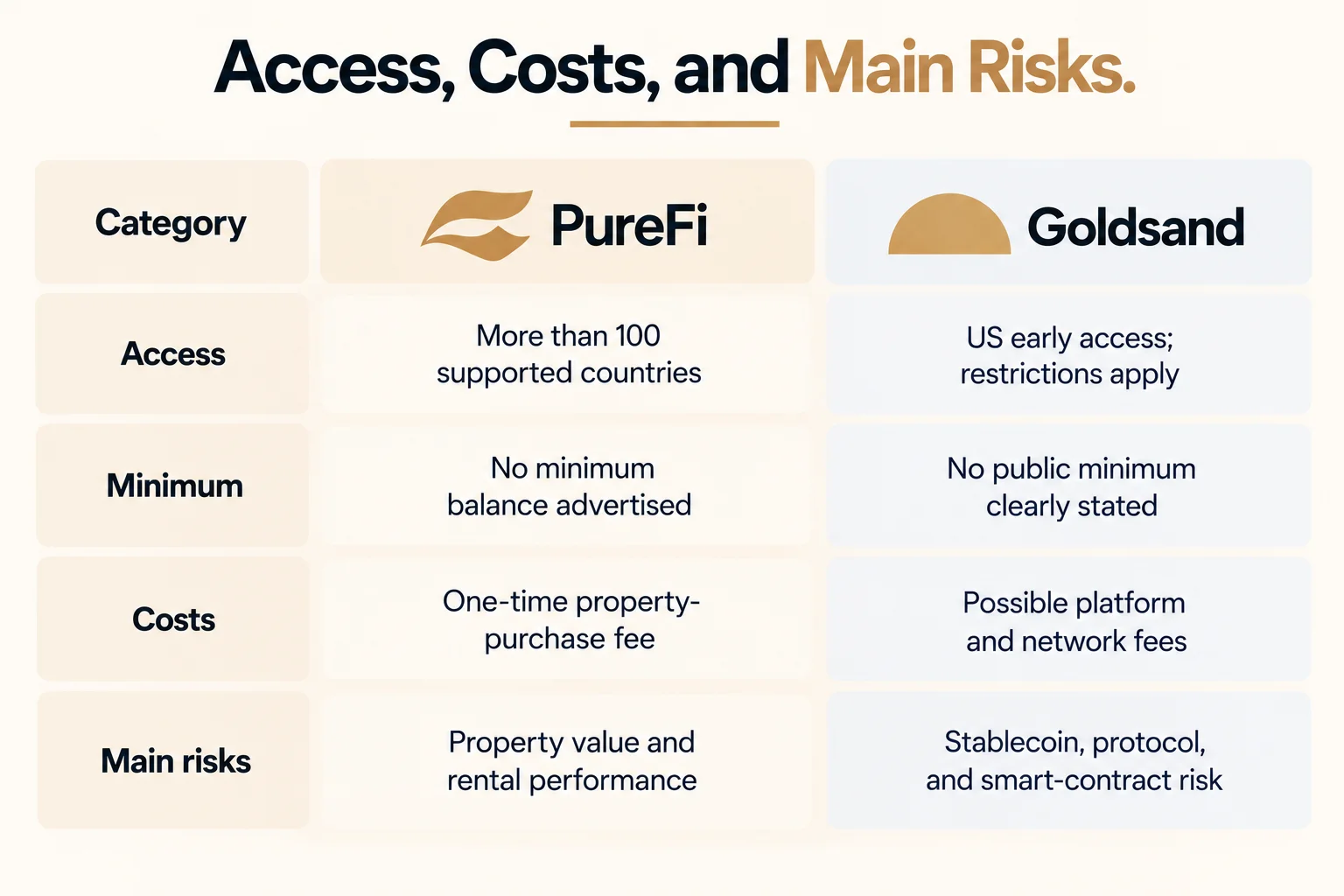
PureFi does not advertise a minimum balance or charge a monthly account fee. Each property-share purchase carries a one-time fee that appears on the order before the user confirms it. Any applicable transfer cost is also displayed before approval. Users should include these costs when estimating the return from a planned investment.
Goldsand promotes withdrawals without penalties or withdrawal fees. Its terms still allow a platform fee, potentially calculated as an annualized percentage of assets managed through the interface and deducted from protocol rewards. Users may also pay blockchain network charges.
Goldsand does not clearly publish a universal minimum deposit. Users should check the current in-app requirement, funding route, platform fee, and network cost before depositing. No stated minimum does not mean every transaction size will be practical.
Neither platform follows the same pricing structure as a no-fee bank account. Our article on high-yield savings accounts with no monthly fees explains what the term normally means for a bank deposit.
Accessibility and Access to Funds
PureFi users handle funding, property selection, rent payments, reinvestment, and sales in the app. Shares can be sold at the current market price without an advertised fixed holding period. The price can change before a sale.
PureFi supports users in more than 100 countries, subject to eligibility requirements. It provides a digital savings platform or online savings app experience, but the underlying product is fractional real estate rather than a deposit.
Goldsand’s website describes US access as early access and iOS as a TestFlight beta. Its terms list 48 states and Washington, DC, excluding New York and Alaska. Users must be at least 18 and meet identity and jurisdiction requirements.
US users can connect a bank account through third-party providers and use ACH-supported services. Goldsand’s terms restrict non-US residents to on-chain stablecoin deposits and withdrawals, so app access does not always include the full dollar funding experience.
Goldsand advertises withdrawals without a waiting period or penalty, but users should still check the selected route for third-party processing time and blockchain network conditions.
Protection, Ownership, and Financial Risk
Neither platform offers an insured bank deposit. PureFi is not covered by the FDIC or another government deposit scheme. Its property shares can fall in value, rental earnings can change, and the selling price may be lower than the amount paid.
Goldsand is not covered by the FDIC, SIPC, or another government agency. Users could lose digital assets placed into a protocol through stablecoin de-pegging, smart-contract bugs, protocol exploits, regulatory changes, or compromised credentials.
Both platforms use non-custodial structures, but that describes control rather than protection from loss. It does not guarantee property-share prices, stablecoin values, smart-contract operation, or future earnings.
This is also why neither product should be evaluated as though it were a conventional bank account. The guide to what a high-yield savings account is explains how bank deposits, variable bank APYs, and federal protection normally work.
Who May Prefer PureFi or Goldsand?
PureFi may suit users who want earnings connected to real homes and tenant rent. It gives users the ability to choose properties, review documentation, track their share of rent, and participate in changes in property value. Its availability across more than 100 supported countries also provides a wider international reach.
Goldsand may suit users who want Shariah-focused, non-lending profit-sharing and understand stablecoins, wallet responsibility, and third-party protocols. Its early-access status makes eligibility an important first check.
The right comparison is therefore real estate versus stablecoin payment infrastructure, not simply 6% versus 7%. PureFi ties the outcome to rented homes. Goldsand ties it to approved digital payment activity. Both provide app-based access, variable earnings, and liquidity options, but each exposes users to a different set of risks.
Anyone deciding whether funds belong in a bank deposit or a variable-return product can also read Are Savings Accounts Good for the Long Term?.
Put your dollars into something real
With PureFi, your projected earnings come from shares of real homes with tenants. Choose your properties from your phone, review the documents, and see every fee before you confirm.
Learn more about how PureFi can help you own real estate shares or download the app to get started today.
Up to 6% APY is projected, variable, and not guaranteed. Property shares can lose value. PureFi is not a bank, and its balances and real estate shares are not covered by FDIC insurance or another government deposit scheme.