PureFi vs E*TRADE
PureFi and E*TRADE both provide digital ways to put money to work. That is where the simple comparison ends.
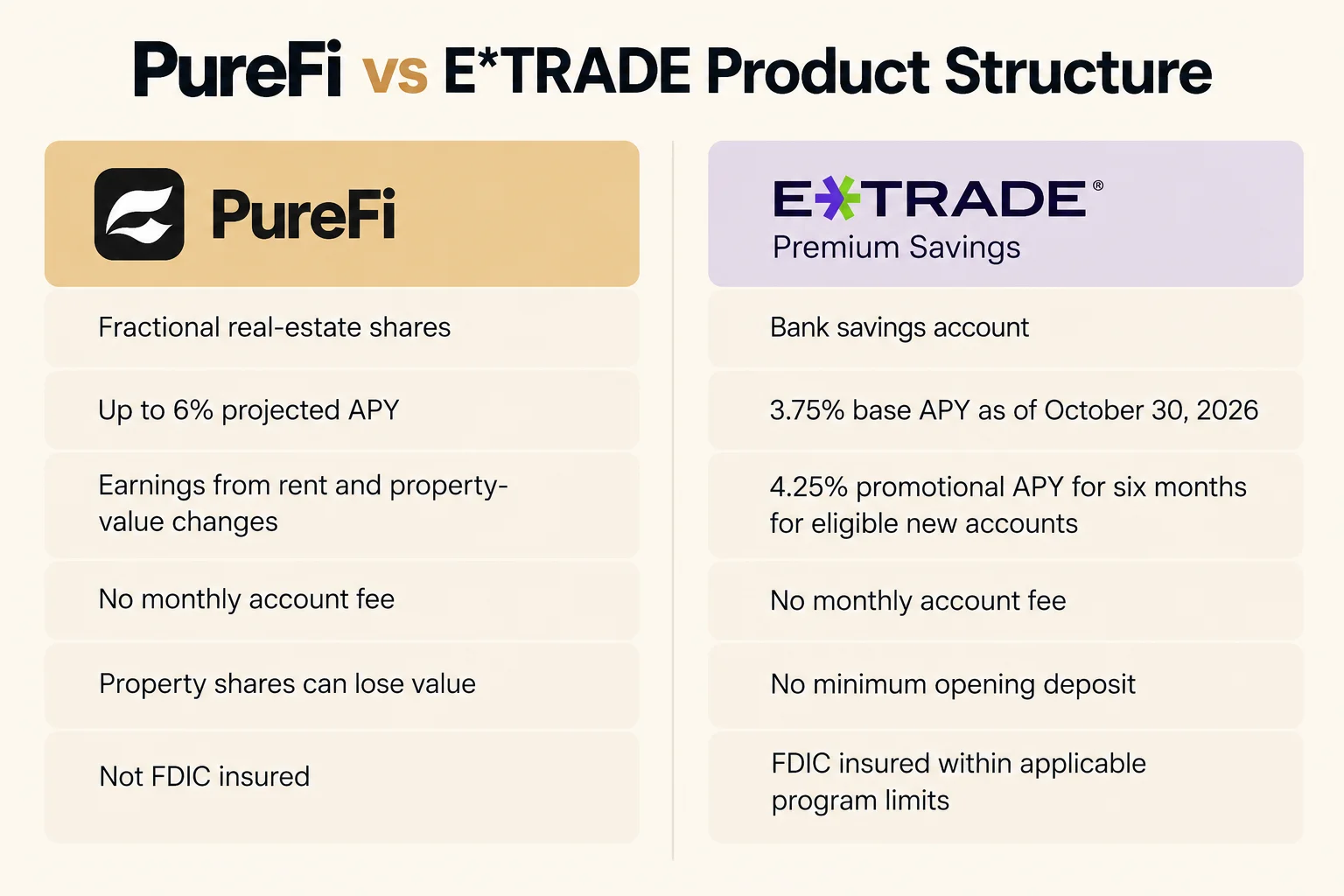
We provide access to shares of real homes with tenants. Projected earnings come from rent and changes in property value. E*TRADE’s Premium Savings Account is a bank deposit account provided by Morgan Stanley Private Bank.
Those structures come with different returns, protections, and ways to access money. PureFi involves property-market risk. E*TRADE Premium Savings provides FDIC protection within applicable program limits. The right option depends on whether the money is being saved or invested.
PureFi vs E*TRADE at a Glance
| Feature | PureFi | E*TRADE Premium Savings |
|---|---|---|
| Product | Fractional real-estate investment platform | Online savings account |
| Advertised return | Up to 6% projected APY | 3.75% base APY; eligible new accounts can receive 4.25% for six months |
| Source of earnings | Rent and changes in property value | Bank deposit yield |
| Monthly account fee | None | None |
| Opening deposit | Amount shown through the app | No minimum opening deposit |
| Main transaction cost | One-time property purchase fee shown before confirmation | Other service or transaction fees may apply |
| Protection | Not FDIC insured | FDIC insured within applicable program limits |
| Access | Property shares must be sold at their current market value | Electronic transfers and instant transfers to E*TRADE brokerage accounts |
| Availability | More than 100 countries, subject to jurisdiction | U.S.-focused |
| Main purpose | Fractional real-estate investing | Holding accessible cash |
E*TRADE’s rates and promotions were checked on October 30, 2026. They can change. PureFi’s projected APY is also variable and not guaranteed.
What Is PureFi?
PureFi provides access to fractional shares of real homes with tenants. Users choose properties through the app, review the available documents, see the fee, and decide whether to purchase shares.
This is an investment structure rather than a bank savings account. The value is connected to the selected properties.
Projected earnings: We project up to 6% APY as of August 25, 2026. Projected earnings come from two sources: rental income and changes in property value.
The projection is not guaranteed. Rental performance can vary, property costs can change, and home values can fall. A user may receive less than expected or lose part of the amount invested.
Fees and minimums: We do not charge a monthly account fee. A one-time property purchase fee is shown before a user confirms the transaction. Users should review the amount displayed in the app before purchasing shares.
Account access: There is no fixed lock-up period. A user can request to sell property shares, but those shares are sold at their current market value. The proceeds may be higher or lower than the original purchase amount.
Protection: We are not a bank. Our balances and real-estate shares are not covered by FDIC insurance or another government deposit scheme.
Our guide to savings vs investing explains why that distinction matters.
What Is E*TRADE Premium Savings?
E*TRADE is part of Morgan Stanley. Its Premium Savings Account is provided by Morgan Stanley Private Bank, National Association, Member FDIC.
The account is separate from ETRADE brokerage products. Money held in Premium Savings is a bank deposit. Securities purchased through an ETRADE brokerage account are investments and have a different protection structure.
Current APY: The base APY is 3.75% as of October 30, 2026. It is variable, so Morgan Stanley Private Bank can change it.
E*TRADE is also offering eligible new accounts a promotional 4.25% APY for six months. The account must be opened during the promotional enrollment period, which is scheduled to end on November 30, 2026.
No minimum deposit is needed to receive the promotional APY. However, the account must be funded within 90 days to remain open. The promotion applies to eligible deposits up to $10 million under the offer’s terms.
When the six-month period ends, the account automatically returns to the standard variable APY available at that time.
Fees and minimums: Premium Savings has no monthly account fee and no minimum opening deposit. Customers should still review the current fee schedule for wires and other optional services.
Account access: Customers can manage the account online or through the ETRADE mobile app. Money can be transferred immediately between Premium Savings and existing ETRADE brokerage accounts.
According to E*TRADE, money brought in through an external Transfer Money transaction is generally available for withdrawal on the third business day when the request is submitted before 4 p.m. Eastern Time.
Protection: The Premium Savings Bank Deposit Program is designed to provide eligible individual accounts with up to $500,000 in FDIC coverage. Eligible joint accounts can receive up to $1 million. Program conditions apply.
The official E*TRADE Premium Savings page contains the current rate and promotional terms.
PureFi vs E*TRADE: How Do the Returns Differ?
PureFi’s projected APY and E*TRADE’s savings APY should not be treated as equivalent percentages.
With PureFi, projected earnings depend on rent and property values. A property may produce rental income while its market value rises, stays flat, or falls. The amount eventually received from selling shares depends on the market value at that point.
E*TRADE pays a deposit yield on the cash held in Premium Savings. The account balance does not change with the price of a home, stock, or fund. The current promotional APY is fixed for six months for eligible new accounts. The standard APY is variable.
This makes E*TRADE easier to evaluate for short-term cash. The APY may change after the promotion, but eligible deposits do not carry property-price risk.
PureFi offers a different trade-off. Users receive exposure to rental homes and accept the possibility that their shares may lose value.
Readers comparing deposit yields can also review our comparison of savings rates.
PureFi vs E*TRADE: Fees and Deposit Requirements
Neither option charges a monthly account fee.
With PureFi, the main stated transaction cost is the one-time property purchase fee. It appears before the user confirms a purchase, so the cost can be reviewed in advance.
E*TRADE does not require a minimum amount to open Premium Savings. The account needs to receive funding within 90 days or it will be closed. Optional banking services may have separate charges.
The $20,000 deposit requirement applies only to the current $200 cash bonus. It is not the account’s standard opening minimum. It is also not required for the six-month promotional APY.
PureFi vs E*TRADE: Access to Money
E*TRADE provides more predictable access to cash.
Customers can make electronic transfers and move funds to an existing E*TRADE brokerage account immediately. Transfers involving an external institution may take several business days.
With PureFi, accessing money means selling property shares. There is no fixed lock-up, but the amount received depends on the shares’ current market value.
A person who may need the money for bills, an emergency, or a near-term purchase may prefer a bank deposit account. Money invested in property shares should not be treated as though it has the same stability or withdrawal process.
Our guide to HYSA liquidity explains how savings-account access works.
PureFi vs E*TRADE: Digital Features
Both platforms can be used without visiting a branch, but the tools reflect different purposes.
PureFi users can select properties, review supporting documents, see the purchase fee, hold shares through a self-custodial wallet, and monitor their property positions through the app. Access is available across more than 100 countries, subject to local rules.
ETRADE customers can manage Premium Savings through its website and mobile app. The account supports electronic transfers, mobile check deposits, and immediate transfers to ETRADE brokerage accounts. E*TRADE also advertises support around the clock.
The connection with brokerage accounts is one of ETRADE’s clearest strengths. Customers already investing through ETRADE can keep cash in Premium Savings and move it to their brokerage account when needed.
For another comparison between real-estate access and an established investment provider, read PureFi vs Fidelity.

Who Might Each Option Suit?
Choose PureFi if:
- You want to select fractional shares of real homes
- You understand that projected earnings are not guaranteed
- You can accept changes in property-share value
- You do not need the money to operate like insured savings
- You want digital access to rental-property investments
Choose E*TRADE Premium Savings if:
- You want an FDIC-insured savings account
- You need electronic access to cash
- You already use E*TRADE for brokerage investing
- You want no monthly account fee or opening minimum
- You qualify for the current promotional APY or cash bonus
These are general product-fit observations. They are not personal financial recommendations.
PureFi vs E*TRADE: Which Is the Better Fit?
ETRADE Premium Savings may be the better fit for accessible cash. It provides deposit protection, has no monthly account fee, and connects directly with ETRADE brokerage accounts.
PureFi may suit someone who wants fractional exposure to rental homes and understands the risk of property values changing.
Start with the job the money needs to do. Cash reserved for emergencies or upcoming expenses should not be treated like money intended for a real-estate investment. The two platforms can both be digital, but they solve different financial needs.
Put your dollars into something real
With PureFi, your projected earnings come from shares of real homes with tenants. Choose your properties from your phone, review the documents, and see every fee before you confirm.
Learn more about how PureFi can help you own real estate shares or download the app to get started today.
Up to 6% APY is projected, variable, and not guaranteed. Property shares can lose value. PureFi is not a bank, and its balances and real estate shares are not covered by FDIC insurance or another government deposit scheme.