PureFi vs Discover Bank
PureFi and Discover Bank can both help customers earn on money they are not spending today. The products behind those earnings are not the same.
With us, customers purchase shares of rented residential properties. Discover historically offered an online savings account backed by a bank deposit. Discover merged into Capital One in 2025, and its public banking pages now promote Capital One products.
That transition affects any current comparison. Existing Discover customers should check their own account terms. New applicants may now be directed to Capital One 360 Performance Savings rather than a new Discover-branded account.
PureFi vs Discover Bank at a Glance
| Feature | PureFi | Discover/Capital One savings |
|---|---|---|
| Product type | Shares of rented residential properties | Bank savings account |
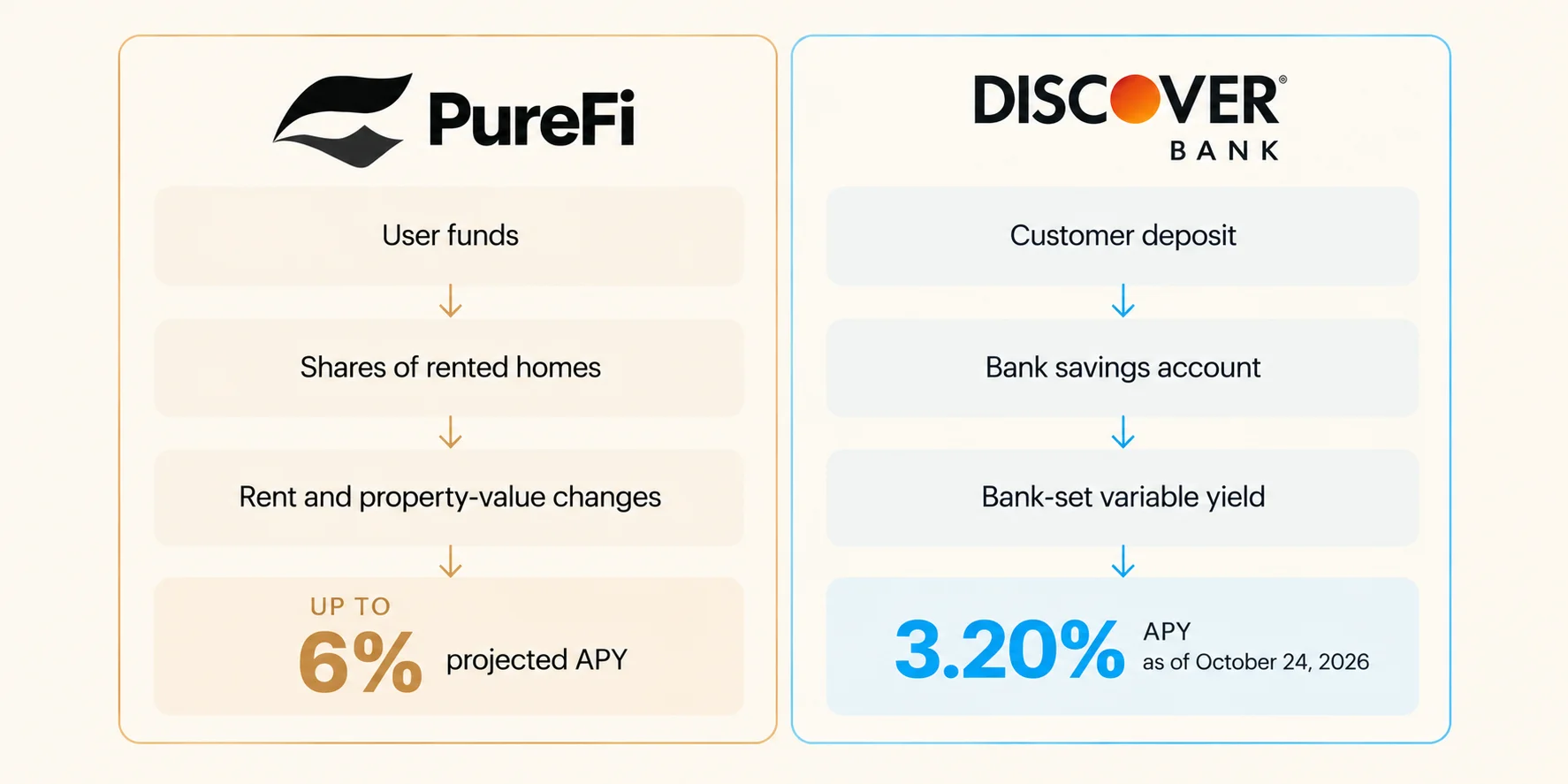
| Displayed return | Up to 6% projected APY | 3.20% APY for 360 Performance Savings as of October 24, 2026 |
| Source of earnings | Rent and changes in property value | Bank-set deposit yield |
| Monthly fee | None | None |
| Minimum opening deposit | No advertised minimum balance | No minimum opening balance |
| Value risk | Property shares can lose value | Deposit balance does not move with property prices |
| Government protection | No FDIC or government deposit insurance | Eligible deposits are FDIC-insured within applicable limits |
| Access | App, self-custodial wallet, and property-share sales | Online banking, mobile app, and bank transfers |
| Fixed term | No fixed lock-up advertised | No fixed savings term |
| Availability | More than 100 supported countries, subject to local rules | Primarily available to eligible U.S. applicants |
The APYs in the table should not be treated as equivalent offers. Our figure is a projection tied to real estate. The bank figure applies to a deposit account and can change when the bank changes its rate.
How Does PureFi Work?
With PureFi, users choose shares of individual homes that already have tenants. They can review the property, legal documents, expected rental performance, and purchase fee before confirming.
Potential earnings come from two sources. The first is rent paid by tenants. The second is any change in the value of the property shares.
We currently project up to 6% APY based on rent and property values. The figure is variable and not guaranteed. A property may generate less rent than expected, and its market value can fall. If a user sells after the value declines, the amount received may be lower than the original purchase amount.
There is no monthly account fee or advertised minimum balance. Each property-share purchase carries a one-time fee, which is displayed before the order is confirmed.
Users hold their balance in a self-custodial wallet. Property shares are held in the user’s name rather than combined into an ordinary bank deposit.
This makes us different from a conventional high yield digital savings account. We are a financial technology company providing access to real estate shares, not a bank.
Our guide to savings versus investing explains why the source of a return matters as much as the displayed percentage.
How Does Discover’s Savings Offering Work Now?
Discover’s historical Online Savings Account was a conventional deposit product. Customers placed money with the bank, received a variable APY, and managed the balance online.
Following the merger, Discover’s public online banking experience now promotes Capital One 360 Performance Savings. The official Capital One page listed a 3.20% APY on all balances as of October 24, 2026. The APY is variable and may change before or after the account is opened.
The account has no monthly maintenance fee and no minimum opening balance. Customers can manage savings through online banking and the Capital One mobile app.
Eligible deposits are held by Capital One, N.A., an FDIC member. They receive deposit protection within the applicable limits and ownership categories.
Existing Discover customers should not assume that the public 360 Performance Savings APY automatically applies to them. Their current rate and account name may depend on where their account is in the transition. The account dashboard and latest notice from Capital One or Discover are the correct places to confirm the live rate.
PureFi vs Discover Bank: APY and Earnings
PureFi displays the higher percentage, but the difference involves more than two numbers.
PureFi’s Projected APY
Our up-to-6% APY is a projection based on current rental income and property values. It is not a fixed return.
Rental income can vary because of vacancies, property expenses, missed payments, or other changes. The value of a home can also increase or decrease. Both factors can affect the user’s result.
A projected APY is useful for estimating what an investment might produce. It should not be read as a promise that every user or property will deliver 6%.
Discover and Capital One Savings APY
The current public Capital One rate is 3.20% APY for 360 Performance Savings. That rate applies to the savings balance rather than a real estate investment.
The account’s APY can rise or fall. A rate available today may not remain in place for the next year.
Unlike property shares, the deposited amount does not change because home prices move. Eligible deposits also receive FDIC protection within federal limits.
Our guide to why high-yield savings rates change explains why a bank can adjust its APY after an account is opened.
PureFi vs Discover Bank: Fees and Minimum Deposits
Neither option charges a standard monthly account fee.
With PureFi, users do not need to maintain an advertised minimum balance. A one-time purchase fee applies when property shares are bought. That fee is shown before the user confirms the transaction.
Additional network, transfer, conversion, or partner charges may depend on how funds enter or leave the platform. The relevant amount should be reviewed before completing a transaction.
Capital One 360 Performance Savings has no monthly maintenance fee and no minimum opening deposit. Discover’s current National Deposit Account Agreement also states that its listed deposit accounts do not have a minimum opening balance requirement.
Less-common banking services can still carry charges. Customers should review the account agreement for wires, expedited services, returned transactions, official checks, or other optional requests.
Our guide to high-yield savings accounts with no monthly fees explains what the no-fee label usually covers.
PureFi vs Discover Bank: Access to Money
Both options provide digital access, but withdrawing money involves different processes.
Accessing Money With PureFi
Users control their balance through a self-custodial wallet. They can choose properties, monitor rental activity, and view the current value of their shares in the app.
There is no advertised fixed lock-up. A user can sell shares at the current market price when they want to exit. That price may be higher or lower than the original purchase price.
Selling an asset is different from transferring cash out of a savings account. The value must be established at the time of sale, and processing depends on the platform and supported withdrawal route.
PureFi is available in more than 100 countries, subject to local regulations and product availability. This gives it a wider geographic reach than many U.S. savings accounts.
Accessing Discover or Capital One Savings
Customers generally access savings through electronic transfers. They can connect another bank account or move money between eligible accounts held with the same institution.
Savings does not provide the same direct spending access as checking. According to the current Discover deposit agreement, debit-card access applies to checking and money market products rather than the Discover Online Savings Account.
Customers may therefore need to transfer money to checking before using a debit card or withdrawing cash.
External transfers can take one or more business days. Weekends, holidays, security reviews, and deposit holds may extend the timeline.
Read Is a HYSA Liquid? for a closer look at transfer times and withdrawal access.
PureFi vs Discover Bank: Protection and Risk
This is the most important difference between the two options.
PureFi Uses Property Shares
Our users buy shares tied to real homes. Those shares can generate rent, but they can also lose value.
We are not a bank. Balances and real estate shares are not covered by FDIC insurance or another government deposit scheme. Self-custody gives users control over their wallets, but it also requires them to protect their login details, recovery information, and device access.
Users should only purchase property shares after reviewing the documents, fees, projected return, and risks.
Capital One Holds Bank Deposits
Capital One, N.A. is an FDIC member. Eligible deposits are generally protected up to $250,000 per depositor, per insured bank, for each ownership category.
FDIC coverage protects eligible deposits if the insured bank fails. It does not lock the APY. Capital One can still raise or lower the savings rate.
Discover and Capital One are now one banking organization. Customers with deposits under both brands should confirm how those balances are combined for FDIC insurance purposes during and after the transition.
Our guide to whether high-yield savings accounts are safe explains what deposit protection covers and what it does not.
PureFi vs Discover Bank: Accessibility

PureFi can serve users in more than 100 countries. Availability depends on the customer’s location, local rules, identity verification, and the properties offered through the app.
The platform may suit someone who wants exposure to U.S. residential real estate without buying and managing an entire property.
Discover and Capital One savings products are aimed primarily at eligible U.S. customers. Applicants need to meet the bank’s identity, residency, contact, and tax-information requirements.
The transition also affects platform access. Some existing Discover customers may continue using Discover tools until they are instructed to move. Others may already manage accounts through Capital One. Customers should follow the instructions connected to their specific account rather than relying on an older online guide.
Who Might Each Option Suit?
The better option depends on whether you want a protected bank deposit or exposure to income-producing real estate. The higher displayed APY should not be the only factor.
Choose PureFi If You:
- Want to choose shares of individual rented homes
- Understand that projected earnings are variable and not guaranteed
- Can accept changes in the value of your property shares
- Want access to real estate without buying and managing an entire home
- Live in one of our supported jurisdictions
- Do not need FDIC or another government deposit scheme to cover the balance
Choose Discover or Capital One Savings If You:
- Want a conventional bank savings account
- Prioritize FDIC protection for eligible deposits
- Do not want your balance exposed to property-price movements
- Need a straightforward place for emergency or short-term savings
- Are eligible to open a U.S. bank account
- Prefer electronic transfers between savings and checking
A high-yield investment platform and an online savings app can both provide digital access. They do not create the same financial product. Compare the source of the earnings, access to funds, possible loss of value, and available protection before deciding.
Put Your Dollars Into Something Real
With PureFi, your projected earnings come from shares of real homes with tenants. Choose your properties from your phone, review the documents, and see every fee before you confirm.
Learn more about how PureFi can help you own real estate shares or download the app to get started today.
Up to 6% APY is projected, variable, and not guaranteed. Property shares can lose value. PureFi is not a bank, and its balances and real estate shares are not covered by FDIC insurance or another government deposit scheme.