PureFi vs CIT Bank Savings
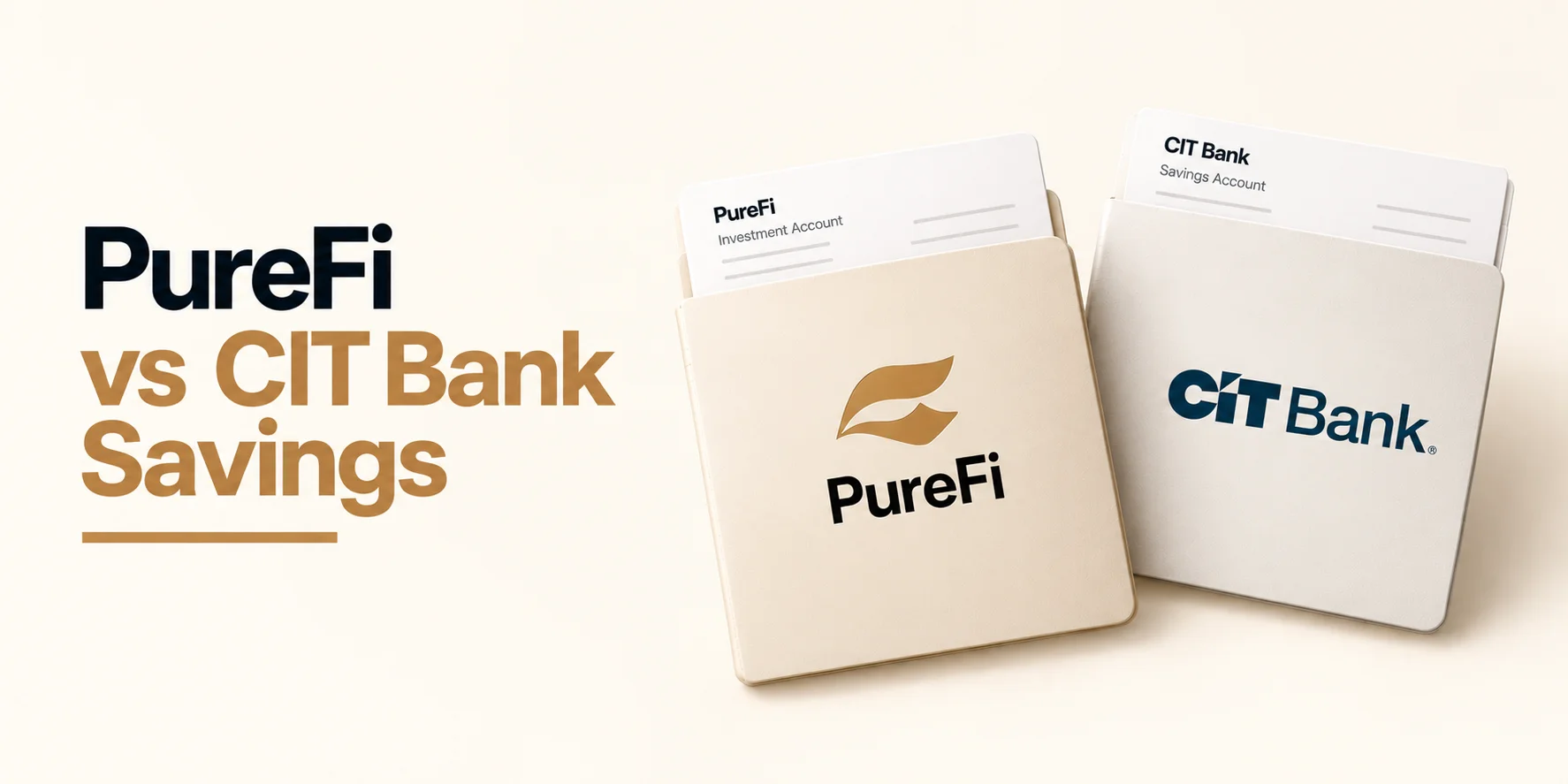
PureFi and CIT Bank both give users a digital way to earn, but they serve different financial purposes. CIT Bank offers FDIC-insured savings accounts for holding cash. PureFi lets users buy shares of rented homes and earn from tenant rent. That distinction affects the meaning of each APY, the protection applied to the original amount, and the way users access their funds.
Using product information available on October 4, 2026, this comparison covers account options, APY, fees, minimum balances, online banking features, accessibility, and risk.
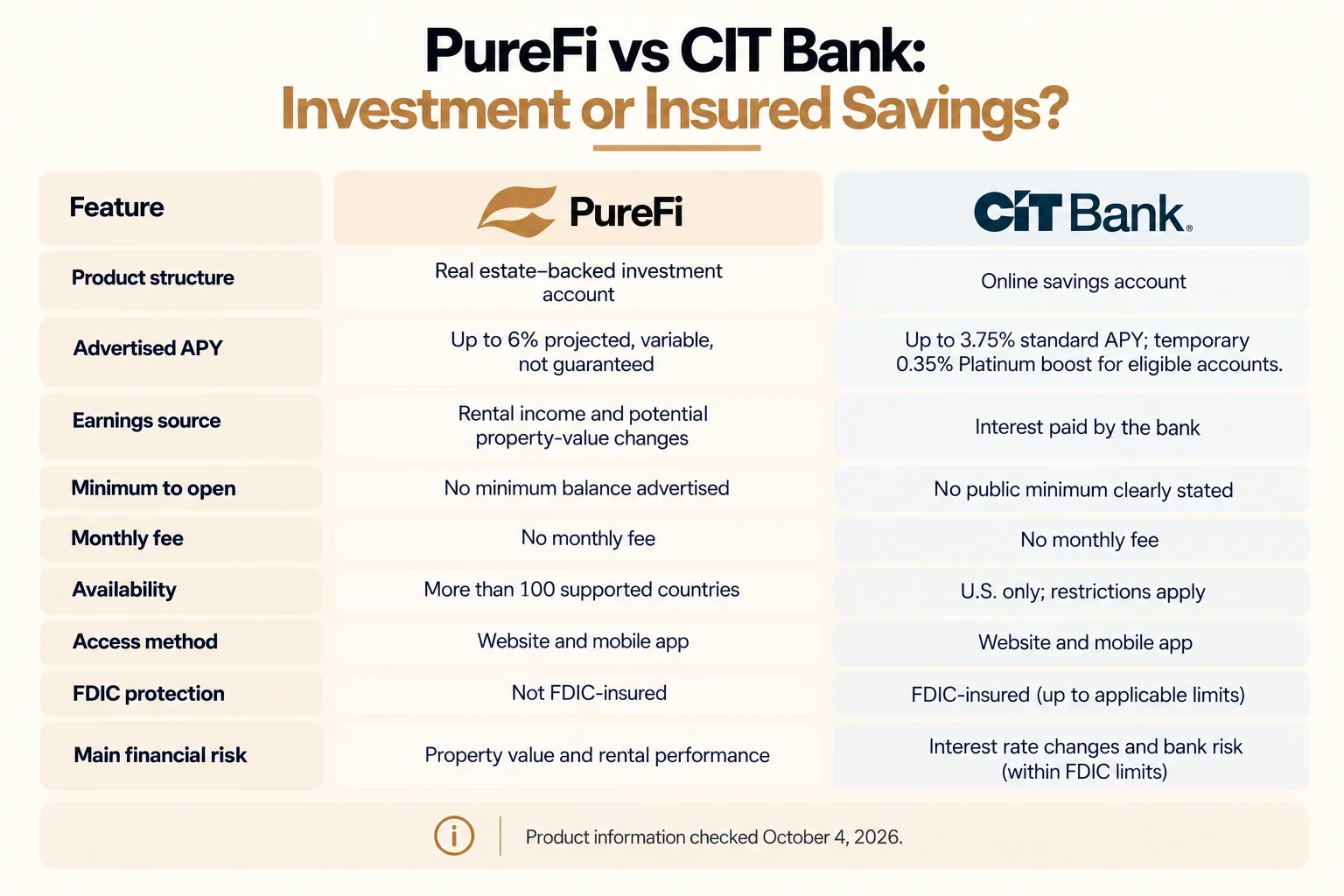
PureFi vs CIT Bank Savings at a Glance
| Feature | PureFi | CIT Bank Savings |
|---|---|---|
| Product | Fractional shares of rented homes | Online bank savings accounts |
| Advertised APY | Up to 6% projected | Up to 3.75% standard APY |
| Temporary offer | None advertised | 0.35% Platinum Savings APY boost for six months, subject to eligibility |
| Earnings source | Tenant rent and changes in property value | Earnings on deposited cash |
| Minimum to open | No minimum balance advertised | $100 for the main savings products |
| Monthly fee | None | None for the main savings products |
| Government protection | Not FDIC-insured | FDIC-insured within applicable limits |
| Access | PureFi mobile app | Online banking and mobile app |
| Availability | More than 100 supported countries | Eligible US applicants |
CIT Bank’s published standard APYs were accurate as of July 1, 2026 and can change. PureFi’s up-to-6% figure is projected from current rents and home values, variable, and not guaranteed.
What Does PureFi Offer?
PureFiis a high yield investment platform that lets users purchase fractional shares of tenant-occupied residential properties. Users verify their identity, add dollars to a self-custodial wallet, and review individual properties and their legal documents before approving a purchase.
When tenants pay rent, each owner receives a proportional share. Property shares can also rise or fall with the underlying home’s value. PureFi projects up to 6% APY using current rent and property values, but actual results can differ.
Users can track properties, rent payments, and total value in the app. Earnings can be withdrawn or reinvested, and shares can be sold at the current market price without an advertised fixed lock-up. The sale amount can be lower than the purchase price.
PureFi is available in more than 100 supported countries. This international reach may suit users who want exposure to rented US homes without financing and managing a complete property. The guide to how PureFi real estate works explains the ownership structure in more detail.
What Savings Accounts Does CIT Bank Offer?
CIT Bank is an online division of First Citizens Bank with no CIT-branded branches. Its main choices are Platinum Savings and Savings Connect, with Savings Builder and Money Market available for different needs.
Platinum Savings
Platinum Savings pays 3.75% APY on balances of $5,000 or more. Below $5,000, the entire amount receives the lower 0.25% tier. It requires $100 to open but no ongoing minimum to keep the account open.
CIT Bank is also running a limited Platinum Savings promotion. Eligible accounts enrolled with the CITBoost code receive an additional 0.35% APY for six months. Enrollment is scheduled to end October 31, 2026, but CIT can end it earlier. The boost moves with the standard rate, so it is not a fixed 4.10% promise.
Savings Connect
Savings Connect pays 3.65% APY across the balance. It requires $100 to open but no ongoing minimum for the published APY. It may suit customers who keep less than $5,000 or frequently cross that threshold.
Additional Account Options
CIT lists Savings Builder at up to 1.00% APY. Its upper tier requires at least $25,000 or a qualifying $100 deposit during the monthly evaluation period. Money Market pays 1.55% APY and includes Zelle. Both require $100 to open.
Readers who want a broader explanation of this account category can begin with what a high-yield savings account is.
PureFi vs CIT Bank APY and Earnings
PureFi displays the higher ongoing percentage at up to 6% projected APY. CIT Bank’s highest standard savings APY is 3.75%, although eligible Platinum Savings customers can receive a 0.35% promotional boost for six months.
The percentages measure different arrangements. PureFi’s projected earnings and share values depend on rental performance and home prices. CIT calculates earnings on deposited dollars. Its APYs can change, but eligible deposits do not move with the housing market.
Balance tiers also matter. Platinum Savings pays its higher standard APY from $5,000, while dropping below that level moves the full balance to the lower tier. Savings Connect may produce more earnings for balances under $5,000 because it has no ongoing balance requirement for its published APY.
CIT calculates earnings daily and credits them monthly. PureFi distributes a user’s share when rent arrives. APY supports annual comparisons but does not remove differences in timing, fees, risk, or protection.
Our guide to how much a high-yield savings account earns explains how balance and APY affect deposit growth. Since CIT’s rates are variable, readers can also review why high-yield savings account rates change.
Fees and Minimum Balance Requirements
PureFi advertises no minimum balance or monthly account fee. A one-time property-purchase fee and any applicable transfer cost appear before the user confirms the transaction.
CIT requires $100 to open each main savings product and charges no account-opening or monthly maintenance fee. Customers should still review its fee schedule for wires, stopped payments, returned items, and other services.
Platinum Savings’ $5,000 threshold is only for the higher standard APY. Customers can keep less, but the lower tier applies to the full balance. Savings Connect avoids this tier while paying slightly less than Platinum’s top standard rate.
For more details on pricing terminology, read High-Yield Savings Accounts With No Monthly Fees.
Online Banking Features and Accessibility
CIT Bank operates as a high-yield savings app and online bank for iOS, Android, and the web. Customers can view transactions, transfer funds, and deposit checks remotely. Platinum Savings supports ACH, incoming wires, mailed checks, and mobile check deposits.
The current agreement allows unlimited monthly transactions on these accounts. Money Market also supports Zelle for eligible customers with a US bank account. Processing times and limits can vary by transfer method.
CIT accounts are designed for eligible US applicants and require an address, phone number, email address, and Social Security number or ITIN. This makes CIT less geographically accessible than PureFi.
PureFi users manage their wallet, property purchases, rent payments, and sales in the app. Its availability in more than 100 supported countries gives it wider international coverage. It may feel like a digital savings platform or online savings app, but the holdings are real estate shares rather than deposits.
Protection and Financial Risk
CIT deposits are held through First Citizens Bank and Trust Company, an FDIC member. Eligible deposits are generally protected up to $250,000 per depositor, per insured bank, for each ownership category. Accounts across First Citizens divisions are combined when calculating coverage.
FDIC coverage protects eligible deposits if the insured bank fails. It does not lock in an APY. CIT can change its variable rates, and customers must continue meeting any tier or promotional conditions to receive the applicable yield.
PureFi is not a bank, and its balances and property shares lack government deposit protection. Rental earnings can change, shares can lose value, and a sale can return less than the original purchase.
PureFi’s self-custodial wallet gives users direct control over wallet transactions. That control does not guarantee the value of real estate shares or protect an investment from market losses. Account security and protection from financial loss are separate considerations.
Who May Prefer CIT Bank Savings or PureFi?
CIT Bank may suit someone who wants an FDIC-insured high-yield digital savings account and meets the US eligibility requirements. Platinum Savings may work for balances consistently above $5,000. Savings Connect may be easier to manage for lower or changing balances because its published APY does not depend on an ongoing minimum.
PureFi may suit someone who wants earnings connected to tenant rent and accepts real estate risk. Users can choose individual properties, review their documents, receive a proportional share of rent, and participate in changes in home values. Its international availability may also help users who cannot apply for a CIT Bank account.
The decision depends on what the money needs to do. CIT Bank is structured for insured cash savings and online banking. PureFi is structured for fractional ownership of rented homes. Comparing only the headline APYs would ignore the difference between a protected deposit and an investment that can gain or lose value.

Put your dollars into something real
With PureFi, your projected earnings come from shares of real homes with tenants. Choose your properties from your phone, review the documents, and see every fee before you confirm.
Learn more about how PureFi can help you own real estate shares or download the app to get started today.
Up to 6% APY is projected, variable, and not guaranteed. Property shares can lose value. PureFi is not a bank, and its balances and real estate shares are not covered by FDIC insurance or another government deposit scheme.