PureFi vs. Bread Savings
PureFi and Bread Savings can both help money earn, but they do it in very different ways. Bread Savings offers bank deposits. PureFi provides shares of rented homes. Bread publishes a variable APY for its high-yield savings account. PureFi projects an APY based on rent and changes in property values.
The distinction affects risk, access and protection. A higher headline figure does not automatically make one option better. You need to know what you own, where the earnings come from and what can happen to the original amount. This PureFi vs. Bread Savings comparison covers the details that matter.
PureFi vs. Bread Savings at a Glance
| Feature | PureFi | Bread Savings | |---||---||---| | Product | Shares of rented homes | High-yield savings account and CDs | | Advertised figure | Up to 6% projected APY | 4.05% variable APY at the time of research | | Source of earnings | Rent and changes in home values | Savings yield paid by the bank | | Opening requirement | Depends on the property-share purchase | $100 for High-Yield Savings | | Monthly fee | None | None advertised for High-Yield Savings | | Other fees | One-time purchase fee shown before confirmation | Service charges may apply in specific situations | | Protection | Not FDIC insured | Eligible deposits are FDIC insured within applicable limits | | Value risk | Shares can lose value | Deposited balance does not move with markets | | Access | Sell shares at the current market price | Transfer funds through the online account |
Bread’s 4.05% APY was displayed when this article was researched in November 2026. PureFi’s up-to-6% APY is a projection dated August 25, 2026. Both figures can change.
How Does PureFi Work?
PureFi is adigital savings platform backed by shares of real, tenant-occupied homes. It is not a bank account. When you select a home, your money purchases property shares held in an account in your name.
Earnings come from two places. Tenants pay rent, and each owner receives their share. The value of the home may also rise or fall. That means the return can be higher or lower than projected, and the shares may be worth less when sold.
PureFi provides:
- Up to 6% projected APY from rent and home-value changes
- Daily rental earnings when tenants pay
- A self-custodial wallet controlled by the customer
- Property documents available inside the app
- No monthly fee
- A one-time purchase fee shown before an order is confirmed
There is no fixed lockup. Shares can be sold at their current market price. That does not guarantee you will receive the amount originally paid.
This is an investment structure, not ahigh-yield digital savings account.
How Does Bread Savings Work?
Bread Savings is an online banking brand offering a high-yield savings account and certificates of deposit.
At the time of research, its High-Yield Savings account offered:
- 4.05% APY
- A $100 minimum opening balance
- Daily compounding
- No monthly maintenance fee
- Earnings on balances of up to $10 million
The last point does not mean $10 million automatically receives full FDIC coverage. Standard insurance is generally limited to $250,000 per depositor, per insured bank and per ownership category. Different ownership categories may receive separate coverage when all requirements are met.
Bread’s APY is variable. It can change after the account is opened. CDs work differently. They use set terms and may charge a penalty when funds are withdrawn early.
Our guide tohow a high-yield savings account works explains the basic bank-account structure.
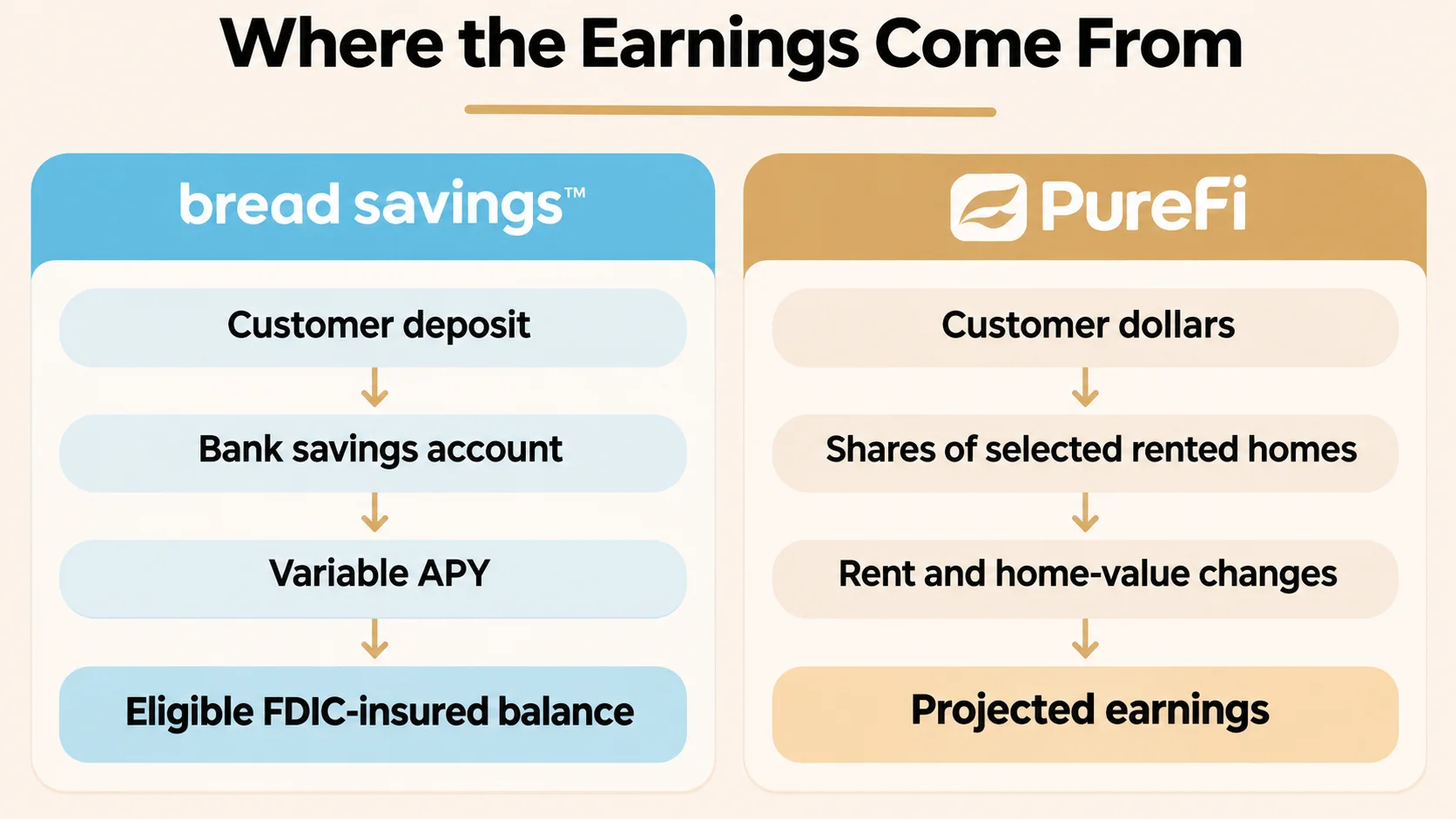
PureFi vs. Bread Savings: Comparing APY
PureFi projects up to 6% APY. Bread Savings advertised 4.05% APY when this article was researched. Those numbers should not be placed side by side without context.
PureFi’s projected APY
PureFi’s figure is based on current rents and home values. It is not promised. A property may have unexpected costs, periods without a tenant or a lower market value. These factors can reduce the return. A home’s value could also increase, but that outcome is not guaranteed.
Bread Savings’ variable APY
Bread’s APY shows the annual effect of its current rate and compounding. The deposited balance does not rise or fall with property prices. However, the bank may reduce the APY at any time under the account terms.
If $10,000 remained at a 4.05% APY for a full year, it would earn about $405. That example assumes no withdrawals, fees or rate changes. Seehow savings earnings are calculated for a fuller breakdown.
Fees and Minimum Requirements
PureFi does not charge a monthly account fee. Each property-share order carries a one-time purchase fee. The amount is displayed before the customer confirms the transaction.
Bread requires at least $100 to open its High-Yield Savings account. It does not advertise a monthly maintenance fee for that product. Customers should still read the current account agreement for charges tied to optional or unusual services.
Bread’s CDs have separate terms and minimums. A CD may also apply an early-withdrawal penalty. Do not assume the savings account and every CD follow the same fee schedule.
If avoiding recurring charges matters most, our guide tohigh-yield savings accounts with no monthly fees lists the other points worth checking.
Readare high-yield savings accounts safe for more on bank coverage and account security.
Access to Funds
Bread Savings is an online account. Customers move money using the transfer options supported by Bread. Transfer limits, processing times and deposit holds may apply. A savings balance does not need to be sold before it can be transferred.
PureFi works through a high-yield savings app with a different structure. Rental earnings land in the available balance. Invested principal is held in property shares. To access that amount, the customer sells the shares at their current market price. The proceeds then return to the balance.
PureFi does not impose a fixed holding period. Still, “no lockup” should not be read as “no risk.” The sale value may be higher or lower than the purchase value.
Savings and Investment Options
Bread Savings is the more conventional choice. Its core products are:
- High-Yield Savings for flexible saving
- CDs for money that can remain untouched for a set term
PureFi focuses on fractional property ownership. Customers may choose individual homes or start with a suggested mix. Each home has its own documents, rental position and projected performance.
Bread is built for deposit saving. PureFi is built for people who want money linked to real assets. If you are comparing flexible saving with a fixed term, readNo-Penalty CD vs. Savings Account.
Who Might Each Option Suit?

Choose PureFi if:
- You want to own shares of rented homes.
- You understand that up to 6% APY is projected, not promised.
- You can accept changes in property-share value.
- You want to choose the assets behind your money.
- FDIC protection is not a requirement for this portion of your funds.
Choose Bread Savings if:
- You want an FDIC-insured savings deposit within applicable limits.
- You prefer a balance that does not move with property prices.
- You can meet the $100 opening requirement.
- You want a choice between flexible savings and CDs.
- You are comfortable managing the account online.
The right choice depends on the job assigned to the money.
Put your dollars into something real
With PureFi, your projected earnings come from shares of real homes with tenants. Choose your properties from your phone, review the documents, and see every fee before you confirm.
Learn more about how PureFi can help youown real estate shares ordownload the app to get started today.
Up to 6% APY is projected, variable, and not guaranteed. Property shares can lose value. PureFi is not a bank, and its balances and real estate shares are not covered by FDIC insurance or another government deposit scheme.