PureFi vs. Bask Bank
PureFi and Bask Bank both provide digital ways to earn, but the products work differently. PureFi connects users with shares of tenant-occupied homes. Bask offers conventional banking products through Texas Capital Bank.
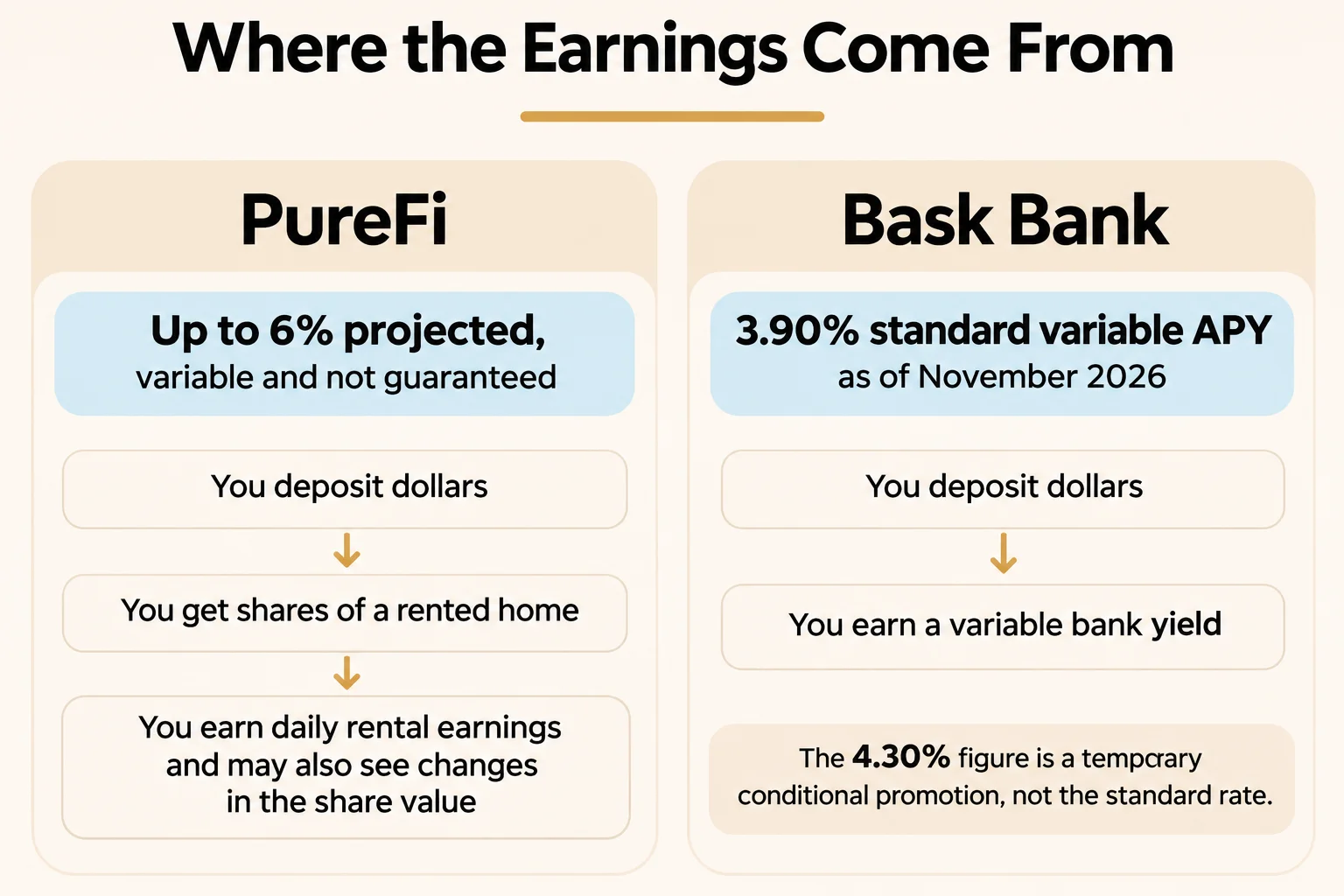
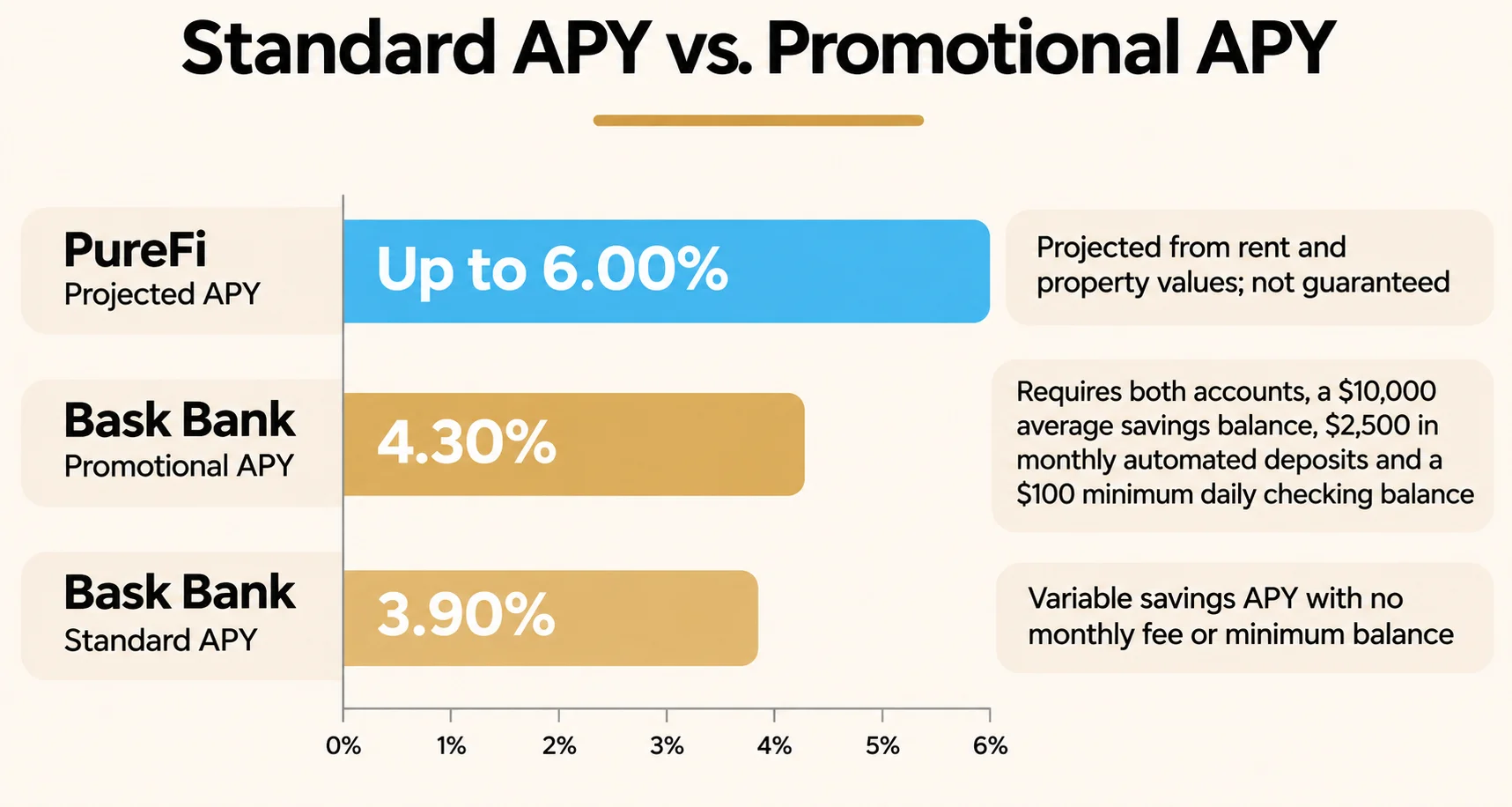
PureFi currently projects up to 6% APY from rent and changes in property values. Bask Interest Savings offers a standard variable APY of 3.90% as of November 2026. A temporary Bask offer can raise that APY to 4.30% when a new customer opens both checking and savings and meets the monthly requirements.
The better fit depends on whether someone wants a bank deposit or real-asset exposure.
PureFi vs. Bask Bank at a Glance
| Feature | PureFi | Bask Bank |
|---|---|---|
| Product | Shares of tenant-occupied homes | Bank savings and checking accounts |
| Published earnings | Up to 6% projected APY | 3.90% standard variable APY |
| Promotional APY | None | 4.30% for eligible new customers |
| Source of earnings | Rent and changes in property values | Yield paid on bank deposits |
| Monthly account fee | None | None |
| Minimum balance | Purchase amount shown in the app | No minimum for savings |
| Access | Sell shares at the current market value | ACH, wires and mobile check deposit |
| Debit card | Cards coming soon | Available with Bask Interest Checking |
| Protection | Not FDIC insured | FDIC insured within applicable limits |
| Availability | More than 100 countries | Eligible U.S. customers |
Rates and promotions can change. Bask’s 4.30% promotional APY is not its standard savings rate and requires customers to meet several conditions.
What Is PureFi?
PureFi is a financial technology company, not a bank. Its digital savings platform lets users buy shares of individual homes that already have tenants.
Projected earnings come from rent and changes in home values. Rental earnings are credited daily. Users can review each property, its documents and the purchase fee before confirming.
PureFi provides a self-custodial wallet, so users control the keys to their balance. Property shares sit in an account in the user’s name and can be sold at the current market price. The up to 6% APY is projected, not guaranteed. Rent can change, and property shares can rise or fall in value.
What Is Bask Bank?
Bask Bank is a digital division of Texas Capital Bank. It offers several conventional products without physical branches.
Bask Interest Savings
Bask Interest Savings currently pays a 3.90% variable APY. The account has no monthly fee and no minimum balance requirement. Earnings compound daily and are credited monthly.
The savings account has no ATM or debit card. Customers use transfers, wires, direct deposit or mobile check deposit.
Bask Mileage Savings
Bask Mileage Savings awards American Airlines AAdvantage miles instead of cash earnings. It currently awards 1.75 miles per dollar saved annually. Miles accrue daily based on the average monthly balance.
Bask also offers Interest Checking and certificates of deposit. Joint ownership is available for certain savings, checking and CD accounts. These are deposit products. The guide to high-yield deposit accounts explains how savings accounts, money market accounts and CDs differ.
PureFi vs. Bask Bank: APY and Earnings
The published figures come from different sources.
How PureFi earnings work
PureFi projects up to 6% APY from the rent collected on tenant-occupied homes and changes in property values. Nothing is lent out to produce the return.
Rental earnings can arrive daily, but the overall value is not fixed. The projected APY can move as rent, property expenses and home values change.
How Bask Bank earnings work
Bask Interest Savings currently has a standard APY of 3.90%. The rate is variable, so Bask can raise or lower it after the account has been opened.
New customers may qualify for a 0.40 percentage-point boost, bringing the APY to 4.30% for up to six statement periods. They must:
- Open Bask Interest Savings and Bask Interest Checking by December 31, 2026
- Maintain an average monthly savings balance of at least $10,000
- Receive at least $2,500 in qualifying automated checking deposits each month
- Maintain a minimum daily checking balance of at least $100
Missing the requirements for a statement period means the customer will not receive the boost for that period.
The comparison of savings rates explains why promotional and standard APYs should be reviewed separately.
PureFi vs. Bask Bank: Fees and Minimums
Neither option charges a monthly account fee. PureFi shows a one-time purchase fee before the user confirms an order. There is no monthly fee for holding the account. The amount needed to buy property shares is shown in the app.
Bask Interest Savings and Mileage Savings have no minimum opening deposit or ongoing minimum balance. However, Bask may close an account that remains unfunded for 15 business days.
Some transactions cost extra. An outgoing domestic wire currently costs $20 online or $35 when handled manually. Other service fees may apply.
“No monthly fee” does not mean “no possible costs.” The guide to high-yield savings accounts with no monthly fees covers other charges worth checking.
PureFi vs. Bask Bank: Access to Funds
PureFi and Bask provide different types of access because one holds property shares and the other holds bank deposits.
PureFi users can sell shares at the current market price. The proceeds return to their balance, but the amount may differ from the original purchase.
Bask customers can move money between Bask accounts or connect another eligible U.S. account. Bask also supports direct deposit, mobile check deposit and wires.
Bask’s savings accounts do not have checks, debit cards or direct ATM access. Bask Interest Checking provides those features, plus Zelle, bill payments and more than 55,000 surcharge-free Allpoint ATMs.
PureFi cards are coming soon. The article on HYSA liquidity explains why access speed matters when money may be needed quickly.
PureFi vs. Bask Bank: Banking Options
Bask offers a broader conventional banking setup. Customers can choose Interest Savings, Mileage Savings, Interest Checking or CDs. They can also hold certain accounts jointly and add beneficiaries.
Mileage Savings provides AAdvantage miles instead of cash earnings. Bask treats their value as reportable income. Customers should consider how much they value airline miles before choosing it.
PureFi focuses on real assets rather than a menu of deposit accounts. Users choose shares of specific rented homes and can see what their money owns.
Someone seeking an online savings app with checking, bill payments, CDs and a debit card may prefer Bask. Someone comparing a high-yield investment platform or high-yield savings app tied to real assets may find PureFi more relevant. A high-yield digital savings account and property shares are not the same product.
PureFi vs. Bask Bank: Eligibility and Accessibility
PureFi is available in more than 100 countries and can be funded from more than 160 countries, subject to local rules and availability. Users manage the account through the PureFi mobile app.
Bask has narrower eligibility. Applicants must be at least 18, have a Social Security number, provide a physical U.S. address and have a mobile number and email address.
Bask may review consumer-reporting information to verify an applicant’s identity and banking history, but applying does not create a hard credit check. Applications submitted from outside the United States may be declined.
This geographic difference is important. Bask is intended for eligible U.S. customers. PureFi is built for a much wider international audience.
Who Might Each Option Suit?
Choose PureFi if:
- You want projected earnings connected to rent from real homes.
- You are comfortable owning property shares instead of a bank deposit.
- You want to select the properties linked to your earnings.
- You live outside the United States in a supported country.
- You understand that projected earnings are not guaranteed and shares can lose value.
Choose Bask Bank if:
- You want an FDIC-insured U.S. savings account.
- You prefer a conventional bank deposit with a variable APY.
- You want no monthly fee or minimum savings balance.
- You can meet the temporary checking and savings promotion requirements.
- You want access to checking, CDs, joint accounts or airline-mile earnings.
Final Comparison
The central difference is not simply 6% versus 3.90%. PureFi provides shares of tenant-occupied homes, with projected earnings coming from rent and changes in property value. Bask provides FDIC-insured bank deposits with a variable APY and a wider selection of traditional banking products.
PureFi may suit users who want access to real assets and accept market risk. Bask may suit eligible U.S. customers who want deposit protection, predictable banking tools and easier links between savings and checking.
Put your dollars into something real
With PureFi, your projected earnings come from shares of real homes with tenants. Choose your properties from your phone, review the documents, and see every fee before you confirm.
Learn more about how PureFi can help you own real estate shares or download the app to get started today.
Up to 6% APY is projected, variable, and not guaranteed. Property shares can lose value. PureFi is not a bank, and its balances and real estate shares are not covered by FDIC insurance or another government deposit scheme.