Premium Bonds vs Savings Accounts: Returns, Access and Risk
Premium Bonds and savings accounts can both hold money outside your current account. They do not produce returns in the same way. Premium Bonds enter each eligible £1 Bond into a monthly prize draw. You may win a tax-free prize, but you may also receive nothing. A savings account pays earnings based on its balance and stated rate. This makes the outcome easier to estimate. The right option depends on whether you prefer predictable earnings or the chance to win a larger prize. Access, tax, deposit limits, and protection also matter.
Premium Bonds vs Savings Accounts at a Glance
| Feature | Premium Bonds | Savings account |
|---|---|---|
| Provider | NS&I | Banks, building societies, and credit unions |
| How returns work | Monthly prize draw | Earnings based on the account rate and balance |
| Guaranteed return | No | Earnings are normally paid under the account terms |
| Rate type | Variable prize fund rate | Fixed or variable account rate |
| Minimum | £25 | Varies by provider |
| Maximum | £50,000 | Provider limits may apply |
| Access | No notice or penalty; payment normally takes 3–5 days | Depends on the account type and provider |
| Tax | Prizes are tax-free in the UK | Depends on the account and saver’s tax position |
| Protection | 100% backed by HM Treasury | Eligible deposits protected by FSCS limits |
| Best for | Savers comfortable with uncertain returns | Savers who want more predictable earnings |
What Are Premium Bonds?
Premium Bonds are offered by National Savings and Investments, or NS&I. Each eligible £1 Bond receives a number and enters a monthly prize draw.
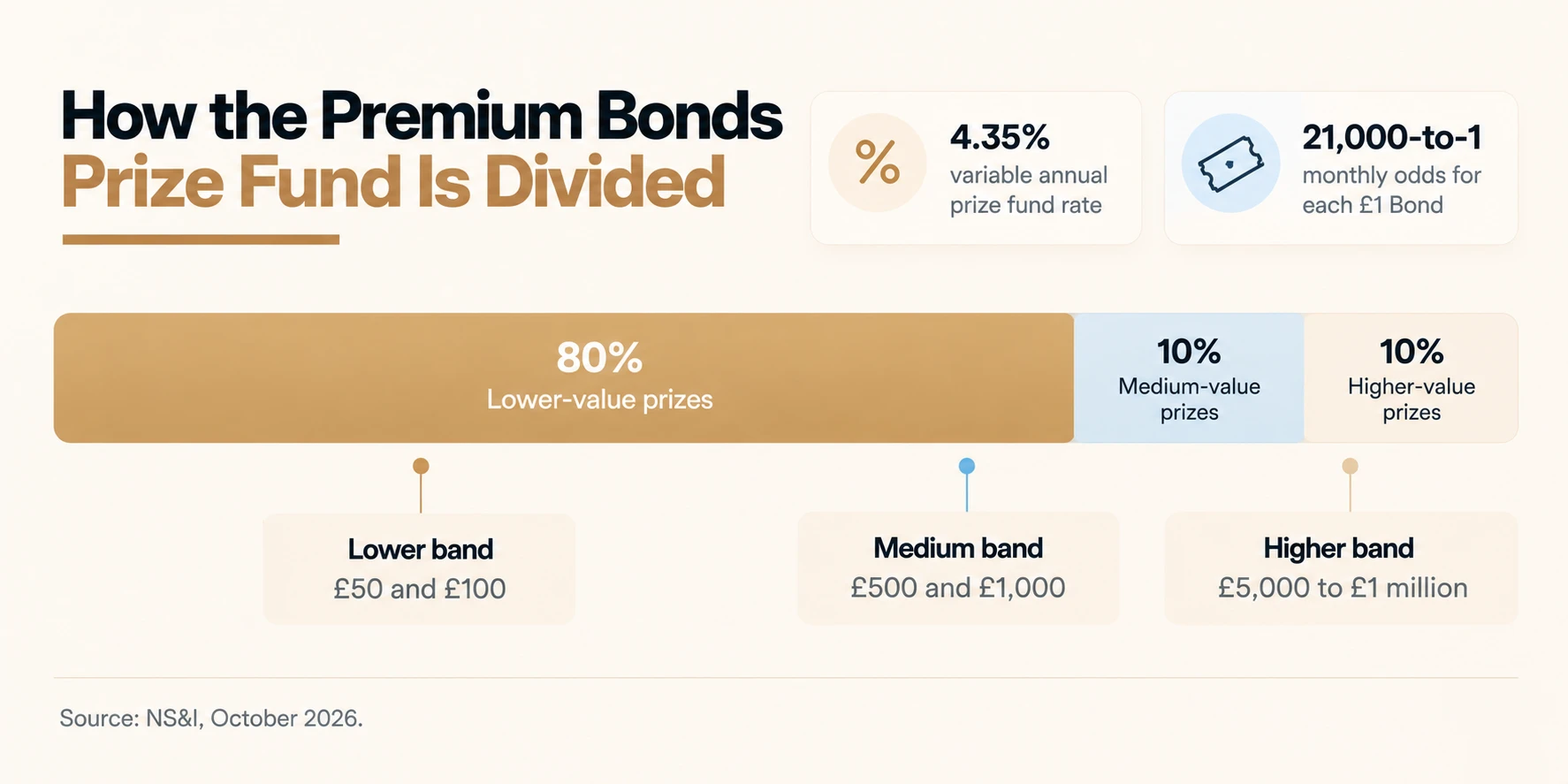
As of October 2026, the annual prize fund rate is 4.35%. The odds of each £1 Bond winning a prize in a monthly draw are 21,000 to 1. Both figures are variable and can change.
The prize fund rate calculates the overall prize fund. It does not mean each holder receives 4.35%. One person may win while another receives nothing.
Current Premium Bond Rules
- You can buy Bonds from £25.
- You can hold up to £50,000.
- Prizes range from £25 to £1 million.
- Prizes are free from UK Income Tax and Capital Gains Tax.
- You must be at least 16 to buy Bonds for yourself.
- You need a UK bank account.
- Adults can also buy Bonds for a child under 16.
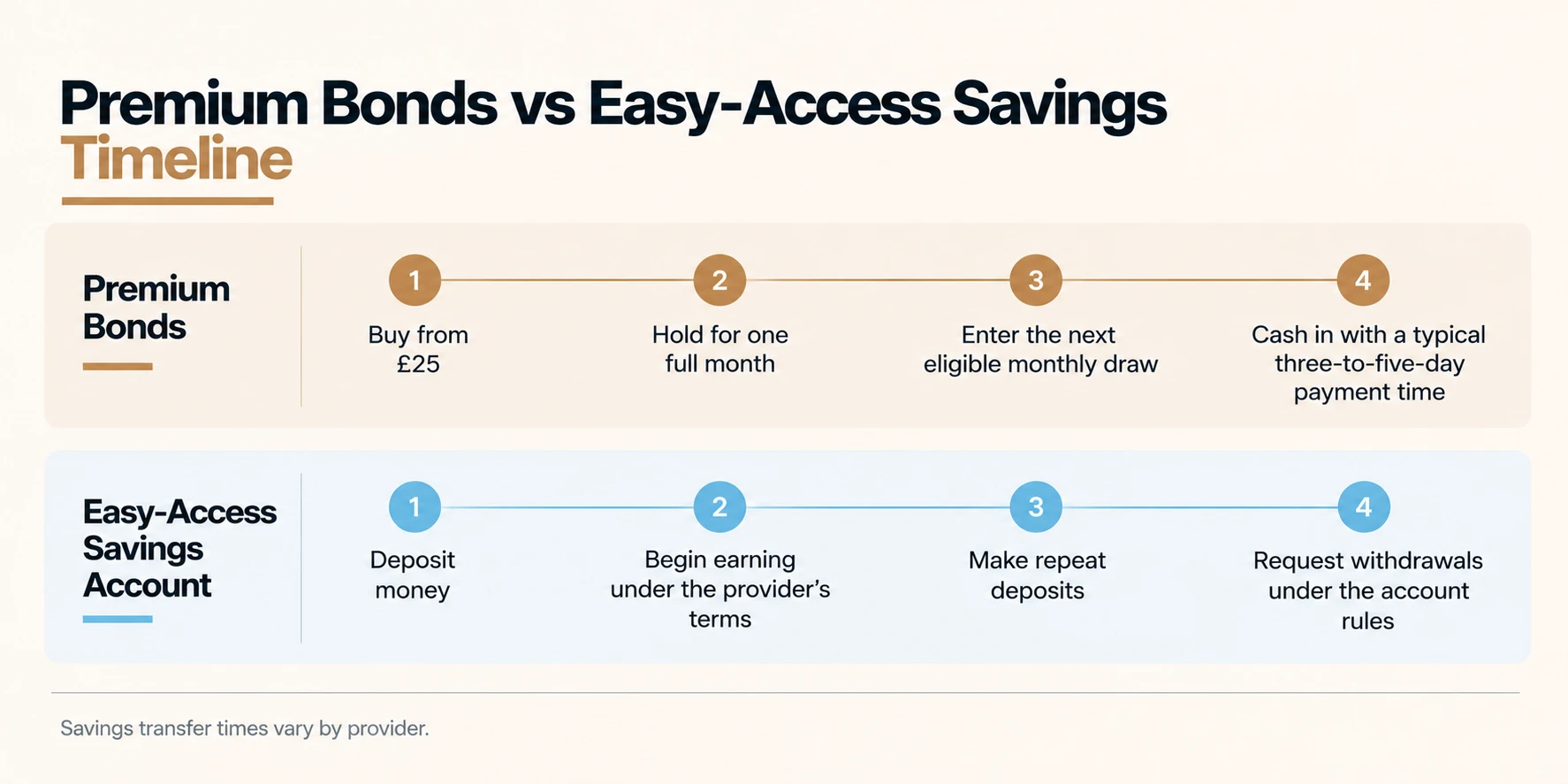
New Bonds must be held for a full month before their first draw. Bonds bought during November normally enter the January draw.
What Is a Savings Account?
A savings account holds cash and pays earnings based on a stated rate. In the UK, providers normally show the annual equivalent rate, or AER. US products normally use APY. Both measures help show the effect of compounding over a year, but they belong to different markets and should not be treated as identical labels.
An easy-access account permits withdrawals under provider rules. Notice and fixed accounts place more limits on access.
A high yield digital savings account usually offers a stronger rate than a standard account. The rate may still be variable. Fees, minimum balances, withdrawal rules, and deposit protection can also differ.
Our guide to what a high-yield savings account is explains the basic account structure.
How Returns Work
Premium Bond Prizes
Every eligible £1 Bond has the same odds. Holding more Bonds gives you more entries but does not guarantee a win.
Prizes are not shared equally. A small number of people win high-value prizes. Many prizes are worth £50 or £100. Some holders receive nothing.
Your personal return is calculated from the prizes you actually receive, not the published prize fund rate.
Savings Account Earnings
A savings account uses its rate and balance to calculate earnings. This makes the result easier to estimate.
For example, £10,000 held at a 4.00% AER would produce about £400 in one year if the rate and balance stayed the same. Deposits and withdrawals change the result.
Variable savings rates can change. Fixed accounts provide more certainty for the agreed term but may limit access.
Which Option Offers More Predictable Earnings?
A savings account is more predictable because you know the current rate, balance, and payment terms.
Premium Bonds do not provide that certainty. You could win more or receive nothing.
For a goal with a fixed date and amount, a savings account is easier to plan around.
For longer time frames, also consider how inflation can reduce buying power. Our guide to using savings accounts for long-term goals covers that issue.
Access to Your Money
Premium Bonds have no fixed term. You can cash in some or all of your Bonds without a withdrawal penalty. NS&I states that withdrawals normally take three to five days to reach the linked bank account. Premium Bonds are accessible but not instant. Keep urgent bill money somewhere faster.
Savings access depends on the product. Easy-access transfers may arrive sooner, while notice and fixed accounts place more restrictions.
A high-yield savings app can make transfer requests easy, but it does not control banking settlement times. Check the actual withdrawal process and delivery estimate.
Risk and Protection
Premium Bonds are backed by HM Treasury. NS&I secures 100% of the money held, including balances above the standard bank deposit limit. The amount originally placed in Bonds does not move with markets.
Eligible deposits with a UK-authorised bank, building society, or credit union receive FSCS protection. Since December 1, 2025, the standard limit has been £120,000 per eligible person, per authorised firm.
Neither option guarantees that your money will keep pace with inflation. Premium Bonds may produce no prize. A provider can lower a variable savings rate.
You can read more about account protection in our guide to high-yield savings account safety.
Tax Treatment
All Premium Bond prizes are free from UK Income Tax and Capital Gains Tax. A prize does not use any part of the Personal Savings Allowance.
Savings earnings may be taxable. This depends on the account, your income, and current rules. Cash ISAs provide a separate tax-free structure.
Tax rules can change. Check current HMRC guidance or speak with a qualified adviser if tax affects the decision.
Eligibility and Deposit Limits
Anyone aged 16 or older with a UK bank account can buy Premium Bonds. Adults can also buy them for a child under 16.
The holding limit is £50,000 per person. Bond numbers above that amount are not eligible to win.
Savings eligibility and deposit rules vary. Some accounts require UK residency, a UK address, or an existing customer relationship. Maximum balances can exceed £50,000.
Who Might Prefer Premium Bonds?
Premium Bonds may suit you if:
- You accept that returns are not guaranteed.
- You like the chance of winning a larger tax-free prize.
- You want full HM Treasury backing.
- You can wait several days for a withdrawal.
- You already have enough money available for immediate needs.
They are less suitable when you need regular earnings or a predictable amount by a set date.
Who Might Prefer a Savings Account?
A savings account may work better for predictable earnings, regular deposits, or faster access.
An online savings app may support automatic deposits and quick balance checks. A digital savings platform may also provide tools for tracking goals. Check the provider behind the app and confirm how eligible deposits are protected.
Our guide to the benefits of a high-yield savings account covers the main features in more detail.
Put your dollars into something real
With PureFi, your projected earnings come from shares of real homes with tenants. Choose your properties from your phone, review the documents, and see every fee before you confirm.
Learn more about how PureFi can help you own real estate shares or download the app to get started today.
Up to 6% APY is projected, variable, and not guaranteed. Property shares can lose value. PureFi is not a bank, and its balances and real estate shares are not covered by FDIC insurance or another government deposit scheme.