HYSA vs Cash Management Account: Rates, Fees and Access
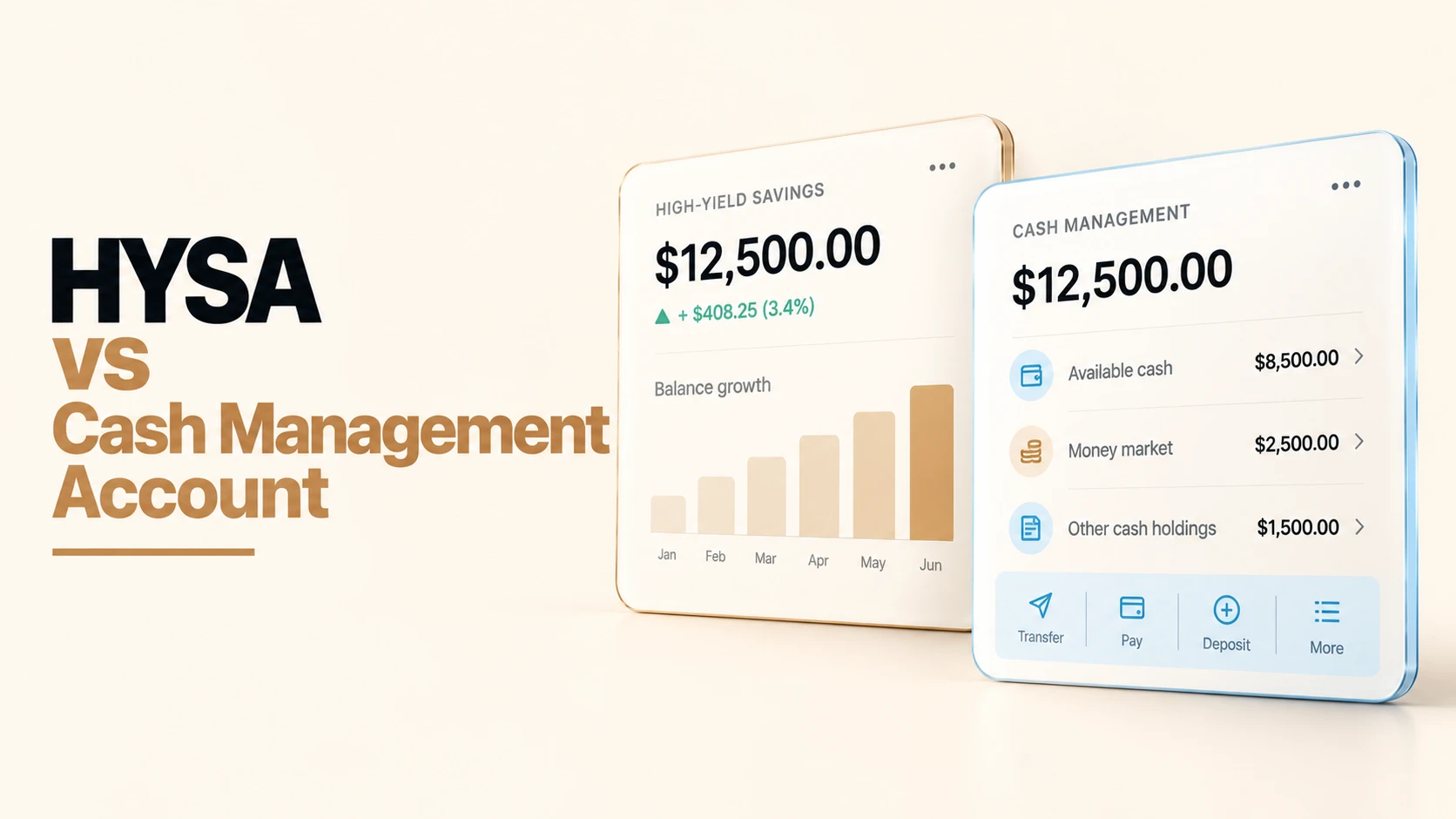
A high-yield savings account and a cash management account can both hold money while generating a yield. The difference is how each product is structured. A HYSA is normally a deposit account opened with a bank or credit union.
A cash management account is commonly offered by a brokerage or financial technology company, which may move cash into partner banks or money market funds. This affects the rate you receive, the way you access your money, and the protection that applies to your balance.
HYSA vs Cash Management Account at a Glance
| Feature | High-Yield Savings Account | Cash Management Account | | Typical provider | Bank or credit union | Brokerage, fintech company, or investment firm | | Return | Variable APY | Variable rate or fund yield | | Where cash is held | At the bank or credit union | Partner banks, brokerage cash position, or money market fund | | Protection | FDIC or NCUA when eligible | Depends on where the cash is held | | Debit card | Not always available | Commonly available | | ATM access | Depends on the provider | Often included | | Check writing | Uncommon | May be available | | Bill payments | Usually limited | Often supported | | Cash deposits | Varies | Often limited | | Transfers | Commonly made through linked accounts | May include transfers, direct deposit, and automatic sweeps | | Monthly fees | Often no monthly fee | Varies by provider | | Investment connection | None | May connect to a brokerage account |
What Is a High-Yield Savings Account?
A high-yield savings account is a deposit account that offers a stronger APY than many standard savings accounts. It can be offered by an online bank, traditional bank, or credit union.
The account’s APY is usually variable. The provider can raise or lower it after the account has been opened. Some accounts pay the same APY on every eligible balance. Others use balance tiers, promotional offers, or monthly activity requirements.
A high-yield digital savings account is normally managed through a website or mobile app. Customers can add money through bank transfers, direct deposits, or mobile check deposits when supported. Withdrawals are commonly sent to a linked checking account.
Monthly fees and minimum balance requirements vary. Many online accounts have no recurring maintenance fee, but wire transfers and optional services may still cost money.
Deposits at an FDIC-insured bank are automatically protected within the applicable limits and ownership categories. Federally insured credit unions provide NCUA share insurance instead.
Our guide to types of high-yield savings accounts covers the different structures available.
What Is a Cash Management Account?

A cash management account, or CMA, is generally offered by a brokerage, investment firm, or financial technology company. It combines several money-management features within one account.
The company providing the CMA may not be a bank. Instead, it may move the customer’s uninvested cash into deposit accounts at one or more partner banks. This process is known as a bank sweep.
Some providers use a money market mutual fund or another brokerage cash position instead of a bank sweep. Others let customers choose between available cash options.
The SEC explains that cash sweep programs may move unused brokerage cash into partner-bank accounts or money market funds. The account agreement should explain which program is used and how its terms can change.
CMAs commonly include features such as direct deposit, debit cards, ATM withdrawals, electronic transfers, check writing, and bill payments. The exact features depend on the provider.
This can make a CMA feel like a checking and savings account combined. However, it is important to identify where the cash is held before treating it like a bank account.
For a more detailed explanation, read What Is a Cash Management Account?.
HYSA vs Cash Management Account: APY and Earnings
Both products can provide a yield, but the return is established differently.
How HYSA APY Works
A bank or credit union sets the APY for its savings account. The APY includes the effect of compounding and gives customers a standard figure for comparing deposit products. Most HYSAs have variable APYs. A rate that is available when the account is opened may rise or fall later.
A provider may also use balance tiers. The highest APY might apply only after the balance reaches a certain amount, or it may apply only up to a balance cap. Activity-based accounts may require direct deposits or another monthly action.
Customers should check the APY that applies to their expected balance rather than relying on the highest number shown in an advertisement.
How CMA Rates Work
A CMA’s return depends on where the provider places the cash. When money is moved into partner-bank deposits, the provider may display an APY. When cash is placed in a money market fund, the provider may display a seven-day yield instead. These figures are calculated differently and should not be treated as identical.
A brokerage may receive one rate from its program banks and pay customers a different rate. The account disclosure should explain how the customer’s return is determined.
The CMA provider may also change its sweep program or the banks participating in it. The SEC notes that brokerage firms must provide written notice when they change the terms, conditions, or products available through a cash sweep program.
HYSA vs Cash Management Account: Protection
The protection available with a HYSA is usually easier to identify. A CMA requires a closer look because the correct answer depends on where the provider holds the money.
Protection for a HYSA
A HYSA opened at an FDIC-insured bank is covered within the applicable federal limits. Coverage is generally $250,000 per depositor, per insured bank, for each ownership category.
Accounts at federally insured credit unions receive comparable NCUA share insurance under the applicable limits.
The important point is that coverage applies at the insured institution. Multiple accounts held in the same ownership category at the same bank are generally combined when coverage is calculated.
Protection for a CMA
Cash swept into qualifying accounts at partner banks may receive pass-through FDIC coverage. This means the customer is treated as the owner of the funds even though the deposits were placed through a third party.
The FDIC defines pass-through coverage as deposit protection for money placed and held at an insured bank through an intermediary. The program must satisfy recordkeeping and ownership requirements for that coverage to apply.
Customers should review the program-bank list. If they already hold deposits directly at one of those banks, the balances may be combined when FDIC coverage is calculated.
Money that remains at a brokerage may be eligible for protection through the Securities Investor Protection Corporation when the brokerage is an SIPC member. SIPC protection is not the same as FDIC coverage. It does not protect against a decline in an investment’s value.
The SEC explains that bank-sweep deposits are held outside the brokerage and are therefore not protected by SIPC if the brokerage fails. Eligible FDIC protection may apply through the receiving program bank instead.
HYSA vs Cash Management Account: Access to Money
The difference in access is one of the clearest reasons to choose one product over the other.
Accessing a HYSA
A HYSA is usually accessed through electronic transfers. Customers link another bank account and move money when needed.
Transfers between accounts at the same institution may be immediate. External transfers can take one or more business days. Providers may also set daily or monthly transfer limits. Some accounts include an ATM card. A smaller number provide a purchase-enabled debit card. Many offer no direct card access at all.
Our guide to whether high-yield savings accounts have debit cards explains the available card and transfer options.
Accessing a CMA
Cash management accounts often provide direct deposit, a debit card, ATM withdrawals, electronic transfers, bill payments, and check writing.
Some providers also reimburse ATM fees. The reimbursement may be limited to certain networks, regions, or monthly amounts.
A CMA can therefore provide quicker access for regular expenses. However, customers should check whether every transaction draws from the same cash position. Money may need to be sold or moved when it is held in a fund rather than a bank sweep.
Settlement periods can also affect access. A recent deposit, security sale, or transfer may not be immediately available for withdrawal.
A good CMA or digital savings platform should show the available balance separately from funds that are pending, invested, or awaiting settlement.
HYSA vs Cash Management Account: Fees and Requirements
Many HYSAs have no monthly maintenance fee. Some still require a minimum opening deposit or a minimum balance to receive the advertised APY.
Other possible HYSA costs include outgoing wire fees, expedited transfer charges, returned-deposit fees, and fees for optional paper services. Our guide to high-yield savings accounts with no monthly fees explains what “no fee” normally covers.
CMA fees vary more widely because the account may include brokerage and payment features. A provider may charge an account fee, subscription fee, advisory fee, outgoing wire fee, or replacement-card fee.
Some CMAs waive account fees when the customer maintains a minimum balance or uses another service from the same company. Others offer ATM reimbursements but require a paid membership.
The yield should be compared after subtracting any recurring charges. A higher rate may not provide greater value when a monthly subscription is required.
Customers should also check whether the CMA has a minimum cash balance and whether uninvested money is swept automatically. A brokerage may use one default cash option unless the customer actively chooses another.
Put your dollars into something real
With PureFi, your projected earnings come from shares of real homes with tenants. Choose your properties from your phone, review the documents, and see every fee before you confirm.
Learn more about how PureFi can help you own real estate shares or download the app to get started today.
Up to 6% APY is projected, variable, and not guaranteed. Property shares can lose value. PureFi is not a bank, and its balances and real estate shares are not covered by FDIC insurance or another government deposit scheme.