High-Yield Savings Account vs Regular Savings Account Compared
A high-yield savings account and a regular savings account do the same basic job. Both hold money outside checking and may pay a variable APY. High-yield accounts often pay more through online banking. Regular accounts may provide easier branch access and faster transfers to checking. Fees, balance rules, ATM access, and withdrawals also vary.
High-Yield vs Regular Savings Account at a Glance
| Feature | High-yield savings account | Regular savings account |
|---|---|---|
| APY | Usually higher | Usually lower |
| Provider | Often an online bank or credit union | Common at traditional banks and credit unions |
| Monthly fee | Often $0, but not always | May apply unless waived |
| Minimum balance | Varies | Varies |
| Branch access | Often limited or unavailable | More commonly available |
| ATM access | Depends on the provider | May include an ATM card |
| Transfers | Usually electronic | Electronic, ATM, or branch options may be available |
| Federal protection | Available for eligible deposits | Available for eligible deposits |
| Best use | Earning more on money held in savings | Convenient access alongside everyday banking |
High-yield is a product description, not a separate legal account category.
What Is a High-Yield Savings Account?
A high-yield savings account pays a more competitive APY than many standard accounts. It is often offered by an online bank or a credit union. Some traditional banks also offer high-yield products.
Online providers may operate without a large branch network. This can support a stronger APY or lower fees, but not every online account pays a high rate.
Common Features
- A variable APY
- Online or mobile account management
- Electronic deposits and withdrawals
- Possible minimum opening deposit
- Possible balance requirement for the top APY
- Limited or no branch access
- Federal protection when eligible funds are held at an insured institution
A high-yield digital savings account may be useful for an emergency fund or another balance that does not move every day. Read our guide to what a high-yield savings account is for a closer look at the account structure.
What Is a Regular Savings Account?
A regular savings account is commonly offered alongside a checking account. It may be available through a bank branch, credit union, website, or mobile app.
The APY is often lower than the rate on a high-yield account. In return, you may get easier access to branches, ATMs, cash deposits, and linked checking transfers.
Common Features
- A variable APY
- Access through a local branch
- Transfers to linked checking
- Possible ATM or teller withdrawals
- Monthly maintenance fees on some accounts
- Minimum balance rules
- Relationship benefits for existing customers
A regular account can work when access matters more than the highest rate.
The Main Difference Is the APY
APY shows how much an account can earn over one year when compounding is included. It makes accounts easier to compare on the same basis.
The Consumer Financial Protection Bureau’s Truth in Savings rules require covered institutions to disclose the APY, minimum balance requirements, and fee schedules.
The APY can change and may require a certain balance or activity.
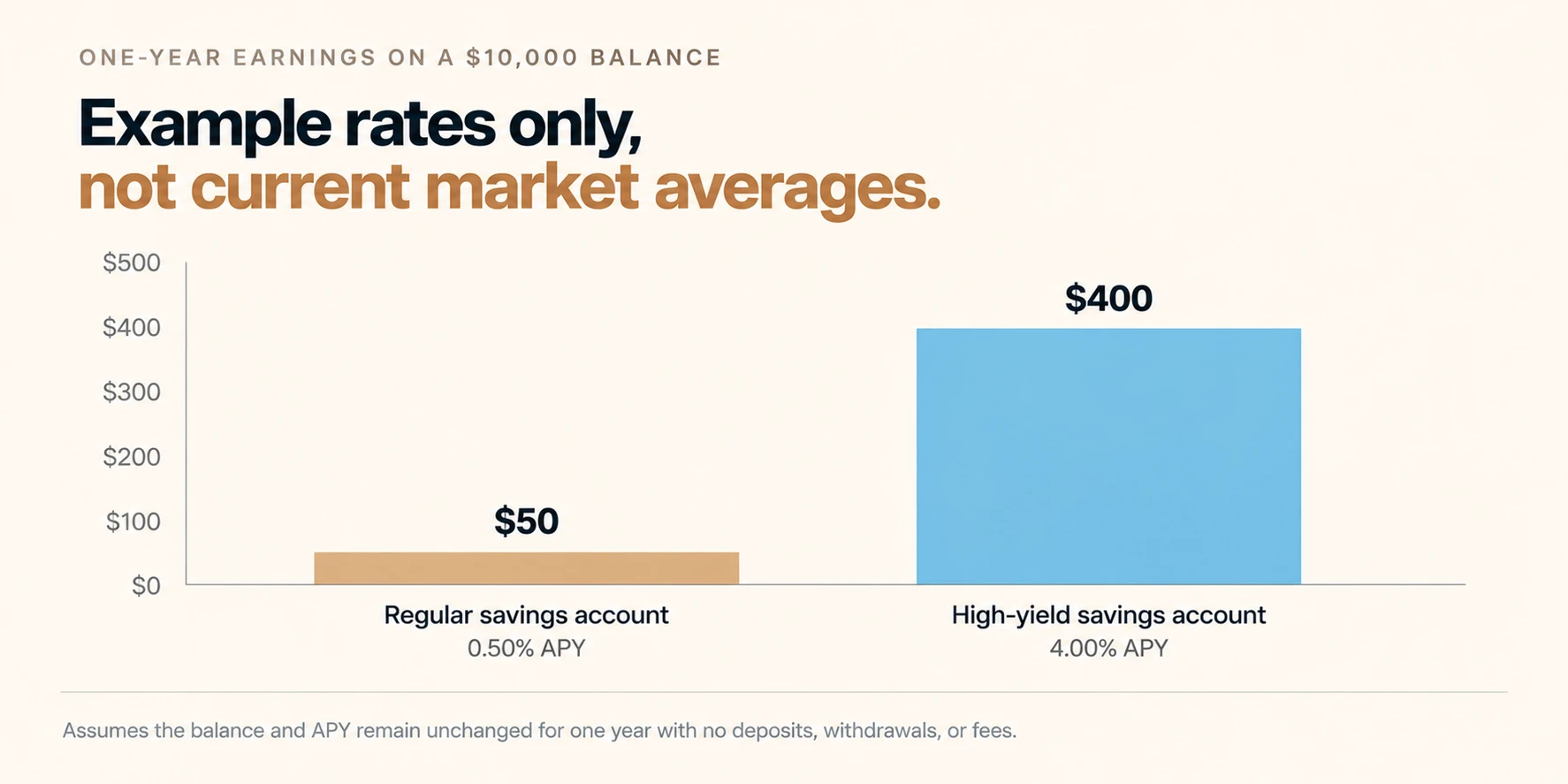
Consider a simple example:
| Account example | APY | Balance held for one year | Approximate annual earnings |
|---|---|---|---|
| Regular savings | 0.50% | $10,000 | $50 |
| High-yield savings | 4.00% | $10,000 | $400 |
These rates are examples, not current market averages. The difference shows why APY matters. Actual earnings change when the APY or balance changes.
Fees and Minimum Balance Requirements
A higher APY can lose value when the account charges fees.
Check for:
- Monthly maintenance fees
- Minimum opening deposits
- Balance requirements for the advertised APY
- Fees for falling below a set balance
- Outgoing wire charges
- Paper statement fees
- Account-closing fees
Under the CFPB’s account disclosure requirements, covered institutions must disclose minimum balances needed to open an account, avoid a fee, or receive the stated APY.
Some regular accounts waive the fee when you maintain a balance or link checking. Compare rules you can meet consistently.
Our guide to high-yield savings accounts with no monthly fees explains the other costs worth checking.
Access to Your Money
A regular savings account may provide more ways to move money. You might have access through a branch, ATM, teller, online transfer, or linked checking account.
A high-yield account may rely on electronic transfers that take several business days. ATM access varies.
The Federal Reserve removed the federal six-per-month limit on convenient savings transfers in 2020. Its current savings deposit guidance confirms that change. A bank or credit union can still set its own limits or charge transaction fees.
Before opening an account, check:
- How long transfers take
- Whether ATM access is available
- Daily or monthly transfer limits
- Deposit hold periods
- Wire and instant-transfer fees
- Whether a linked checking account is required
A good high-yield savings app makes transfers easy to request. It cannot remove the provider’s settlement times or account rules.
Our guide to withdrawing from a high-yield savings account covers these rules in more detail.
Account Opening Requirements
Both account types have a similar application process. You will normally provide your name, date of birth, address, contact details, and Social Security number or other tax information.
The provider may also request a government-issued identity document. Online applications can include an identity or facial check.
You may need to connect another bank account for the first deposit. Opening minimums vary. Eligibility may depend on your location or credit-union membership.
See our guide to opening a high-yield savings account for the full application process.
Are Both Accounts Federally Protected?
Eligible deposits at an FDIC-insured bank receive the same protection whether the product is described as regular or high-yield.
The FDIC standard coverage limit is $250,000 per depositor, per insured bank, for each ownership category. It applies across eligible deposits in the same category at that bank.
Eligible accounts at a federally insured credit union receive similar protection through the National Credit Union Share Insurance Fund. The NCUA provides official coverage information and a Share Insurance Estimator.
Do not assume an account is protected because it appears in an app. Confirm which institution holds the deposit and check its insurance status.
Which Account Is Better for Earnings?
A high-yield account usually earns more when the balance is the same, the APY stays higher, and fees do not reduce the difference.
Check whether the rate covers the full balance or requires certain activity. A strong variable rate can move lower after opening.
Which Account Is Better for Access?
A regular savings account may be better if you need branches, cash deposits, ATM access, or quick transfers to checking.
A high-yield account may work better for money kept apart from daily spending. An online savings app simplifies management, but transfer speed still matters.
Neither account should be treated like checking. Savings products are designed to hold money, not handle every daily payment.
Can You Use Both?
Yes. You could keep a smaller balance at your main bank for quick access and hold a larger emergency fund in a high-yield account. This combines convenience with stronger earning potential, but creates two sets of account terms.
What Should You Compare?
Focus on the full account rather than the headline APY.
- Current APY
- Monthly fees
- Minimum balance
- Transfer speed
- Withdrawal rules
- ATM or branch access
- Federal protection
- Customer support
- App security and account controls
A digital savings platform can make deposits, transfers, and balance checks easier. The institution holding the money and the account agreement still matter more than the interface.
Our guide to different types of savings accounts can help you compare other options.

Put your dollars into something real
With PureFi, your projected earnings come from shares of real homes with tenants. Choose your properties from your phone, review the documents, and see every fee before you confirm.
Learn more about how PureFi can help you own real estate shares or download the app to get started today.
Up to 6% APY is projected, variable, and not guaranteed. Property shares can lose value. PureFi is not a bank, and its balances and real estate shares are not covered by FDIC insurance or another government deposit scheme.