High-Yield Savings Account vs Checking Account
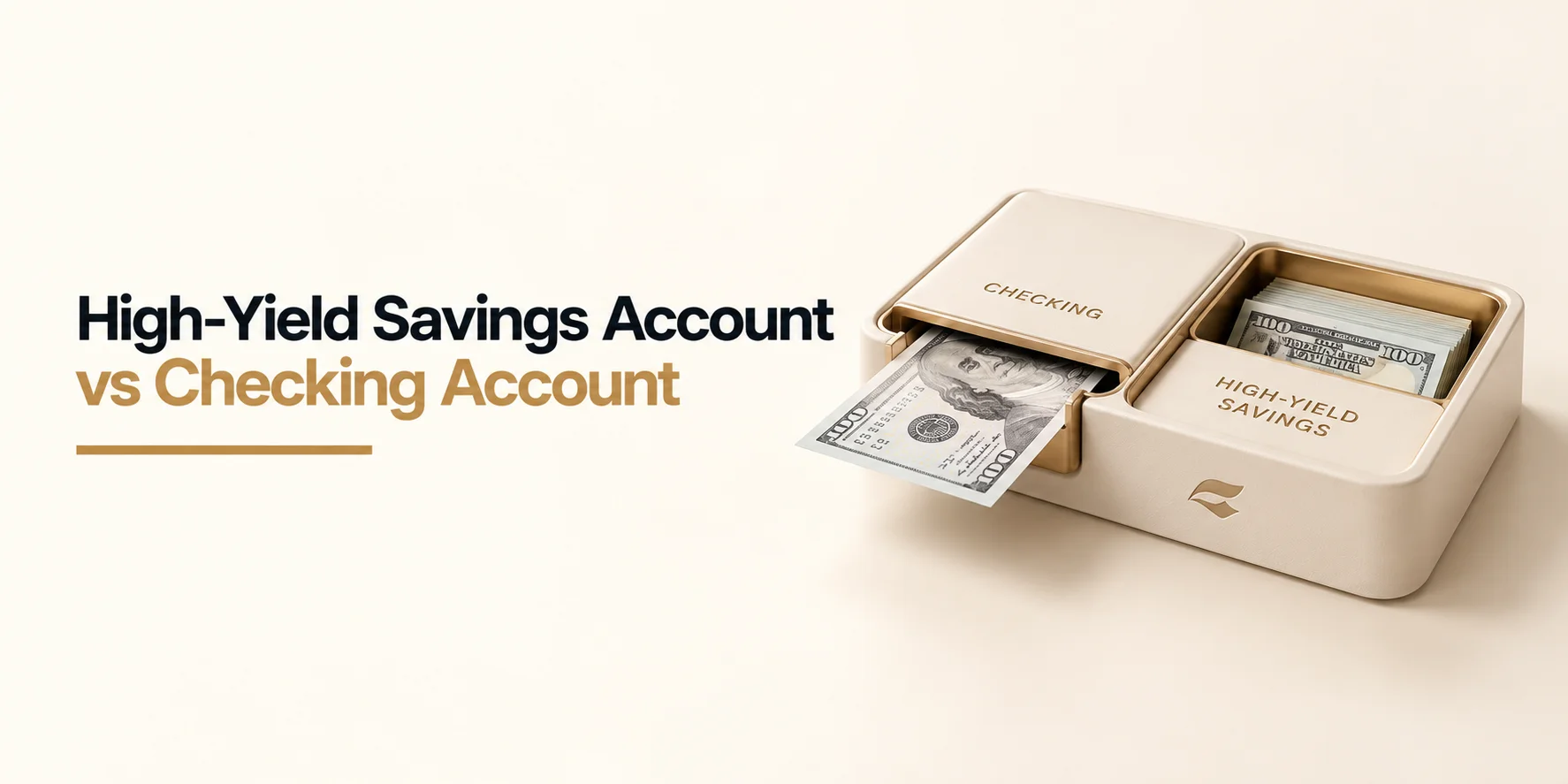
A high-yield savings account and a checking account can hold your money, but they are built for different jobs. Checking is designed for frequent spending, bill payments, cash withdrawals, and incoming deposits. High-yield savings is designed to help money earn while it waits for a future use. The better choice therefore depends on what you need the funds to do.
Before choosing an account or digital savings platform, compare the APY, access methods, fees, balance requirements, and federal protection. A high yield may be attractive, but it is less useful if the account cannot support the transactions you make every day.
High-Yield Savings vs Checking: A Quick Comparison
A high-yield savings account is a deposit account offering a higher APY than many standard savings accounts. It is commonly used for emergency funds, planned purchases, and money that is not needed every day. The APY is usually variable.
A checking account is built to receive paychecks, pay bills, support debit-card purchases, and provide regular access to cash. Many offer a low APY or none at all.
| Feature | High-yield savings account | Checking account |
|---|---|---|
| Main purpose | Saving and earning | Everyday transactions |
| Typical APY | Usually higher | Usually lower or none |
| Debit card | Not always available | Commonly included |
| Bill payments | May be limited or indirect | Designed for regular payments |
| ATM access | Depends on the provider | Usually available |
| Common fees | Monthly, transfer, or minimum-balance fees | Monthly, ATM, or overdraft fees |
Checking handles money in motion. High-yield savings gives funds a place to earn until they are needed. Our guide to what a high-yield savings account is explains the savings side further.
Which Account Earns More?
A high yield digital savings account will generally offer a stronger APY than an everyday checking account. That difference can become meaningful as the balance and time in the account increase.
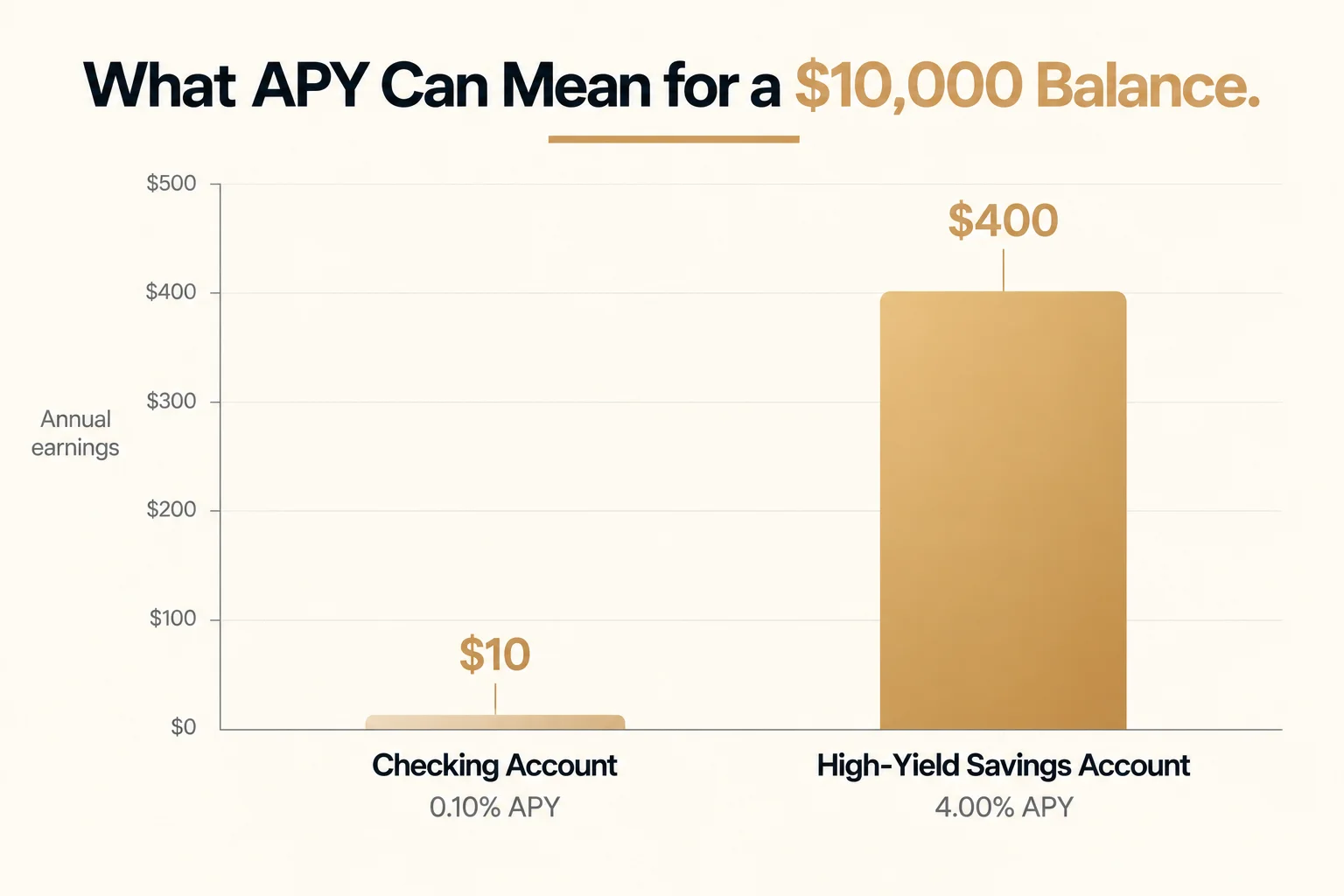
If $10,000 remains in an account for one year, 4.00% APY would produce about $400. At 0.10% APY, it would produce about $10. These examples assume the balance and APY remain unchanged.
APY accounts for compounding over a year. It does not show whether fees will reduce your net earnings or only part of the balance qualifies.
Some checking accounts advertise a competitive APY based on monthly activity. Conditions can include direct deposits, debit-card purchases, electronic statements, or a qualifying balance. If you would not meet them naturally, the headline APY may not reflect what you earn.
High-yield savings can have conditions too. The best APY may have a balance cap, minimum, or new-customer requirement. Economic conditions and provider decisions can also change a variable APY. Read Do High-Yield Savings Account Rates Change? for more detail.
To compare the dollar effect rather than only the percentage, see How Much Does a High-Yield Savings Account Earn?.
How Does Access to Funds Differ?
The biggest practical difference appears when you use the money. Checking is made for transactions. Savings allows access under the provider’s rules but is not designed for daily spending.
Checking Is Built for Everyday Banking
A checking account commonly supports:
- Debit-card purchases and ATM withdrawals
- Direct deposits from an employer or another payer
- Online bill payments and recurring subscriptions
- Checks, bank transfers, and person-to-person payments
These features suit rent, utilities, groceries, transport, and other regular expenses. Payments can leave the account directly.
ATM operators and banks may impose withdrawal or transfer limits, while newly deposited checks may not be available immediately. Even so, checking supports frequent activity.
Savings Access Depends on the Provider
A high yield savings app may allow transfers at any time, but funds may not arrive immediately. Some providers require a linked checking account, while others offer an ATM card or faster options.
The Federal Reserve removed the old federal six-transfer limit. A bank or credit union can still set transaction limits or fees, so check the current account agreement.
For an online savings app, check transfer limits, ATM availability, withdrawal methods, support hours, and processing times. This matters when the account holds emergency funds.
If checking and savings are held at different institutions, test a small transfer before relying on the connection. Confirm the cutoff time, weekend handling, and any hold placed on incoming funds. A displayed balance may not always mean the full amount is immediately available to withdraw.
How Do the Fees Compare?
Fees depend more on the product than its label. Checking may carry a monthly charge unless you receive qualifying deposits or maintain a required balance. Other costs can include ATM, overdraft, nonsufficient-funds, paper-statement, and check-order fees.
If a payment exceeds the available balance, the institution may decline it, transfer funds from a linked account, or cover it and charge a fee. Check your overdraft settings and agreement.
High-yield savings is not automatically free. Charges may apply for maintenance, outgoing wires, expedited transfers, or falling below a minimum. Missing account conditions may also reduce the APY.
Compare the likely annual fees with the earnings you expect. A $10 monthly charge adds up to $120 per year, which can offset much of the benefit of a higher APY on a modest balance. Our guide to high-yield savings accounts with no monthly fees covers the conditions worth checking before opening an account.
Are Checking and High-Yield Savings Accounts Protected?
Eligible checking and savings deposits can both receive federal protection when held at an insured institution. At an FDIC-insured bank, the standard limit is $250,000 per depositor, per insured bank, for each ownership category. Federally insured credit unions provide comparable protection through the NCUA.
Checking and savings do not receive separate coverage merely because they are different products. Balances in the same ownership category at the same bank are generally combined. Different ownership categories may qualify separately when requirements are met.
Verify the bank or credit union holding the deposit rather than assuming an app is insured. Investments do not become federally protected deposits because they appear beside an insured balance in the same app.
Which Account Fits Different Banking Needs?
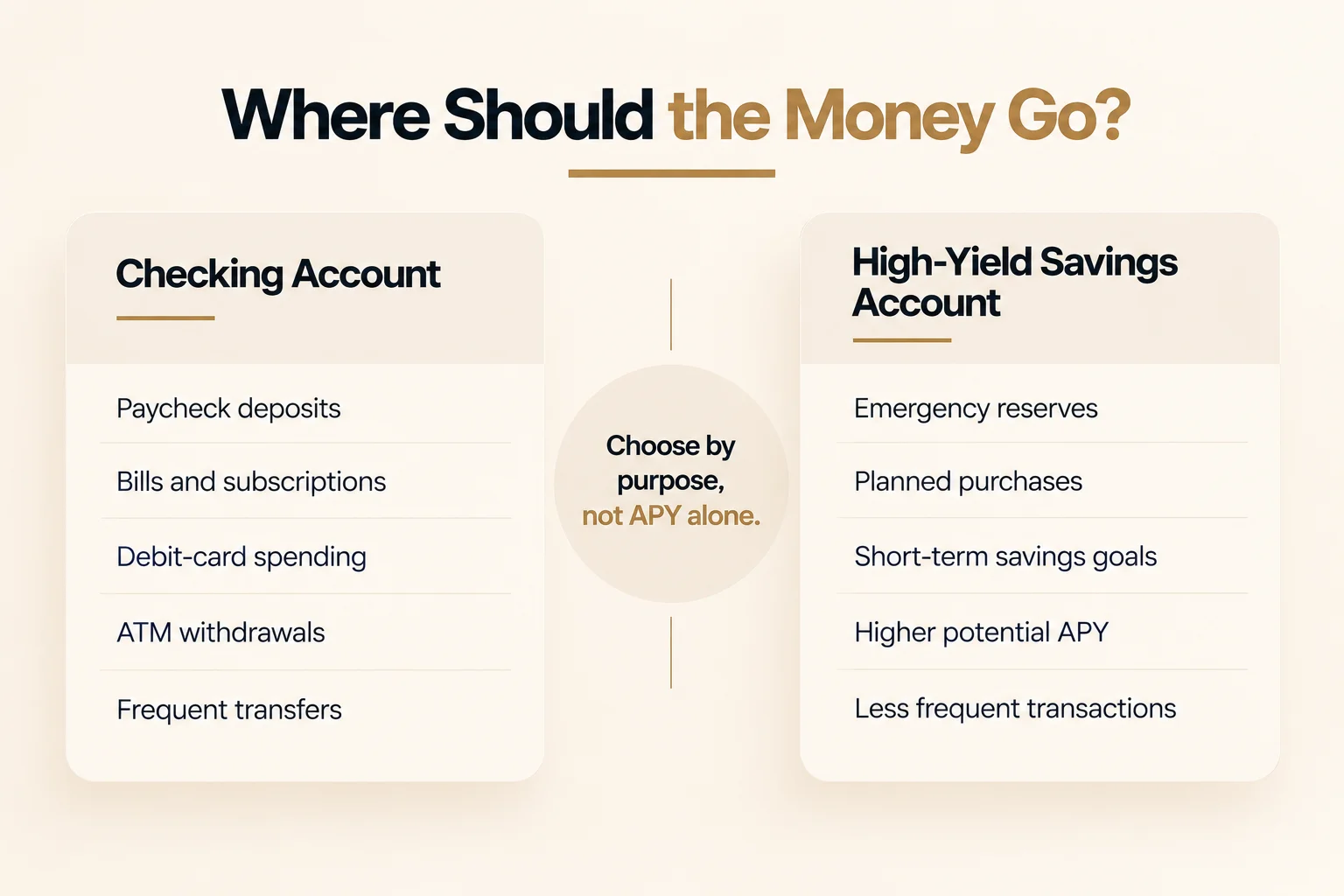
The best account depends on the job assigned to the money.
| Banking need | More suitable account | Why |
|---|---|---|
| Receiving a paycheck | Checking | Supports direct deposit and frequent transactions |
| Paying bills | Checking | Designed for scheduled and recurring payments |
| Debit-card spending | Checking | Usually includes direct card access |
| Building an emergency fund | High-yield savings | Separates funds and provides potential earnings |
| Saving for a planned purchase | High-yield savings | Allows the balance to earn while it waits |
| Frequent cash withdrawals | Checking | Usually provides easier ATM access |
| Holding funds needed soon | Depends on access rules | Transfer speed and withdrawal methods matter |
Checking suits money expected to leave during the current month. High-yield savings suits money assigned to a future goal and separates it from everyday card spending.
The highest APY should not override the account’s purpose. Slow transfers may be unsuitable for funds needed the same day, while no-fee checking may be better for frequent transactions.
Compare the expected balance, access frequency, required payment tools, and fee-waiver conditions rather than choosing solely on APY.
How Is PureFi Different From Both Accounts?
With PureFi, your projected earnings come from shares of real homes with tenants. Choose your properties from your phone, review the documents, and see every fee before you confirm.
Learn more about how PureFi can help you own real estate shares or download the app to get started today.
Up to 6% APY is projected, variable, and not guaranteed. Property shares can lose value. PureFi is not a bank, and its balances and real estate shares are not covered by FDIC insurance or another government deposit scheme.