
Can You Lose Money in a High-Yield Savings Account?
Can You Lose Money in a High-Yield Savings Account?
You can lose money in a high-yield savings account, but the main risks come from fees, fraud, uncovered balances, and a loss of buying power.
Your balance does not normally rise and fall with the stock market. If the account is held at an insured bank or credit union and your deposit stays within the applicable limit, your money may also have federal protection if the institution fails.
That does not make every account completely risk-free. You still need to check who holds the funds, what fees apply, and how the account is protected.
In this article, we’ll explain what can reduce your savings, what happens when the APY falls, how federal coverage works, and what you can do to protect your money.
Can the balance in a high-yield savings account go down?
Your deposited balance should not change because of movements in the stock or property markets. A high-yield savings account is a deposit account, not an investment in a market asset.
However, the balance can still fall in some situations. These include:
- The provider charges a fee.
- An unauthorized transfer leaves the account.
- A payment or withdrawal creates a negative balance.
- Part of your deposit is not covered when an institution fails.
- The product is not actually an insured savings account.
A lower APY does not take money out of the account. It only reduces how much the account may earn from that point onward.
Fees can reduce your savings
Some high-yield savings accounts have no monthly maintenance fee. Others charge a fee if you do not meet certain conditions. Possible charges include:
- Monthly account fees
- Wire transfer fees
- ATM fees
- Paper statement fees
- Charges for certain withdrawal methods
- Fees linked to a minimum balance
Suppose an account earns $10 during a month but charges a $12 maintenance fee. Your balance would be $2 lower even though the account produced earnings. This is why the highest APY is not always the best deal. Check how much the account may earn after fees.
A high-yield digital savings account with a slightly lower APY may leave you with more if it has simpler rules and no regular fee.
Amounts above federal limits may not be covered
Eligible deposits at an FDIC-insured bank are generally protected up to $250,000 per depositor, per insured bank and per ownership category. The same basic limit applies to eligible accounts at federally insured credit unions through the NCUA.
If you keep more than the applicable limit at one institution, the extra amount may not be covered if that institution fails.
For example, a person with several single-owner accounts at the same bank cannot assume that every account receives its own separate $250,000 limit. Those balances are usually added together under the same ownership category.
Different rules can apply to joint accounts, retirement accounts and trust accounts. Check your actual coverage rather than estimating it.
You can review the FDIC deposit coverage guide or the NCUA share coverage guide for more information.
Not every savings app is a bank
A website or app may describe itself as a savings service without being a bank. Some financial technology companies place customer funds at one or more partner banks. Federal protection may pass through to the customer when the arrangement and account records meet the required conditions.
Do not assume this applies automatically. Before using an online savings app, check:
- The legal name of the bank holding the money
- Whether that bank is federally insured
- Whether your account qualifies for pass-through coverage
- How your ownership is recorded
- What happens if the app company closes
- How you can contact the partner bank
An app saying that it “works with insured banks” is not the same as clear confirmation that your exact balance qualifies for coverage.
Fraud can lead to a loss
A bank account can be targeted by scammers even when the bank itself is insured. Someone may try to steal your password, verification code or personal information. They may also send a fake message that looks like it came from your bank.
Federal deposit coverage protects eligible deposits if an insured institution fails. It does not replace every dollar lost through scams, identity theft or payments that you approved yourself.
Report unfamiliar activity as soon as you see it. Waiting can make the issue harder to resolve. To reduce the risk:
- Use a unique password.
- Turn on multi-step verification.
- Never share a verification code.
- Do not open account links from unexpected messages.
- Check the website address before signing in.
- Review account activity regularly.
- Contact the provider through its official app or website.
A bank or support agent should not ask you to transfer money to a “safe account.”
Rising prices can reduce buying power
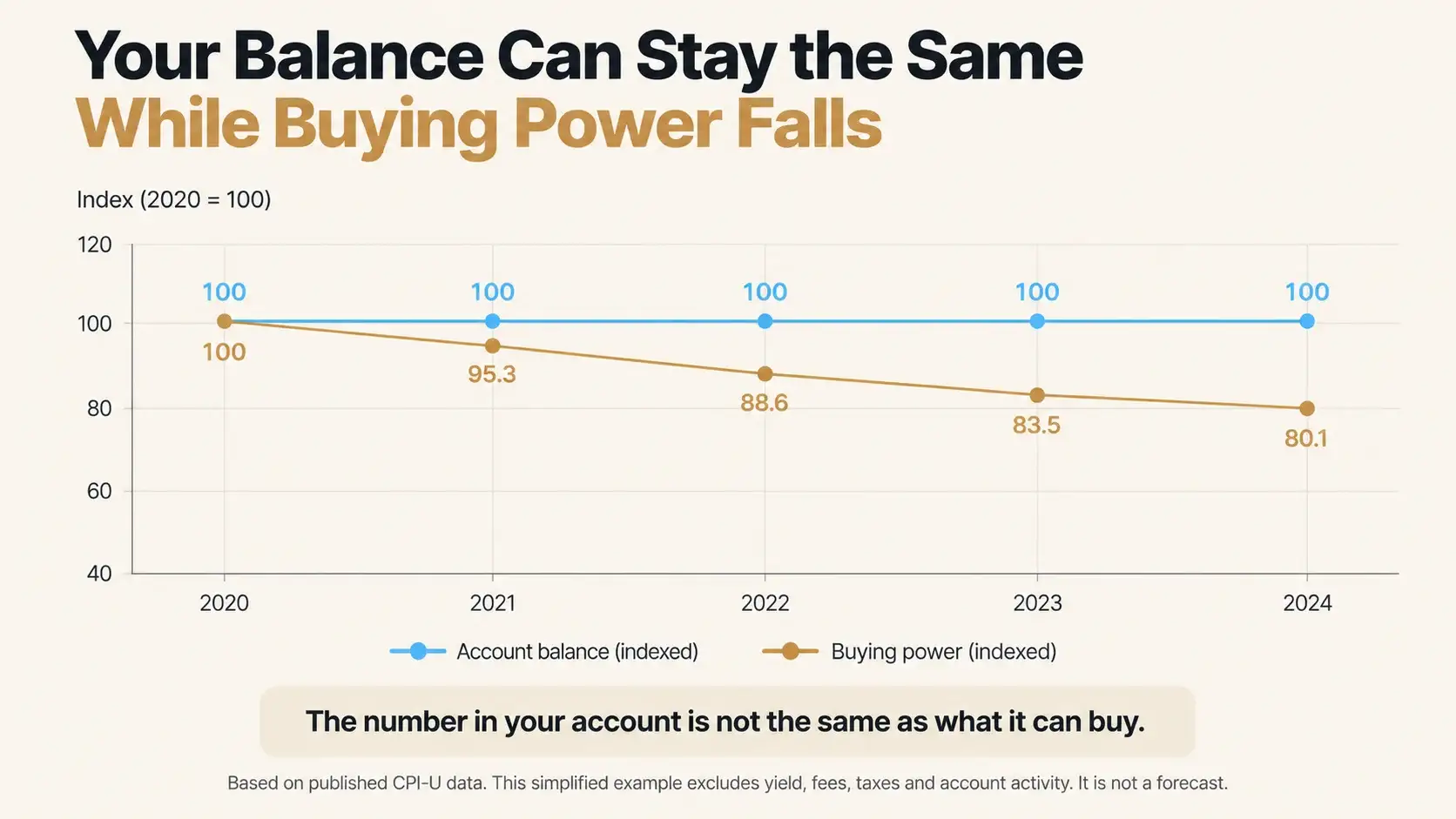
Your account balance may grow while the money itself becomes less useful. This happens when prices rise faster than your savings. If your account earns 3% during a year but the cost of the things you buy rises by 4%, your balance is higher but its buying power has fallen.
This is not a direct loss from the account. The dollars are still there. They simply buy less than they did before. A competitive APY can help reduce this effect. It cannot always prevent it.
This is one reason a savings account is usually used for emergency funds and short-term goals. Money intended for a goal many years away may need a different approach, depending on the risk you can accept.
Can you lose money when the APY falls?
A falling APY does not normally reduce the balance already in your account. It means the account will earn less going forward.
For example, if the provider lowers its APY from 4% to 3%, the money already deposited remains in the account. The next earnings calculation will use the lower APY.
Most high-yield savings accounts have variable APYs. The provider can change the APY after the account is opened. You should not treat the opening APY as a promise. Promotional APYs may also end after a set period.
Check your statements or account dashboard to see the APY currently applied to your balance.
Can you lose money by withdrawing it?
A normal savings account does not have a maturity date, so there is usually no CD-style early withdrawal penalty. However, withdrawal rules vary.
The provider may charge for:
- A wire transfer
- An out-of-network ATM
- A same-day transfer
- A withdrawal above an account limit
- Sending money in a different currency
The provider may also place a temporary hold on a recent deposit. This can delay access without reducing the balance. Read the transfer and withdrawal rules before relying on the account for emergencies.
How does federal account protection work?
FDIC and NCUA coverage protects eligible deposits when a covered institution fails. It does not protect every financial product sold by that institution. Stocks, property shares, and other investments do not become federally protected simply because they are available through a bank or credit union.
Coverage also depends on how the account is owned. A single-owner account is treated differently from a joint account or certain trust accounts. When checking a high-yield savings app or digital savings platform, confirm three things:
- The name of the institution holding the funds.
- Whether that institution is federally insured.
- Whether your balance falls within the applicable limit.
Do not rely only on an app logo or general statement about banking partners.
How PureFi protects accounts

PureFi is a financial technology company, not a bank or high-yield savings account. Customer balances are held in self-custodial wallets controlled by the account holder.
PureFi says it uses encryption, identity checks, Face ID, two-factor verification and automatic fraud monitoring. Card, deposit, and withdrawal services are provided through licensed technology partners. You can read more on the PureFi security page .
PureFi balances and property shares are not FDIC insured or protected by another government agency. Its projected APY comes from rent and changes in the value of real homes. Returns can change, and property shares may lose value.
Put your dollars into something real
With PureFi, your projected earnings come from shares of real homes with tenants . Choose your properties from your phone, review the documents, and see every fee before you confirm.
Learn more about how PureFi can help you own real estate shares or download the app to get started today.
Up to 6% APY is projected, variable and not guaranteed. Property shares can lose value. PureFi is not a bank, and its balances and real estate shares are not covered by FDIC insurance or another government deposit scheme.