
5 Best Real Estate Investment Apps for 2026
5 Best Real Estate Investment Apps for 2026
Real estate investment apps let you put money into property without buying and managing an entire building yourself. Some let you choose individual homes. Others place your money into a fund containing several properties.
The best real estate investment apps are not all built for the same user. Minimum investments, fees and access rules can be very different. Some platforms are open to everyday investors. Others only accept people who meet specific income or asset requirements.
In this article, we compare where earnings come from, how fees can affect your yield, whether projected returns can change, how you can access your money, and what account protections or investment limits apply.
Note: The information below was checked in September 2026. Fees, availability and investment terms can change, so always read the latest documents before investing.
Best real estate investment apps at a glance
| Platform | Main investment option | Starting amount | Main fees | Access to money | Best for |
|---|---|---|---|---|---|
| PureFi | Shares of individual rental homes | Shown in the app | One-time purchase fee; no monthly fee | Sell at the current market price; no fixed lock-up | Global access to individual homes |
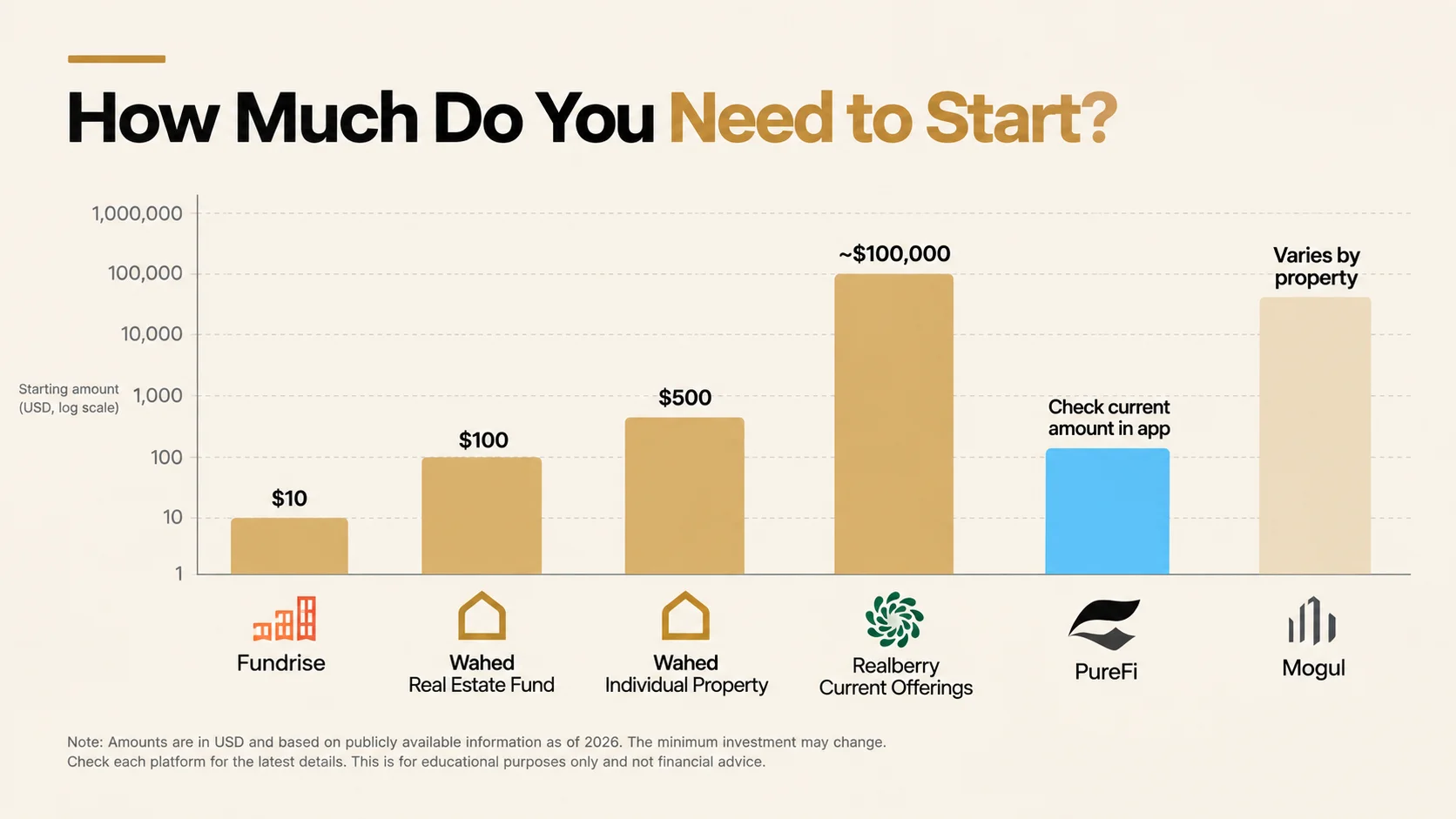
| Wahed | Individual homes and a residential property fund | $100 for the fund; $500 for individual properties | Sourcing, management and possible redemption fees | Depends on the product and holding period | Zero-debt US residential property |
| Mogul | Fractional shares in individual rental homes | Varies by property | One-time 5% platform fee within the property’s starting capital | Usually held for 3 to 10 years | Choosing individual US rental homes |
| Fundrise | Managed private real estate funds | $10 | 0.15% annual advisory fee plus 0.85% fund management fee | Most requests are reviewed quarterly | Low-cost access to managed funds |
| Realberry | Private development and acquisition projects | Around $100,000 for current offerings | Varies by project | Generally long-term and difficult to sell early | Accredited investors seeking private deals |
These platforms use different ownership structures. The starting amount alone does not tell you which option is suitable. You also need to check what you will own, how long you may need to hold it, and how the platform earns its fees.
1. PureFi
PureFi lets users buy shares of individual, income-producing homes from their phones. Each home is purchased outright and professionally managed. Users can review the property and its legal documents before making a purchase.
PureFi earns the first position on this list because it combines direct property selection with broad international availability. It is available in more than 100 countries, although access still depends on local rules.
Key features
- Shares of identifiable real homes
- Homes bought outright
- Professional property management
- Legal documents available in the app
- Rental earnings paid into your balance
- No monthly account fee
- No fixed lock-up
- Access in more than 100 countries
- A self-custodial wallet controlled by the user
How PureFi works
You create an account and complete an identity check. You can then add US dollars from a supported country. The app may suggest a mix of homes, or you can choose properties yourself. You review the details and confirm each purchase. Shares of the selected homes are held in an account in your name.
When tenants pay rent, your share is added to your balance. You can reinvest it in more property shares or take it out. Your investment may also gain or lose value as property prices change.
PureFi currently shows projected earnings of up to 6% APY. This figure is variable and is not promised. It is based on rent and changes in home values. Your shares can lose value. PureFi explains how its real estate product works here.
Fees and accessibility
PureFi does not charge a monthly fee. A one-time purchase fee applies to each order. The full amount is shown before you confirm the purchase. You can sell your shares at their current market price without waiting for a fixed holding period to end. The amount received will depend on the value of the shares when they are sold.
PureFi is a financial technology company, not a bank. Real estate shares are investments, not bank deposits. They are not covered by FDIC insurance or another government deposit scheme.
The platform uses identity checks, encryption, fraud monitoring and secure payment systems. A user’s balance remains in a self-custodial wallet rather than being held by PureFi. Read more about PureFi’s security measures.
Best for
PureFi may suit people who want to choose individual rental homes instead of placing their money into one large property fund. Its international reach also makes it more accessible to people living outside the US.
2. Wahed Real Estate
Wahed provides two ways to invest in US residential property. Investors can choose shares linked to an individual home or buy shares in a fund containing several single-family rental homes. Properties are purchased using a zero-debt structure. Wahed manages the homes, tenants, and maintenance for investors.
Key features
- Individual property investments
- A diversified residential fund
- US single-family rental homes
- Zero-debt property purchases
- Professional property management
- Potential rental distributions
- Potential gains when property values rise
- Access for qualifying non-accredited investors
How Wahed works
For an individual property, you choose a home listed on the platform and buy shares in the legal entity connected to it. Potential earnings come from rent after property costs. You may also receive part of any gain when the property is eventually sold.
The individual property minimum currently starts at $500. These investments are designed to be held for a defined period. Access may depend on the property being sold. The Wahed Real Estate Fund works differently. Instead of choosing one home, you buy shares in a fund holding several US rental properties. The minimum investment is $100. The fund aims to make potential distributions every quarter.
The fund is open to qualifying accredited and non-accredited US investors. Non-accredited investors may be subject to limits on how much they can invest.
Fees and accessibility
Fees depend on whether you choose an individual property or the wider fund. They may include a sourcing fee, an annual management fee and a fee for redeeming shares early.
The fund has a six-month initial holding period. After that, redemption requests can be submitted during scheduled windows held twice a year. A request is not the same as guaranteed immediate access. It remains subject to the fund’s rules and available liquidity.
Best for
Wahed may suit US investors who want residential property bought without debt. The fund may work for someone who wants several properties in one investment, while the individual option provides more control over property selection.
3. Mogul
Mogul focuses mainly on fractional ownership of US single-family rental homes. Investors select individual properties instead of being placed automatically into a broad real estate fund.
Each property is placed inside its own limited liability company. Investors buy fractional ownership in that company.
Key features
- Individual single-family rental homes
- Fractional ownership through property companies
- Monthly potential rental distributions
- Property information and projections
- Investor voting rights
- Online performance dashboard
- Community investment clubs
How Mogul works
Mogul selects and purchases a property through a separate company. It then divides ownership into smaller shares that can be purchased by investors.
An investor’s share determines their portion of potential rental distributions, property expenses, and sale proceeds. Mogul says its usual holding period is between 3 and 10 years.
The platform has discussed a secondary market for selling shares before a property is sold. Its published information currently labels this feature as coming soon. Investors should therefore plan around the stated holding period rather than assume they can sell whenever they want.
Fees and accessibility
Mogul states that a one-time 5% platform fee is included in the property’s starting capital structure. This slightly reduces the investor’s ownership share instead of appearing as a separate payment after purchase.
Each property can also have operating, maintenance, management and transaction costs. These should be listed in the property documents. Minimum investment amounts may vary between available homes.
Best for
Mogul may suit investors who want to research and choose individual US rental properties. It is less suitable for someone who may need quick access to their money.
4. Fundrise
Fundrise gives individual investors access to managed private real estate funds. Rather than selecting one house, most users choose an investment plan and receive exposure to a portfolio of properties and related assets.
Its real estate investments may include rental housing, industrial buildings, warehouses and other private property projects.
Key features
- Managed private real estate funds
- Residential and commercial property
- Diversification across several assets
- $10 starting amount
- Automatic recurring investments
- Standard and retirement accounts
- Online and mobile account access
How Fundrise works
You create an account and select a portfolio based on your goal. Fundrise then allocates your money across eligible funds. The available strategies may focus on income, long-term growth or a balance of both. Potential earnings can come from rent, property operations, distributions and increases in asset values.
Fundrise may add new assets to an existing portfolio over time. Investors can also make additional payments or set up recurring investments.
Fees and accessibility
Fundrise charges a 0.15% annual advisory fee. Its real estate funds also charge a 0.85% annual management fee. Together, these charges equal $10 a year for every $1,000 invested, before any additional costs that may apply to a particular fund.
Most Fundrise real estate investments are private and do not trade on a public exchange. The platform offers quarterly liquidity for many funds, but this does not mean withdrawals are automatic. Requests may be limited, delayed or suspended under the fund’s rules.
Best for
Fundrise may suit US investors who want a low starting amount and a managed property portfolio. It can also work for someone who prefers diversification over choosing individual homes.
5. Realberry
Realberry is different from the other names on this list. It is a private real estate investment platform and manager, rather than a low-minimum fractional property app.
The company was previously known as McWhinney. It develops, acquires and manages property projects, with a focus on the Mountain West region of the US.
Key features
- Direct access to sponsor-managed projects
- Residential and commercial real estate
- Property development and acquisitions
- Detailed financial and legal documents
- Direct contact with the investment manager
- Long-term private offerings
How Realberry works
Realberry creates and manages its own real estate offerings. It does not mainly act as a marketplace for projects run by unrelated outside sponsors. Eligible investors review the documents for a specific offering. These may include the project plan, financial information, legal structure, expected holding period and distribution terms.
Investors then commit money to that particular project. Potential earnings may come from property operations, distributions and a future sale. The result depends on how the project performs.
Realberry is open to accredited investors. In the US, this normally means meeting specific income, net worth or professional requirements. Its current opportunities have starting amounts of around $100,000, although the figure can vary by project.
Fees and accessibility
Fees are set separately for each offering. They may include property management, development, acquisition, sale or performance-based charges. Investors need to read the project documents to see the full cost.
These are usually long-term private investments. There may be no simple way to sell early, so investors should only commit money they can leave invested for the stated period.
Best for
Realberry may suit accredited investors who want direct access to larger private development and acquisition projects. It is not designed for beginners looking to start with a small amount.
Real estate investment apps are not savings apps
A real estate investment app and a digital savings platform serve different purposes.
An online savings app or high-yield savings app is usually used to hold money that may be needed soon. A high-yield digital savings account may also have bank or credit union protection, depending on the provider and country.
Real estate apps use your money to buy shares in property or property funds. The value can rise or fall. Rental payments can change. Selling may also take time.
The same distinction applies when comparing real estate investments with a multi currency savings account. Holding different currencies is not the same as owning property. One is mainly used for storing and managing money in several currencies. The other is an investment with the possibility of gains and losses.
Calling an app a high-yield investment platform does not mean the yield is fixed. Check where the earnings come from and whether the figure shown is historical, current or projected.

Put Your Dollars Into Something Real
With PureFi, your projected earnings come from shares of real homes with tenants. Choose your properties from your phone, review the documents, and see every fee before you confirm.
Learn more about how PureFi can help you own real estate shares or download the app to get started today.